Closed-form solution to the nonlinear pendulum equation
Explores the exact closed-form solution to the nonlinear pendulum equation using Jacobi elliptic functions, comparing it with numerical and linearized solutions.
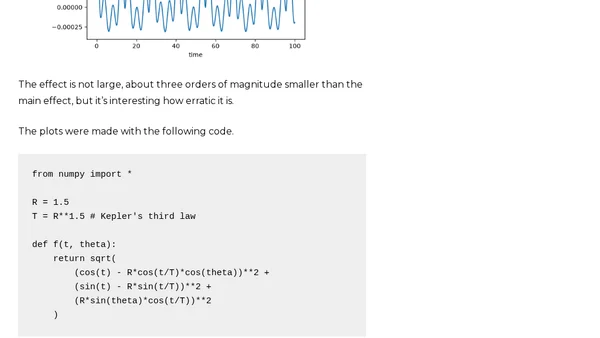
A mathematical approximation for solving oblique triangles without inverse trig functions, with Python code example.
Testing OpenAI's ChatGPT Images 2.0 with a Where's Waldo-style raccoon and ham radio prompt, comparing results across models.
Testing OpenAI's new ChatGPT Images 2.0 model by generating 'Where's Waldo' style images with a raccoon holding a ham radio.
A workflow for understanding open-weight LLM architectures using config files and code from Hugging Face.
A workflow for understanding new open-weight LLM architectures using config files and code from Hugging Face.
Exploring thinning/lifting e-graphs for alpha equivalence using functional lifting combinators and Python examples.
Announcing PyCon US 2026 in Long Beach with new AI and security tracks, plus community highlights.
Announcement of PyCon US 2026 in Long Beach with new AI and security tracks, including schedule highlights.
Solving for a parabola through two points with given slopes using conic section constraints.
How to fix Alembic's multiple heads problem using Git commit order, with an open-source library that automates migration chaining.
Analysis of dependency cooldowns as a flawed security practice, arguing they promote free-riding and fail to address supply chain attack root causes.
Explores the distribution of digits in decimal fractions of prime denominators, with examples in Python.
Announcement of a grant for pimsync to port vdirsyncer features, with a deprecation plan for vdirsyncer.
A developer builds a Django-powered site to host 20,000 photos, exploring the intersection of photography, coding, and tool-building philosophy.
A Python developer creates free OP-XY presets using code-generated synthesis, offering 69 instruments and 12 drum kits.
A musician creates an album where each track is a Python script that generates WAV files using the PyTheory synthesis engine, blending coding and music composition.
Explores using NumPy as a synth engine to generate instrument sounds like plucked strings and tabla via math and DSP algorithms.
A developer creates a mini DAW in the Python REPL using a music theory library with synthesized sounds, effects, and automation.
PyTheory is a Python music theory library built with a 'for humans' philosophy, overcoming a five-year creative block through human-AI collaboration.