“Help” Doesn't Mean What it Meant
A software engineer reflects on the changing meaning of 'help' in tech, where coding is replaced by documentation and AI agents.
Explores how Wolverine and Vertical Slice Architecture improve AI coding agent efficiency by compressing code and reducing context pollution.
Guide on writing a CLAUDE.md file to turn your repository into a project brain for AI coding assistants like Claude Code.
Improvements to Critter Stack CLI tools for faster cold start and AI-assisted development, focusing on command line diagnostics and source generators.
Martin Fowler discusses LLM-augmented programming, codebase restructuring with AI, and NHS closing open source repos.
Practical habits for using AI effectively as a software engineer, focusing on fundamentals, context, and understanding.
Explore three static code analysis sensors for maintainability in AI-assisted coding, covering linting, dependency rules, and coupling data.
Explores how AI changes the definition of a 10x engineer, shifting focus from writing more code to higher-impact decisions and judgment.
Review of Nextpad++, a Mac port of Notepad++ built using AI vibe-coding, discussing its alien feel on macOS.
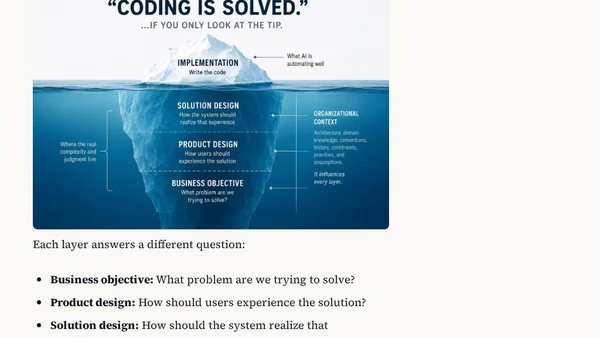
Explores the end of traditional coding, shifting from writing syntax to expressing intent and leading AI agents in software development.
Structured-Prompt-Driven Development (SPDD) workflow for governable, reviewable, and reusable LLM-assisted code changes.
Hands-on enablement session in Munich on Kiro, AWS Transform Custom, and AWS DevOps Agent for developers.
A practical guide on using Agentic AI in software development, sharing a workflow for building projects with AI as a supportive tool.
How AI accelerates code output, creating a review bottleneck, and strategies to rebalance the development pipeline.
Exploring 'mouth coding'—using AI and live conversation to collaboratively build websites in real time.
How AI helped overcome procrastination by building personal tools quickly, turning ideas into working prototypes in minutes.
An analysis of how AI is transforming software development, shifting focus from building to planning and judgment.
Explores how AI reduces the cost of building personal software tools, enabling 'infrastructure for one' over generic products.
Explores harness engineering as a control layer for specs-driven AI development, shifting from human-in-the-loop to automated validation.
Analyzes design choices for effective GitHub Copilot Agent skills, focusing on task shape, descriptions, boundaries, and testing.