Millions of Locations for Thousands of Brands
Analyzing All The Places' open-source location data project, detailing the technical setup and process for downloading and examining millions of brand locations.
Mark Litwintschik is a Big Data, AI, GIS, and networking consultant with international experience, helping clients across the UK, USA, Europe, and beyond. He specializes in large-scale data analysis, geospatial insights, and technology consulting for major corporations and organizations.
97 articles from this blog
Analyzing All The Places' open-source location data project, detailing the technical setup and process for downloading and examining millions of brand locations.
A technical analysis and comparison of various administrative boundary datasets, including OpenStreetMap, using Python, DuckDB, and QGIS.
Analyzing Business Insider's dataset on US data center locations, ownership, and resource consumption using Python, DuckDB, and QGIS.
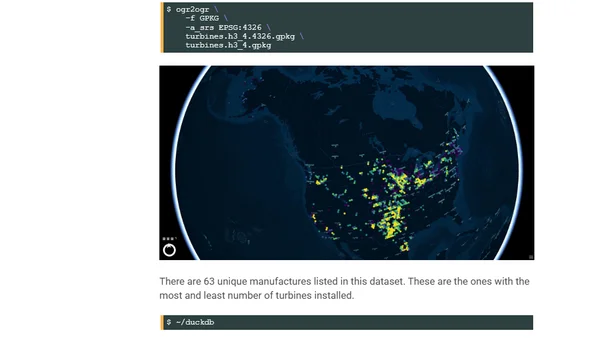
A technical walkthrough of converting the US Wind Turbine Database to Parquet format and analyzing it using tools like GDAL, DuckDB, and QGIS.
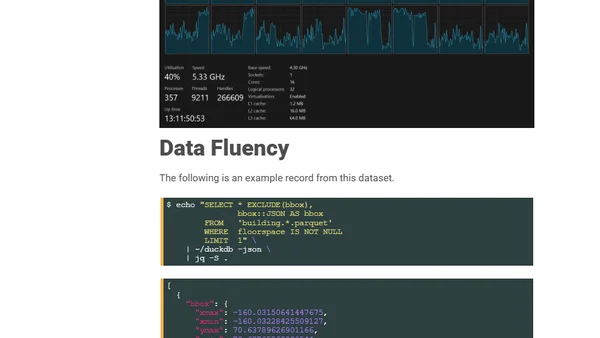
A technical walkthrough of converting the massive OpenBuildingMap dataset (2.7B buildings) into a columnar Parquet format for efficient cloud analysis.
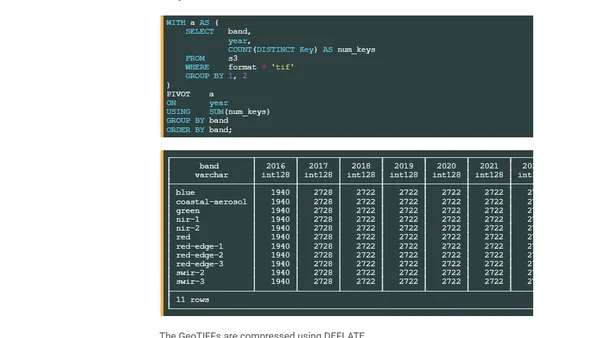
Analyzing Australia's coastal imagery using satellite data, Python, GDAL, DuckDB, and QGIS on a high-performance workstation.
Exploring the GM-SEUS dataset of US solar farms using GIS tools like QGIS and DuckDB for spatial data analysis.
A technical exploration of the ICMM's global mining dataset, detailing the setup, tools, and process for data analysis using Python, DuckDB, and QGIS.
An analysis of Statistics Canada's Open Database of Buildings (ODB) dataset, covering data processing, tools used, and technical setup.
Exploring the Layercake project's analysis-ready OpenStreetMap data in Parquet format, including setup and performance on a high-end workstation.
An analysis of Canada's new national building footprint dataset, exploring its sources, technical setup, and initial processing steps.
Analysis of a new global building dataset (2.75B structures), detailing the data processing, technical setup, and tools used for exploration.
Exploring Planet Labs' open hyperspectral satellite imagery data, including setup and analysis using Python, GDAL, and DuckDB.
A guide on using the new ArcGIS Pro add-in to download and work with Overture Maps Foundation's global geospatial datasets via Parquet files and DuckDB.
Analyzing iPhone 15 Pro depth maps stored in HEIC files using Python scripts to extract and convert image metadata.
A technical walkthrough of running Apple's DepthPro depth estimation model on high-resolution Maxar satellite imagery of Bangkok.
A review of Building Regulariser, a Python package that improves AI-generated building footprints from satellite imagery by making outlines more regular and plausible.
Overview of new features and technical specifications in Esri's ArcGIS Pro 3.5, including Python updates, Parquet support, and system requirements.
A technical guide applying the Depth Anything V2 AI model to analyze high-resolution Maxar satellite imagery of Bangkok for depth estimation.
Explores 3D Gaussian Splatting, a technique for creating real-time 3D worlds from videos, comparing different generation methods and web-based tools.