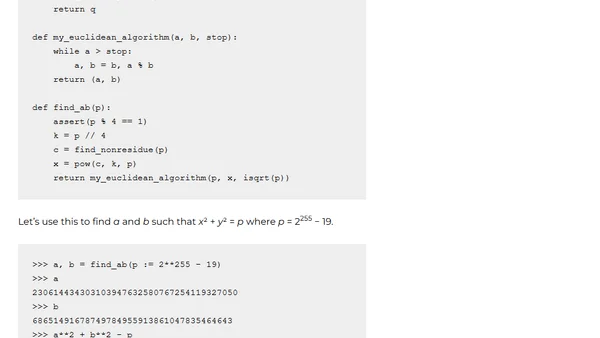
Wagon’s algorithm in Python
A technical guide implementing Wagon's algorithm in Python to solve x² + y² = p for large primes, using quadratic residues and a modified Euclidean algorithm.
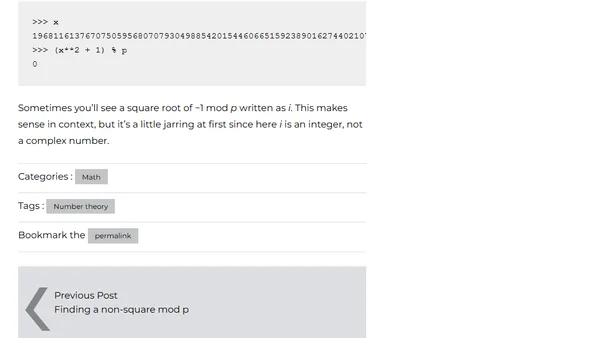
Explains how to compute a square root of -1 modulo a prime p, using number theory and Python code examples.
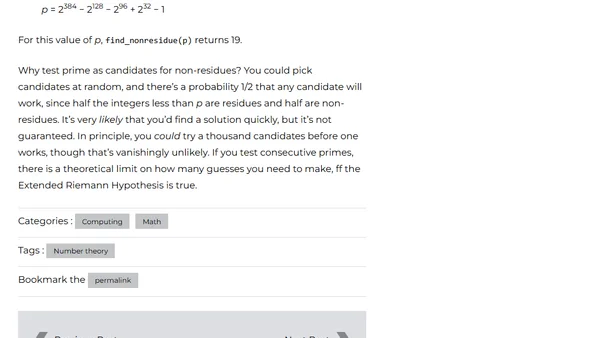
Explains an algorithm for finding a non-square modulo a prime, with Python code and examples from cryptography.
Explores Fermat's theorem on expressing primes as sums of two squares, comparing Gauss's formula with a more efficient computational algorithm.
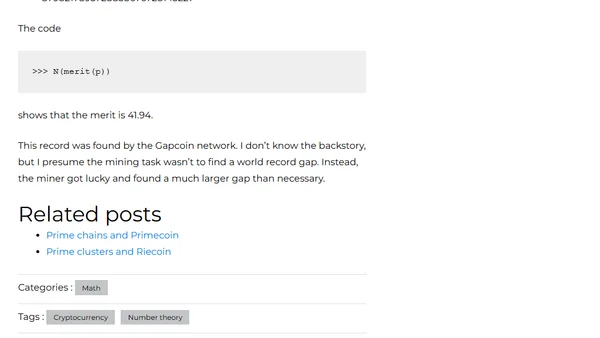
Explores prime gaps, their mathematical merit, and their use as proof-of-work in the Gapcoin cryptocurrency.
Explores prime clusters, their mathematical definition, and their use as proof-of-work in the Riecoin cryptocurrency.
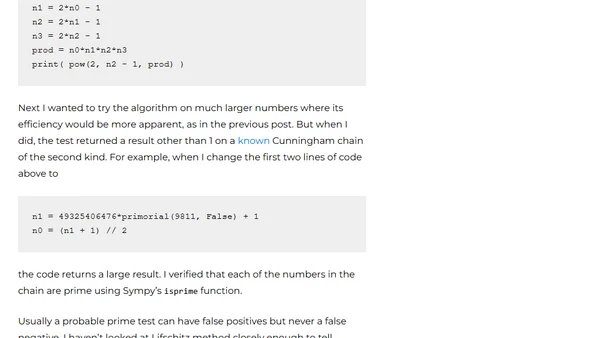
Explores a method for testing Cunningham prime chains efficiently, with applications in cryptocurrency proof-of-work systems.
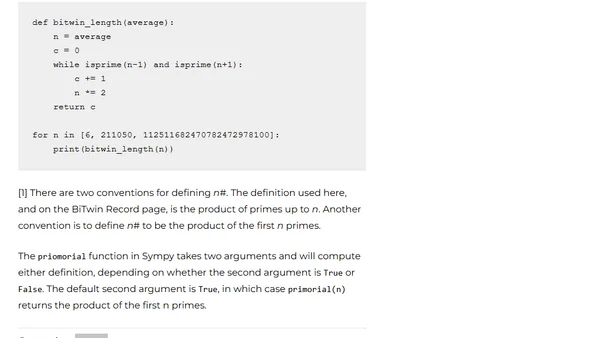
Explores bi-twin prime chains, a mathematical pattern where sequences of twin primes follow a doubling rule, with examples and Python verification code.
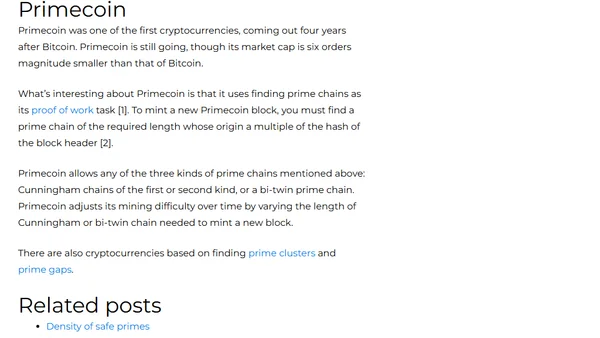
Explores prime number chains like Cunningham chains and their application in the Primecoin cryptocurrency's proof-of-work system.
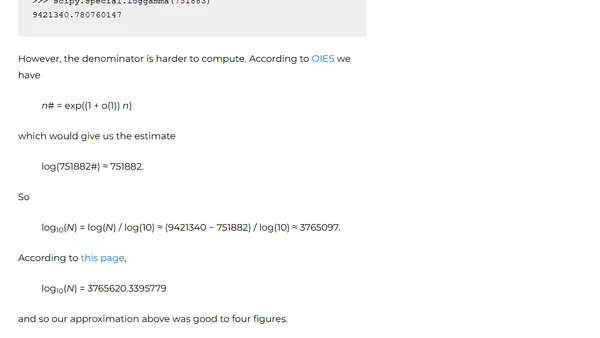
A new record for the largest known 'compositorial prime' has been set, a prime number with over 3.7 million digits.
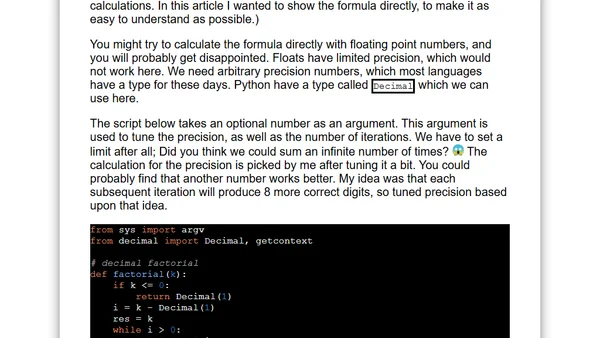
Celebrates Pi Day with two math tricks: a party trick using the 'Rule of 37' and a computer implementation of Ramanujan's formula for calculating Pi.