Opus 4.6 and Codex 5.3
Anthropic releases Opus 4.6 and OpenAI releases GPT-5.3-Codex, with analysis on their incremental improvements and capabilities.
A video Q&A session on database administration topics, recorded during a music festival cruise, answering SQL Server and DBA questions.
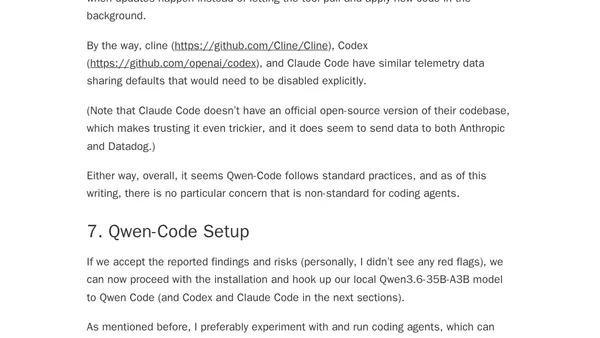
The author describes using an LLM (Codex) to rewrite the pycparser project, replacing its PLY-based parser with a hand-written recursive-descent parser.
Martin Fowler shares fragmentary thoughts from a tech event, covering AI's impact on understanding code, LLMs as navigation tools, and the future of software libraries.
Introducing GameGrammar, an AI system that uses six specialized agents to generate complete board game designs from a simple theme in seconds.
Explores how software architecture principles for human cognition, like fractal design, could improve AI's ability to work with large codebases.
Explores the unpredictable second-order effects of AI evolution, focusing on how AI coding tools may reshape developer choices and business models.
A software engineer argues that learning to code remains essential despite AI's ability to generate code, as coding skills are needed to evaluate and work with AI-generated output.
An experiment using AI to build a working IndexedDB browser API implementation from scratch, aiming to pass Web Platform Tests.
Explores Pi, a minimal coding agent within the OpenClaw project, highlighting its design, tools, and why the author prefers it for agentic programming.
A developer's 2025 year-in-review focusing on AI documentation projects, including LLMs.txt generation and Kapa AI integration for Expo docs.
A software engineer describes replacing a $120/year SaaS tool with a custom LLM-generated solution in just 20 minutes, questioning the future of simple SaaS.
Martin Fowler critiques the overuse of bold text in technical writing, arguing it diminishes emphasis and suggests better typographic practices.
Kimi K2.5 is a new multimodal AI model with visual understanding and a self-directed agent swarm for complex, parallel task execution.
Kimi K2.5 is a new multimodal AI model with visual understanding and a self-directed agent swarm for complex task execution.
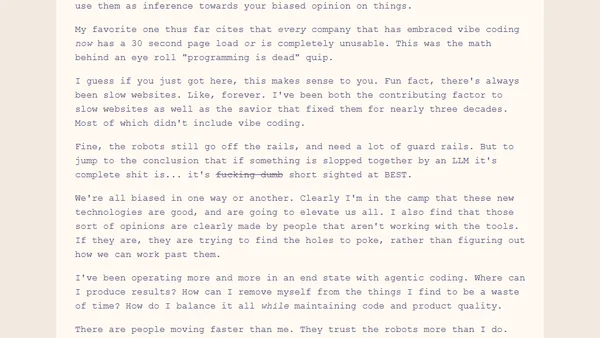
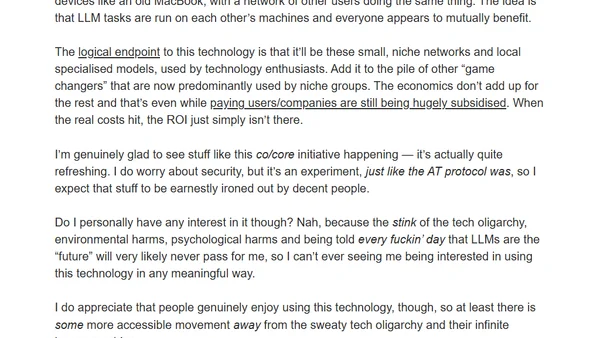
A developer reflects on the dual nature of LLMs in 2026, highlighting their transformative potential and the societal risks they create.
An analysis of using AI to generate automated tests, arguing it misses the point of TDD and reduces testing to a superficial ceremony.
A software engineer's personal journey from skepticism to embracing AI coding assistants, examining the tribalistic debates surrounding LLMs in development.
An overview of inference-time scaling methods for improving LLM reasoning, categorizing techniques and highlighting recent research.
An overview of inference-time scaling methods for improving LLM reasoning, categorizing techniques like chain-of-thought and self-consistency.