Editing NotebookLM Slides: A 4-Tool Pipeline
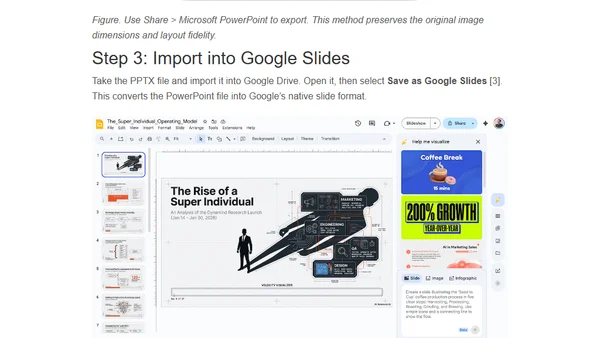
A guide to converting NotebookLM's uneditable PDF slides into fully editable presentations using a 4-tool pipeline involving Canva, Google Slides, and AI.
Benny Cheung is a software engineer and AI enthusiast focused on building intelligent systems and agent-driven workflows. His writing covers AI agent orchestration, edge AI, local-first architectures, and AI-powered automation for real-world applications.
10 articles from this blog
A guide to converting NotebookLM's uneditable PDF slides into fully editable presentations using a 4-tool pipeline involving Canva, Google Slides, and AI.
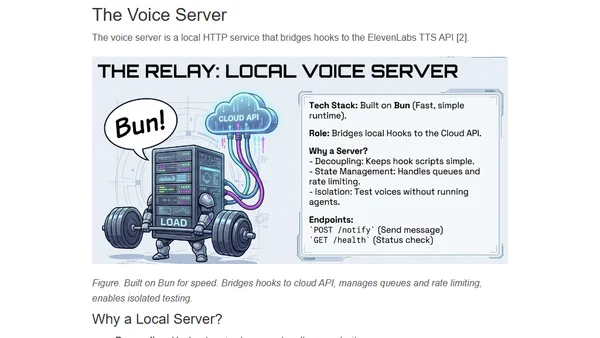
A guide to adding voice notifications to Claude Code AI agents using hooks, a local server, and ElevenLabs TTS for ambient awareness of parallel tasks.
Case study on building an edge AI food monitoring system using AI-led development with the BMAD framework, achieving rapid delivery with minimal human oversight.
A guide to building an offline, edge AI food monitoring system using a Raspberry Pi, YOLO11, and a local-first architecture for privacy.
A technical comparison of YOLO-based food detection from 2018 to 2026, showing the evolution of deep learning tooling and ease of use.
A technical workflow using AI to transform hand-drawn mind maps into searchable, shareable digital visualizations in a consistent illuminated manuscript style.
Proposes a new AI agent architecture based on Alfred North Whitehead's process philosophy, treating agents as dynamic processes rather than static entities.
A technical guide on integrating two distinct AI agent systems (BMAD and PAI) using a layered architecture to combine their strengths.
Explores Abstraction of Thought (AoT), a structured reasoning method that uses multiple abstraction levels to improve AI reasoning beyond linear Chain-of-Thought approaches.
Explains how a semantic ontology model acts as a 'queryable brain' to understand, document, and confidently modernize complex legacy software systems.