Capability Debt: When AI Productivity Weakens the Expert Pipeline
Explores how AI-driven productivity can create 'capability debt' by reducing learning opportunities, weakening expert pipelines, and increasing future operational risk.
Analyzes why measuring AI productivity by individual time savings is flawed, focusing on collective time costs.
Mitchell Hashimoto announces Superlogical, a new company building a terminal multiplexer, and reflects on his journey from Ghostty.
Explores how LLMs impact software engineering standards, warning against vibe-coding and loss of code ownership.
A curated reading list covering AI models, reliability, LLM code familiarity, tokenomics, and tech career shifts.
Explores three key components to becoming AI antifragile: deep understanding, desire for change, and capability to build.
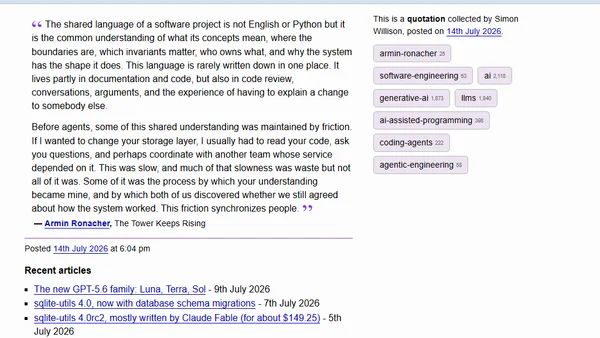
A reflection on shared understanding in software projects, quoting Armin Ronacher on the role of friction in team synchronization.
A daily tech reading list covering AI agents, Jevons Paradox, Amazon SQS at 20, and AI's impact on software engineering teams.
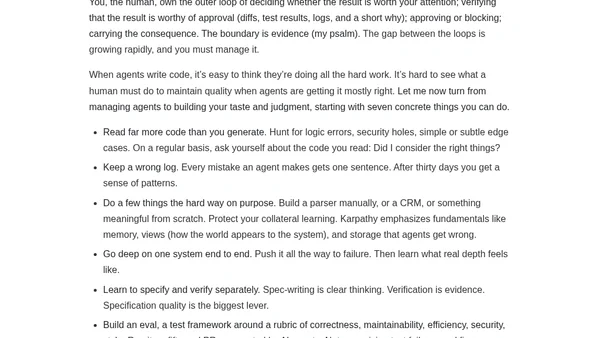
Explores how AI agents are reshaping junior developer career paths by automating learning reps, impacting taste and judgment development.
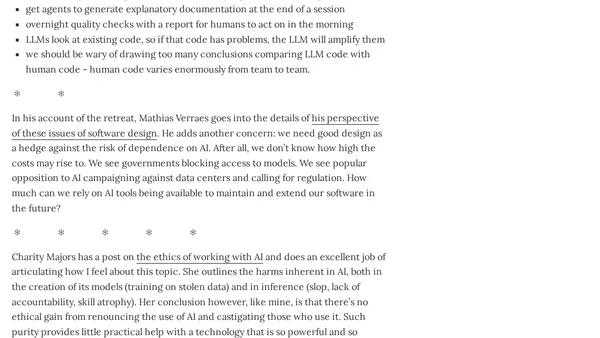
Martin Fowler shares fragments from the second Future of Software Development Retreat, focusing on agentic development and its impact on software engineering.
Career advice for engineers in the AI era, focusing on scarce resources like reputation and problem selection over solution skills.
Explores why top engineers prioritize discipline over speed in AI-driven software development, emphasizing careful code over rapid generation.
A developer reflects on 12 months of using Claude Code, exploring how it transforms programming productivity and challenges traditional skill-building.
Explores agentic autonomy levels in AI engineering, proposing a two-axis framework of agency and orchestration for multi-agent systems.
Analysis of merge queue limitations under AI agent workloads, challenging Hashimoto's critique with a defense of serialization as coordination.
Monthly roundup of 113 tech links covering AI impact, software engineering, and development tools for June 2026.
Exploration of coding agent loops beyond simple prompts, discussing harness-level loops and challenges with AI-generated code quality.
A programmer reflects on prioritizing family over coding, sharing hard-earned life lessons from a decade of misplaced focus.
Charity Majors argues that AI-generated code requires more engineering discipline, not less, drawing parallels to the shift from server pets to immutable infrastructure.
Explores how AI coding agents shift engineering focus from writing code to code review, making review the most leveraged skill in software.