Second order effects
Explores the unpredictable second-order effects of AI evolution, focusing on how AI coding tools may reshape developer choices and business models.
Explores how architects use metaphors to translate complex IT concepts for business leaders, bridging the gap between technical and non-technical audiences.
A guide for engineers on when to challenge technical decisions and when to accept and support them for team cohesion.
A guide to recognizing and managing personal bias in technical decision-making, focusing on objective data and open-minded discussions.
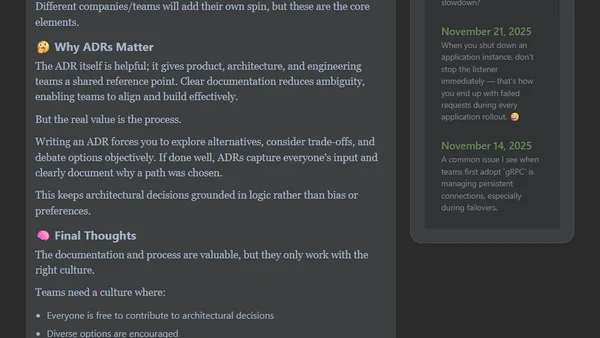
Explains the value of Architecture Decision Records (ADRs) for documenting technical choices and fostering a collaborative engineering culture.
A blog post arguing that computer programming is fundamentally about making a series of nested decisions, from high-level goals to low-level syntax.
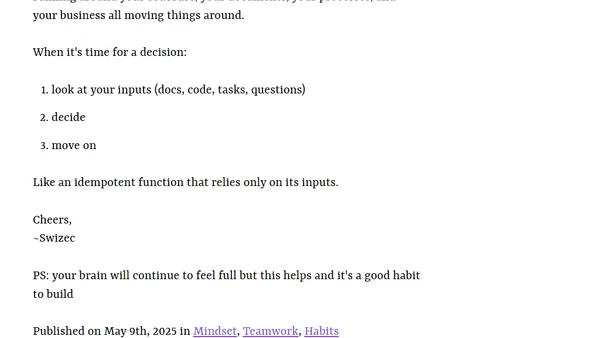
A software engineer shares strategies for managing cognitive load and improving productivity through documentation, delegation, and focused task completion.
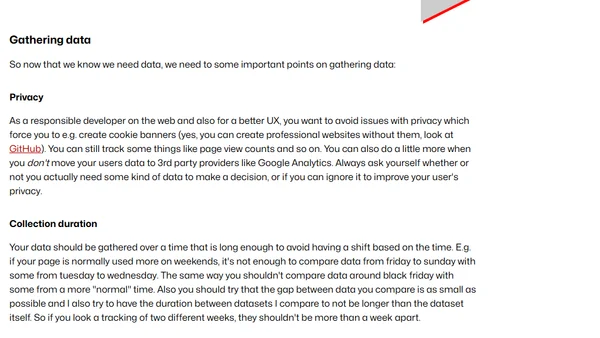
A developer argues for using data over intuition when making web development decisions, explaining how 'facts' can become outdated 'feelings'.
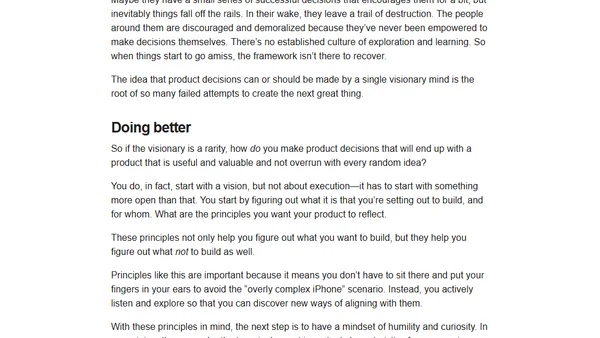
Critiques the 'single visionary' myth in tech product development, arguing for collaborative, principle-driven decision-making instead of autocratic design.
A developer shares a mental exercise for changing one's mind by assuming the other person is right, emphasizing good faith and intellectual humility.
A guide for founders on scaling by empowering new leaders, focusing on reversible vs. irreversible decisions in tech and product management.
A reflection on how differing personal and professional contexts shape decision-making, especially in software architecture and team collaboration.
A tech company discusses running monthly ethical dilemma workshops to prepare employees for complex, real-world decision-making in the industry.
The article argues for intentionally adding friction in development workflows to improve code quality and performance, using npm as a key example.
Practical rules for running effective and productive meetings within a technology company environment.
Applying software CI principles to leadership, proposing a 'Leadership CI' framework of reflective questions for better decision-making.
An article exploring the causes of FOMO (Fear Of Missing Out), its paralyzing effects, and practical strategies for managing it.
Analyzes decision-making quality in sports and board games, where clear data reveals the high cost of poor choices.
A programmer uses a software function metaphor to argue against free will, based on neuroscience experiments showing brain activity precedes conscious decisions.
Argues against relying on human reasoning for decisions, advocating for data-driven, scientific approaches like experimentation in tech and business.