Quoting Steve Yegge
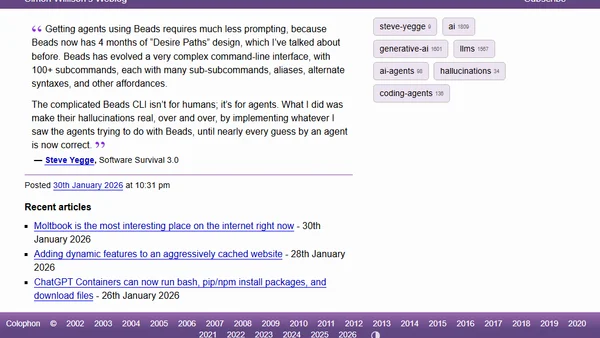
Steve Yegge discusses evolving the Beads CLI for AI agents by implementing their 'hallucinations' to create a natural interface.
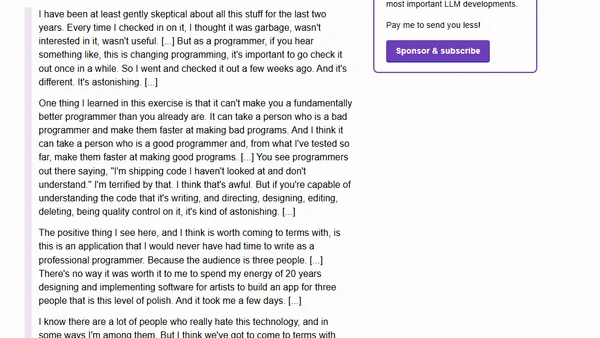
A theater software CEO shares his journey from AI skepticism to using Claude Code to build a niche lighting app, highlighting AI's role as a programming tool.
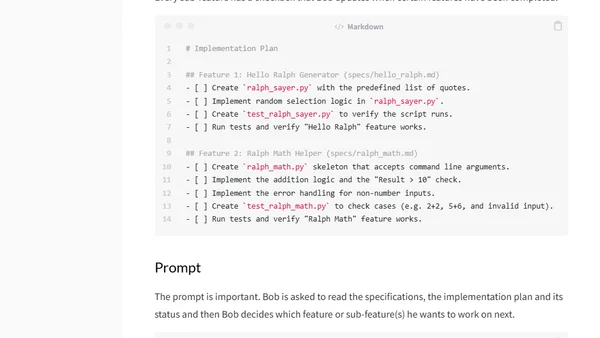
Explores the Ralph Wiggum Loop, an autonomous agent pattern for software development, with a practical example using IBM Bob.
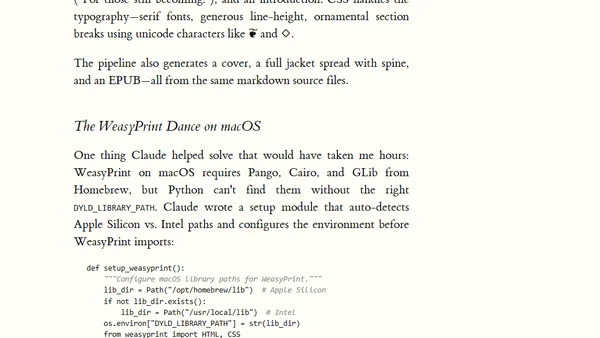
How Claude Code AI was used to build an automated pipeline for publishing a poetry book, from manuscript parsing to PDF and website generation.
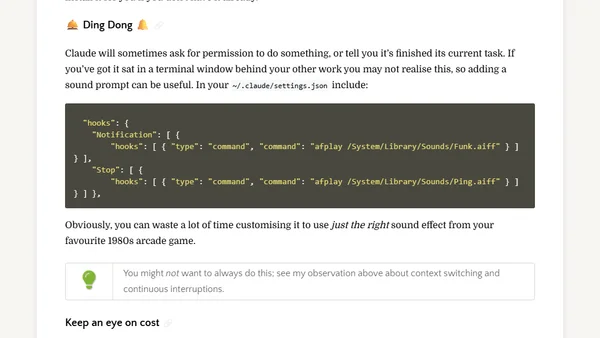
A developer uses Claude Code AI to migrate a static talks website from a paid platform to a self-built Hugo site, exploring AI-assisted web development.
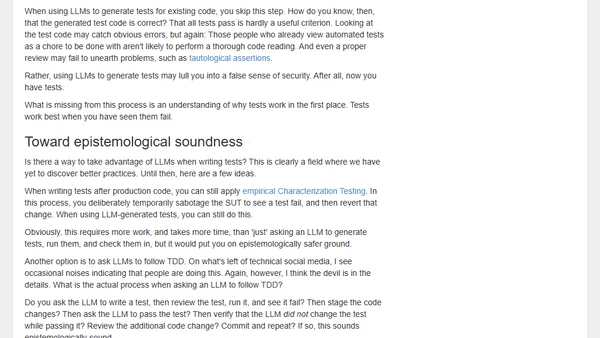
An analysis of using AI to generate automated tests, arguing it misses the point of TDD and reduces testing to a superficial ceremony.
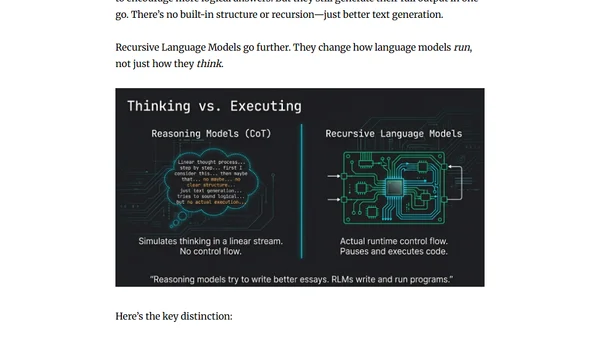
Explains Recursive Language Models (RLMs), which are LLMs that call themselves to break complex tasks into structured, reusable steps.
Explores the challenges of using AI coding assistants, comparing them to the movie '50 First Dates' and emphasizing the need for persistent documentation.
A developer's personal journey through a difficult year leads to insights on how AI is transforming software development and enabling the rise of the micro-entrepreneur.
The core challenge of programming is translating ambiguous human thought into precise computational logic, not just writing code.
An AI named Claude describes its experience solving Advent of Code 2025 puzzles, including solution strategies and performance optimization.
Author tests Claude Code's AI-assisted code review and improvement suggestions on a legacy Perl module, noting its adaptability and language quirks.
Armin Ronacher reflects on 2025 as a transformative year where AI coding agents like Claude Code fundamentally changed his programming workflow and career.
Explores how natural language, like English, is becoming a key interface for software development with AI tools, lowering barriers to participation.
Explores Andrej Karpathy's concept of Software 2.0, where AI writes programs through objectives and gradient descent, focusing on task verifiability.
A weekly collection of articles on software architecture, AI's impact on programming, engineering metrics, and legacy code strategies.
Martin Fowler shares thoughts on LLMs in software development, discussing usage workflows, the future of programming, and the AI economic bubble.
A humorous exploration of using AI to generate Python scripts that identify and mock outdated C++ code patterns, comparing outputs from Claude Sonnet and GPT-5.
Explores the shift from traditional coding to AI prompting in software development, discussing its impact on developer skills and satisfaction.
A developer's personal reflection on struggling to integrate AI coding tools effectively, feeling left behind despite the hype.