The Five Levels: from Spicy Autocomplete to the Dark Factory
A five-level model for AI-assisted programming, from basic autocomplete to fully autonomous 'dark factory' software development.
Kimi K2.5 is a new multimodal AI model with visual understanding and a self-directed agent swarm for complex, parallel task execution.
Explores the two distinct uses of AI-assisted coding: professional developer acceleration and 'vibe coding' for rapid prototyping, and the implications for the industry.
Explores the AI-driven evolution of software engineering from autocomplete to autonomous agents, shifting the developer's role from coder to orchestrator.
Explores NanoLang, a new programming language designed for LLMs, and tests AI's ability to generate working code in it.
A developer's experience using AI coding agents in a real production environment, highlighting productivity gains and the critical role of engineering expertise.
Author explores the legal and ethical implications of using LLMs to port open source code between programming languages, based on personal experiments.
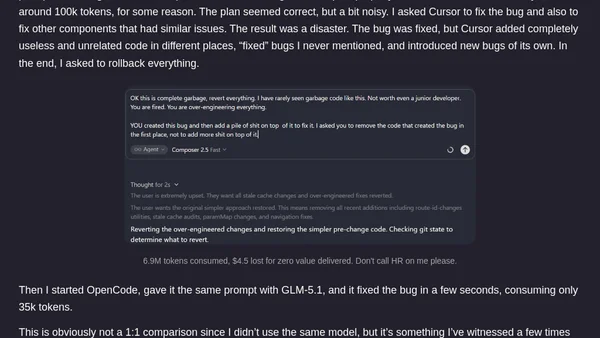
A developer compares the workflow and experience of using Claude Code vs Cursor AI coding assistants, focusing on their distinct strengths in exploration and convergence.
A software engineer shares practical strategies for effectively using AI coding agents like Claude Code, emphasizing setup and feedback loops.
Explores practical uses of AI as a 'force multiplier' for software engineers, focusing on prototyping, offloading cognitive load, and first-pass reviews.
Armin Ronacher reflects on 2025 as a transformative year where AI coding agents like Claude Code fundamentally changed his programming workflow and career.
Obie Fernandez reflects on AI coding agents shifting developer focus from writing code to decision-making and intent.
Testing various LLMs to generate a POV-Ray script for a pelican riding a bicycle, comparing results and fixing errors.
A developer shares personal guidelines for effectively using AI coding assistants like Copilot and Claude, emphasizing supervision and small, specific tasks.
A guide on using custom instruction files like copilot-instructions.md to tailor GitHub Copilot's behavior for specific projects and improve code suggestions.
Explores GitHub Copilot's new custom agents feature, detailing how to create specialized AI coding assistants for specific workflows and frameworks.
A guide to improving LLM-generated code quality by using contextual rules and agents to enforce production-ready patterns and architecture.
An analysis of Spec-Driven-Development (SDD), exploring its definition and comparing three tools: Kiro, spec-kit, and Tessl.
A technical guide on implementing real-time streaming for AI-generated content using Apple's Foundation Models and the Streaming API.
Introduces agent-rules, an open-source CLI tool that standardizes security and coding rules across AI coding assistants like GitHub Copilot and Cursor.