A Memory That Knows What It Remembers
Explores the concept of typed, budgeted, and auditable memory for AI agents, moving beyond flat retrieval to structured context management.
Explains why tech leaders should adopt proven solutions instead of building custom systems, focusing on cost, maintenance, and competitive advantage.
Analysis of how prioritizing speed over communication in tech projects leads to collaboration breakdowns, technical debt, and system fragmentation.
Explores the decision between rebuilding or refactoring legacy software, covering challenges and business considerations.
Explores cognitive, technical, and intent debt in software systems, plus LLMs as System 3 thinking.
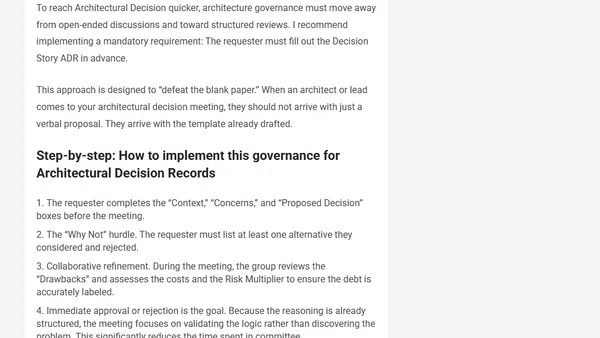
A Debt-Aware ADR Model to manage technical debt and speed up architectural decision-making by treating choices as financial transactions.
A reflection on the value of time, patience, and friction in software development and company building.
A guide for developers on identifying and addressing recurring technical friction in codebases to improve long-term maintainability.
Explores 'comprehension debt,' the hidden cognitive cost of over-relying on AI-generated code, which erodes team understanding and long-term maintainability.
Argues that AI coding agents can help developers produce higher quality code and reduce technical debt by automating tedious refactoring tasks.
Argues that AI coding agents should be used to improve code quality and reduce technical debt, not just speed up development.
Argues that Windows patching is an organizational governance and risk management issue, not a technical one, and defines clear operational roles.
A software engineer reflects on the importance of mentoring and delegating to avoid becoming trapped in a critical role, advocating to 'code yourself out of the job'.
Explores how AI-generated code creates 'cognitive debt'—a loss of system understanding—which can paralyze developers more than technical debt.
Explores how AI-assisted coding creates a bottleneck in code review, comparing it to historical industrial constraints and questioning sustainability.
A daily tech reading list covering AI-generated code, tech debt, AI's impact on work, and updates on tools like Go 1.26 and Vertex AI.
Explains the three key growth curves—exponential, linear, and logarithmic—that define a scalable software business and an engineer's role in building long-term assets.
A developer details using GitHub Copilot's plan and agent modes to refactor the Azure Quick Review tool, eliminating technical debt and improving performance.
A daily tech reading list covering AI adoption, technical debt, new developer tools, and industry trends from Google, Anthropic, and more.
Explores the reality of managing legacy code and continuous migration in production software, emphasizing adaptability over perfect design.