Capability Debt: When AI Productivity Weakens the Expert Pipeline
Explores how AI-driven productivity can create 'capability debt' by reducing learning opportunities, weakening expert pipelines, and increasing future operational risk.
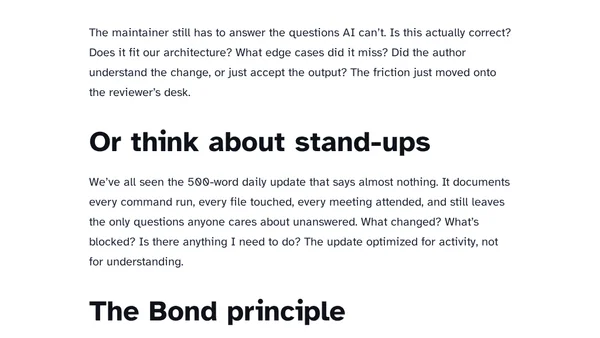
Analyzes why measuring AI productivity by individual time savings is flawed, focusing on collective time costs.
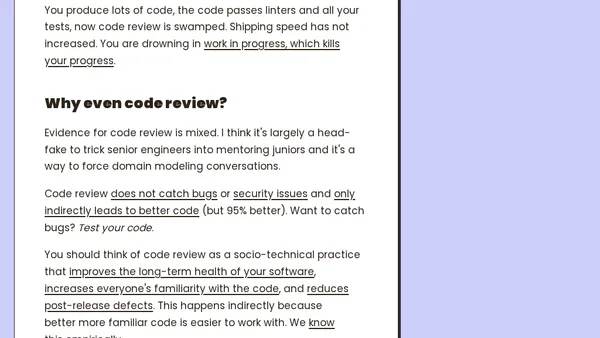
Explores how the theory of constraints applies to AI-assisted coding, showing that code review bottlenecks limit shipping speed despite faster code generation.
Analysis of a growing trend in engineering departments to cut back on AI spending due to unclear productivity gains.
Analysis of AI productivity claims, questioning the lack of holistic data and the hidden costs of AI adoption in business.
Analysis questioning the lack of holistic productivity data on AI adoption, highlighting hidden costs and need for skilled oversight.
A reflective analysis on whether AI tools truly boost productivity or just create a sense of performative busywork in software development.
Explores the paradox of AI tools boosting productivity yet causing distraction, with personal anecdotes and ADHD perspectives.
Daily tech reading list covering AI efficiency, burnout, Go modules, engineering culture, and solo founding trends.
AI makes work feel productive but not finished; focus on user outcomes over artifacts.
A daily tech reading list covering AI productivity, developer tools, cloud security, and industry trends from sources like Google Cloud and Replit.
A study finds AI tools increase cognitive load and work intensity, leading to potential burnout despite productivity gains.
A study finds AI tools increase cognitive load and work intensity, leading to potential burnout, despite feeling more productive.
An analysis of how AI, specifically Claude, is transforming software development workflows, with a focus on real-world implementation details and the role of TDD.
A developer's 2025 retrospective covering career moves, open-source project stewardship (HTML Minifier), and the impact of AI on engineering productivity.
Explores practical uses of AI as a 'force multiplier' for software engineers, focusing on prototyping, offloading cognitive load, and first-pass reviews.
A critique of AI's role in software development, arguing that output is not productivity and that expertise remains essential for solving real problems.
A developer argues that AI tools, while feeling productive, actually create more low-priority busywork and reduce overall effectiveness.
A study reveals AI tools like Cursor may slow developers down by 19%, despite their perception of increased productivity.
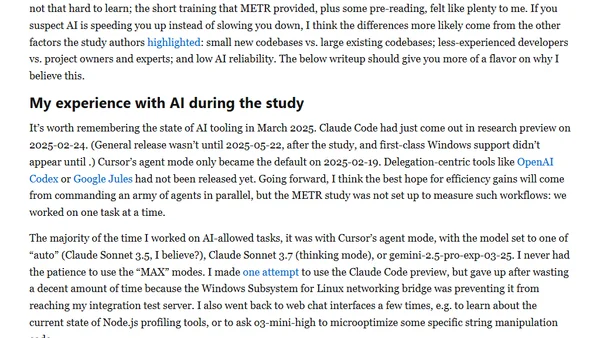
A developer shares their firsthand experience participating in a METR study that found AI-assisted coding tasks took 19% longer, using the jsdom project as a case study.