Quoting Jasmine Sun
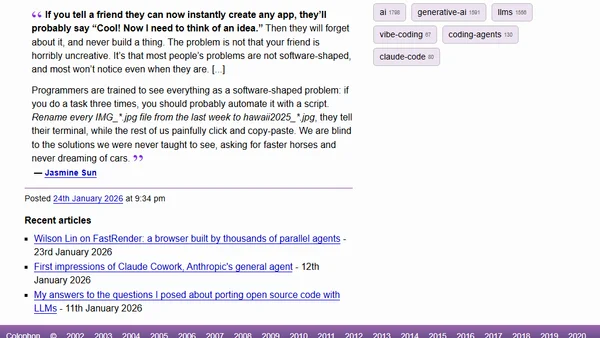
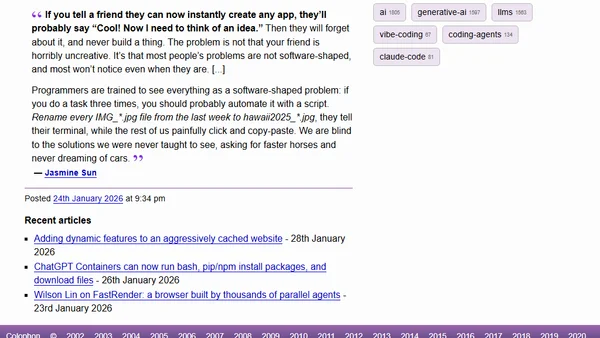
Explores why non-programmers struggle to see software solutions, contrasting their mindset with the automation-focused perspective of developers.
Explores why non-programmers struggle to see software solutions, contrasting their mindset with the automation-focused thinking of developers.
Discusses how LLMs fit into a software developer's career, emphasizing the enduring importance of understanding fundamental computer science concepts.
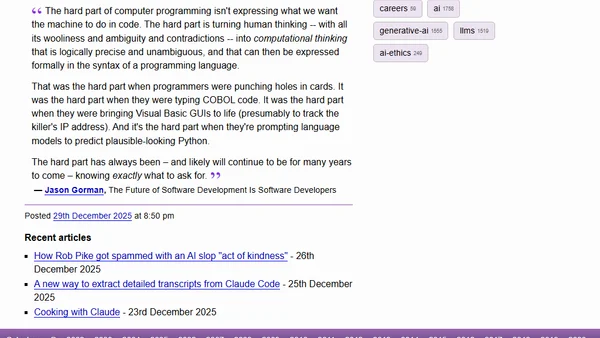
The core challenge of programming is translating ambiguous human thought into precise computational logic, not just writing code.
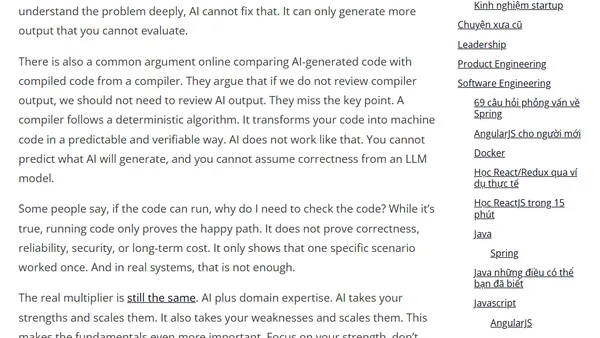
A critique of AI's role in software development, arguing that output is not productivity and that expertise remains essential for solving real problems.
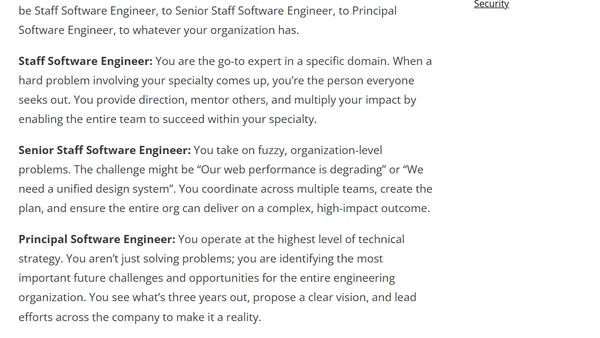
A guide on advancing your software engineering career by shifting from solving defined problems to identifying the right business problems to solve.
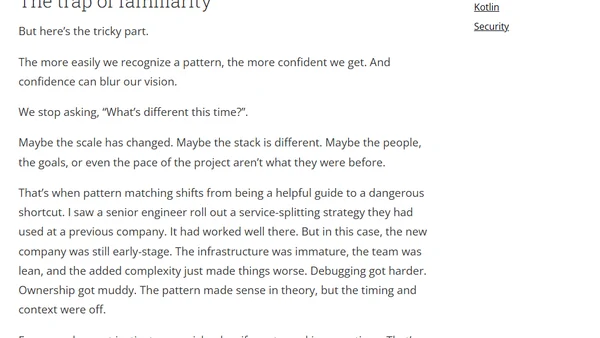
Explores how pattern matching in programming relates to the mental patterns experienced software engineers use to solve problems efficiently.
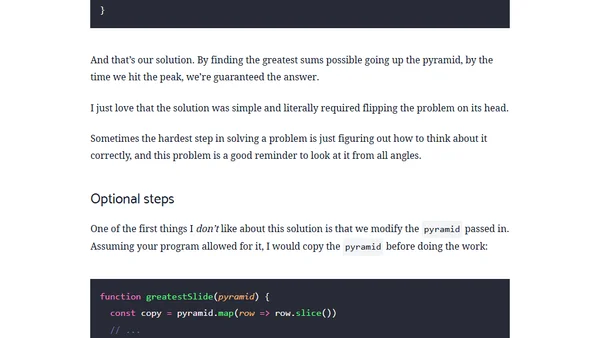
A walkthrough of solving the 'Pyramid Slide Down' coding problem using dynamic programming, starting from the bottom up.
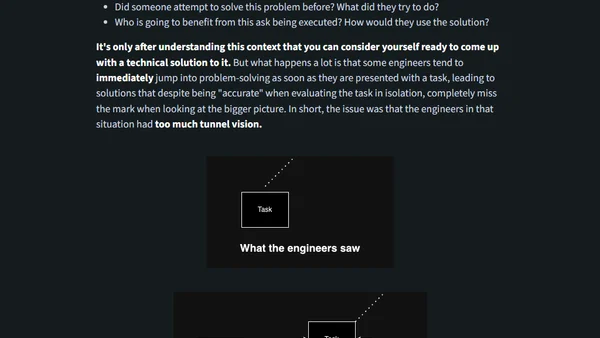
Engineers should focus on understanding the underlying problem behind a task, not just executing it, to avoid creating useless or poorly designed features.
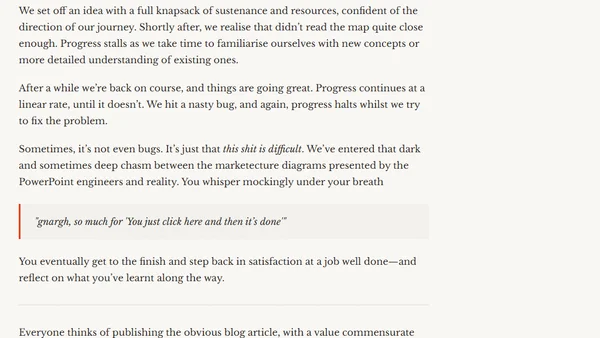
A developer argues that embracing confusion leads to deeper technical understanding and valuable blog content.
Explores how preparation and pre-thinking can compensate for a lack of quick-wittedness in meetings and technical discussions.
The article explains the XY Problem, a common communication issue where someone asks about their attempted solution instead of their actual goal.
Explores how software engineers create and focus on imaginary problems to escape boring tasks, leading to inefficient solutions and bad software.
Senior engineers must excel at communication and problem articulation, not just technical skills, to be truly effective.
A childhood baking failure leads to reflections on patience, productivity, and the pitfalls of rushing in software development.
Explains second-order thinking, a mental model for considering long-term consequences of actions, with examples from software engineering and management.
An analysis of how people with superficial knowledge confidently propose flawed solutions to complex problems in fields they don't understand.
Explores the creative process in coding, comparing it to artistic fields like music, and argues that programming is fundamentally a creative problem-solving activity.
A programmer's takeaways on improving coding skills by understanding underlying concepts, debugging, and asking effective questions.
The author argues that being willing to appear stupid by asking naive questions leads to a deeper understanding of complex topics over time.