
Dietary Shapes
An essay discussing diet optimization history, George Stigler's linear programming diet problem, and its cultural impact.
Ben Recht is a researcher and writer exploring the history, theory, and practice of decision-making by humans and machines. On arg min, he covers optimization, machine learning, cybernetics, and occasional reflections on music and culture.
37 articles from this blog
An essay discussing diet optimization history, George Stigler's linear programming diet problem, and its cultural impact.
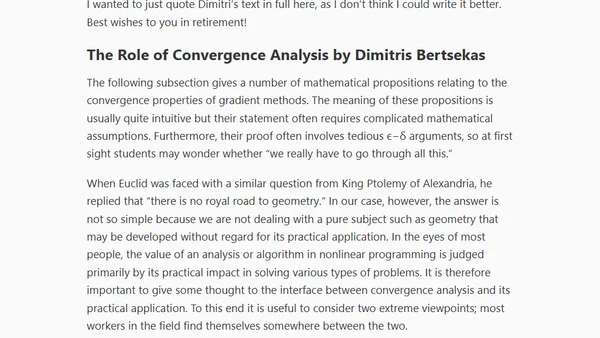
A tribute to Dimitri Bertsekas, a pioneer in optimization and reinforcement learning, reflecting on his contributions and legacy.
Analysis of Midjourney's pivot to medical ultrasound, sparking debate between tech boosters and medical practitioners over AI in healthcare.
An essay comparing optimization culture to elimination diets and GLP-1 drugs, critiquing the technical language of maxxing.
Explores how large language models automate reification, turning abstract concepts into perceived reality through AI-generated explanations.
An analysis of David Graeber's theories on bureaucracy, violence, and interpretative labor, linking games and rules to social metrics.
Explores the tension between population-level statistics and individual experience, questioning the applicability of averages to personal decisions.
An analysis of the quantification trap in technology and society, exploring how metrics and benchmarks become authoritative despite their limitations.
Explores whether LLMs are mathematically rational, contrasting their human-like language with computational rationality.
A blog post assembling a reading list and syllabus for a course on engineering architecture, covering computing systems and cyber-physical systems.
Explores architectural theory in computer science, covering internet, software, and hardware design principles like abstraction layers and protocols.
Explores Cosma Shalizi's view of AI as a mechanization of cultural traditions, analyzing how LLMs retrieve and synthesize formulaic information.
Explores the balance between model simplicity and precision in system identification for control engineering and machine learning.
A critique of how quantitative benchmarking and evaluation culture shapes and potentially distorts progress in machine learning research.
Explores the contrasting mindsets of AI and control theory, focusing on the limits and practical challenges of optimal control in sequential decision-making.
Explores the history of data science through early 20th-century rat diet experiments, drawing parallels to modern statistical methods.
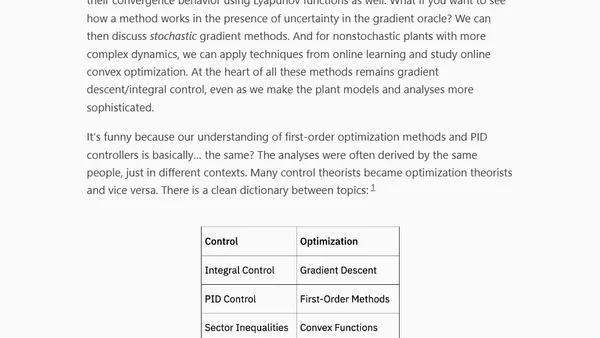
Explores the theoretical links between optimization algorithms (like gradient descent) and control theory, analyzing them as dynamical systems.
Lecture on control theory, exploring PID controllers and their role in taming complex systems, from steam engines to modern robotics.
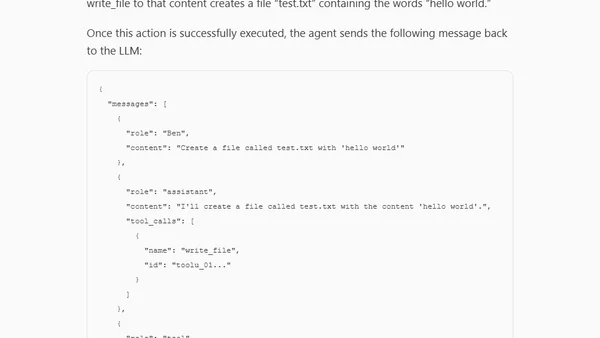
An analysis of AI coding agents, explaining their simplicity and power through a hands-on experiment building a minimalist agent with Claude Code.
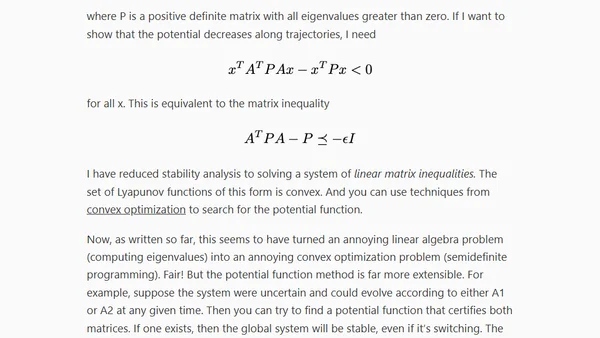
Explores Lyapunov's two methods for stability analysis in dynamical systems, focusing on linearization vs. potential functions.