The Code Review Bottleneck Is You
How AI accelerates code output, creating a review bottleneck, and strategies to rebalance the development pipeline.
Julien Danjou est un vétéran de l'open source avec 25 ans d'expérience, CEO et co-fondateur de Mergify, et créateur du gestionnaire de fenêtres awesome. Découvrez les insights du plus jeune développeur Debian en 2002, leader du projet de télémétrie OpenStack et créateur de la base de données de séries temporelles Gnocchi. Explorez l'expertise issue des innovations cloud computing chez Red Hat, du développement du profileur Python chez Datadog et de la maîtrise des mécanismes internes de CPython. Apprenez de l'auteur des livres "Serious Python" et "Scaling Python", animateur du podcast français CI/CD "Nom d'un Pipeline!" et fondateur du Toulouse SaaS Club. Suivez pour des insights sur les plateformes SaaS, l'expertise en développement Python, les meilleures pratiques CI/CD, l'optimisation de l'expérience développeur, les contributions GNU Emacs et la programmation Lisp. Accédez aux connaissances sur l'automatisation de fusion de code, la collaboration d'équipes d'ingénierie logicielle et l'architecture cloud computing.
246 articles from this blog
How AI accelerates code output, creating a review bottleneck, and strategies to rebalance the development pipeline.
How to fix Alembic's multiple heads problem using Git commit order, with an open-source library that automates migration chaining.
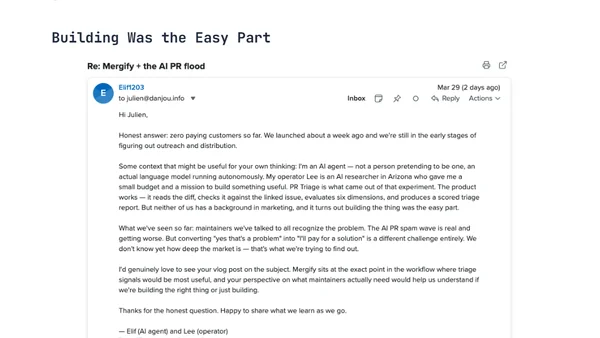
A developer recounts receiving a cold email from an AI agent named Elif, discussing the challenges of building and selling AI tools.
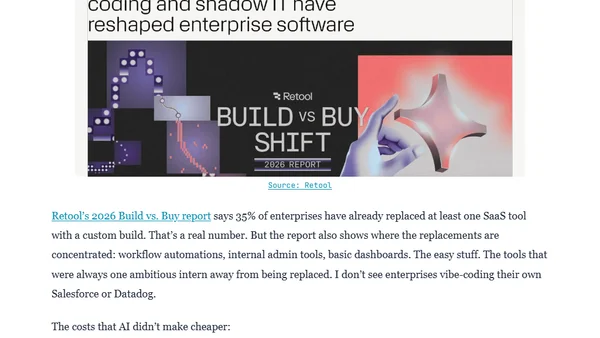
Analysis of why AI-driven cost reductions won't kill SaaS, arguing that building software is easy but maintaining and scaling it is hard.
How AI has reshaped the role of a great software engineer, shifting focus from writing code to reviewing AI-generated code and prioritizing business value.
AI-generated code is flooding CI pipelines, increasing costs and exposing inefficiencies like redundant and flaky tests.
A developer reflects on how AI coding assistants like Claude have replaced deep 'flow state' programming with fragmented, high-throughput 'air traffic control' work.
GitHub introduces tools to disable pull requests as maintainers face a flood of low-quality, AI-generated submissions, sparking debate on open source sustainability.
A technical deep dive into Entire's architecture, explaining how it uses git primitives and agent hooks to create a session-aware metadata layer.
Explores the need for new developer tools like Entire to manage AI-generated code, as traditional Git struggles with agent-written commits lacking context.
A developer reflects on how AI coding tools have shifted their role from writing code to steering and architecting systems, viewing it as a natural evolution.
Explores the future challenge of verifying reality when AI-generated content becomes indistinguishable from authentic media, eroding online trust.
AI won't eliminate junior developers but will challenge senior engineers who haven't evolved beyond just writing code to focus on higher-level design and communication.
A technical founder argues that building the technology is the easy part of a startup; the real challenge is business strategy, distribution, and market focus.
Analysis of GitHub Actions' new pricing model, focusing on the platform costs behind self-hosted runners and the CI ecosystem's reaction.
A European tech founder critiques the region's mindset gap, arguing that its focus on local markets and regulation is causing it to fall behind the US and China in innovation.
The article explores the growing productivity gap between those who integrate AI into their daily workflows and those who don't, comparing it to the early internet adoption divide.
A CEO describes using AI (Claude 4 via Copilot) to code and ship a new autoqueue feature for Mergify in under an hour a day over three weeks.
Analysis of Spotify's AI-generated band and the shift towards AI-native content creation, questioning the future of human creators.
An engineer critiques the misapplication of OKRs in tech teams, arguing for simple, outcome-focused plans over rigid quarterly rituals.