Small projects, clear scope
A software engineer discusses the benefits of clear project planning and scope definition to reduce stress and improve team productivity.
The article argues that the 'software crisis' of the 1960s never truly ended but evolved from unpredictability into a modern crisis of overwhelming complexity.
Practical steps for successfully leading a software or tech project, focusing on scope, communication, and iterative delivery.
Critique of superficial tech transformations that rename teams and processes without addressing root causes, leaving delivery slow and ineffective.
Explores how AI is fundamentally changing product management, shifting from traditional documentation to rapid prototyping and real-time feedback.
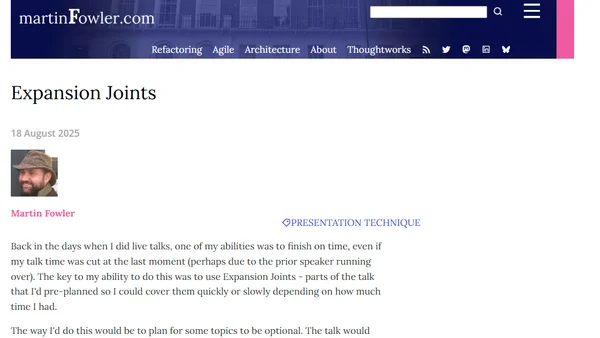
Martin Fowler explains 'Expansion Joints', a technique for dynamically adjusting presentation length by using optional, flexible content segments.
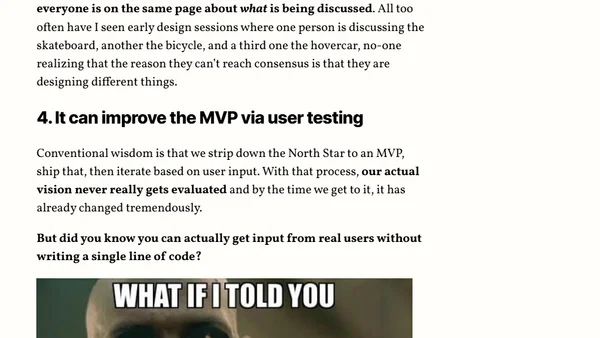
A framework for product design that expands the MVP concept with stages from a basic 'Skateboard' to an ideal 'Hovercar' vision.
A software engineer discusses strategies for prioritizing and integrating technical cleanup work into the development process, arguing against isolated "technical sprints".
A developer explores adapting coding styles to different situations, inspired by the 'Six Thinking Hats' framework.
A software engineering manager shares a strategic framework to diagnose and fix common team problems like low morale, buggy code, and poor communication.
How an IT team uses brainstorming sessions to tackle ambiguous challenges like upcoming ESG regulations and develop innovative software solutions.
A consultant provides 20 questions to assess the maturity, predictability, and effectiveness of software development teams and their processes.
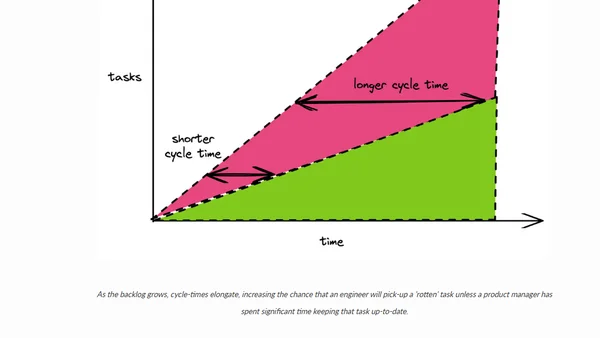
Argues that product backlogs are harmful, never shrink, and proposes working without them for better productivity and team alignment.
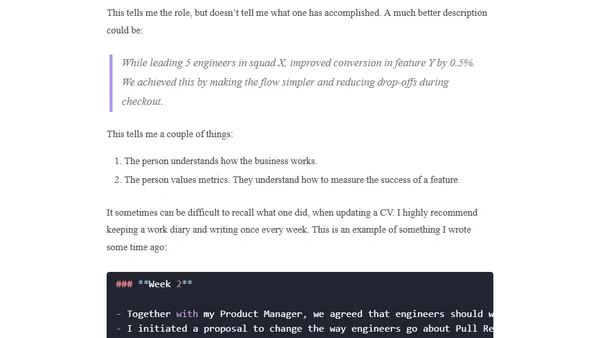
Tips for writing effective CVs for tech roles, focusing on quantifying achievements and keeping a work diary to track accomplishments.
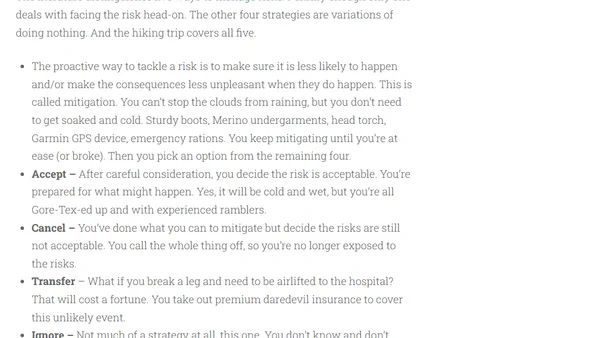
Explores the role of courage in Agile software development for managing inherent project risks, using a hiking analogy to illustrate risk strategies.
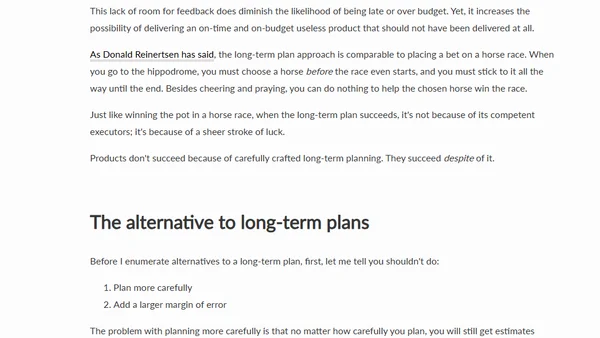
Critique of long-term software development plans, explaining why they fail and offering alternative approaches for product teams.
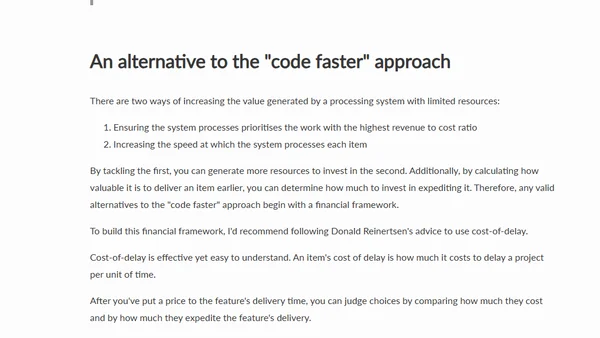
Critiques the 'code faster' management approach, arguing for quantifying economic value and prioritizing work to maximize profit with limited resources.
Explains the 'working backwards' problem-solving technique, using a child's puzzle and Amazon's product development process as examples.
A software engineer critiques story-point-driven estimation in agile development, arguing it's often misleading and doesn't solve core estimation problems.
Explains the YDNIY (You Don't Need It Yet) principle for shipping software faster by delaying non-essential features.