The hard problem with hard problems
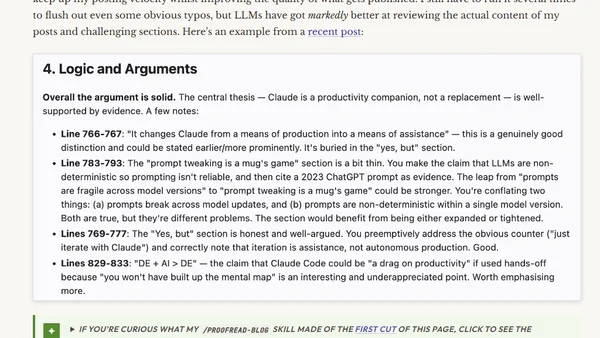
A critical analysis of why LLMs like Claude Code struggle with complex coding tasks, arguing the real issue is not intelligence but poor software engineering practices.
The New York Times uses a custom AI tool called the 'Manosphere Report' to track and analyze podcast content for news coverage.
Introduces GLM-5, a massive new open-source AI model, and discusses the emerging concept of 'Agentic Engineering' for software development with LLMs.
GLM-5, a massive new 754B parameter open-source AI model, is discussed in the context of the emerging field of 'Agentic Engineering' for software development.
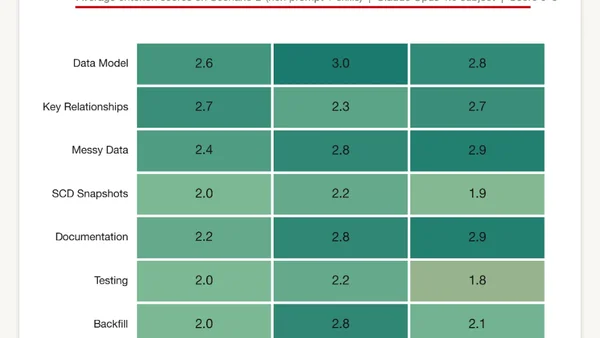
A research paper analyzes LLM performance on SQL generation tasks using different structured data formats and large schemas, comparing frontier and open-source models.
Research paper analyzes LLM performance on large SQL schemas, comparing 11 models across 4 data formats for structured context engineering in agentic systems.
Martin Fowler reflects on the future of software development with AI, discussing cognitive debt, the role of LLMs, and how they might change programming.
Anthropic's Claude AI reportedly discovered 500 zero-day vulnerabilities, sparking debate on AI's role in security research.
Anthropic introduces a faster 'fast mode' for Claude Opus 4.6 at a significantly higher cost, with a temporary discount.
An analysis of AI coding agents, explaining their simplicity and power through a hands-on experiment building a minimalist agent with Claude Code.
Anthropic releases Opus 4.6 and OpenAI releases GPT-5.3-Codex, with analysis on their incremental improvements over previous models.
Anthropic releases Opus 4.6 and OpenAI releases GPT-5.3-Codex, with analysis on their incremental improvements and capabilities.
A video Q&A session on database administration topics, recorded during a music festival cruise, answering SQL Server and DBA questions.
The author describes using an LLM (Codex) to rewrite the pycparser project, replacing its PLY-based parser with a hand-written recursive-descent parser.
Martin Fowler shares fragmentary thoughts from a tech event, covering AI's impact on understanding code, LLMs as navigation tools, and the future of software libraries.
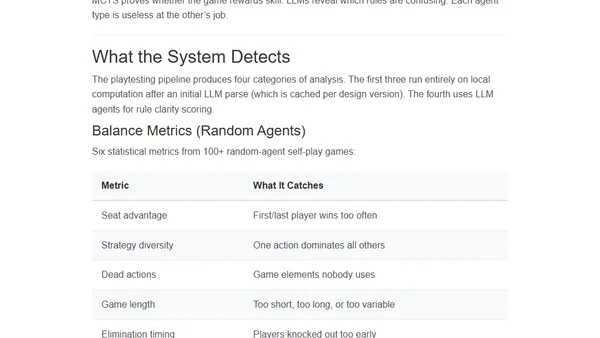
Introducing GameGrammar, an AI system that uses six specialized agents to generate complete board game designs from a simple theme in seconds.
Explores how software architecture principles for human cognition, like fractal design, could improve AI's ability to work with large codebases.
A software engineer argues that learning to code remains essential despite AI's ability to generate code, as coding skills are needed to evaluate and work with AI-generated output.
Explores the unpredictable second-order effects of AI evolution, focusing on how AI coding tools may reshape developer choices and business models.