AI Memory Architecture: Context, RAG, and Persistent State
AI memory architecture: context, RAG, and persistent state — designing reliable use of information across model parameters, retrieval, and workflow state.
Enterprise RAG citation controls: separate citation existence from evidence quality, applicability, and disclosure permission.
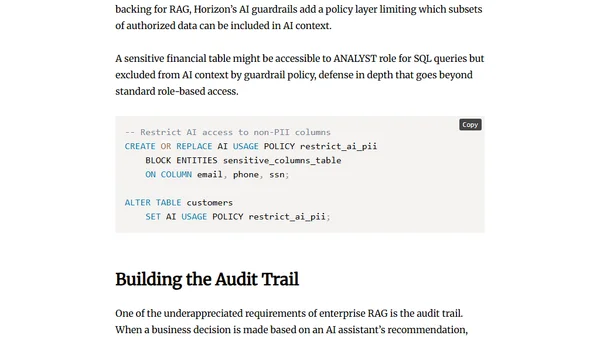
How to enforce RAG retrieval permissions based on the user, not service accounts, to prevent unauthorized access.
Enterprise RAG security as a data boundary: source admission, processing controls, derived data governance, and lifecycle management for AI pipelines.
Overview of RAG implementation in Microsoft Agent Framework, covering TextSearchProvider, retrieval modes, and production considerations.
Learn how to keep RAG pipelines fresh with Drasi's SyncVectorStore, which syncs embeddings continuously via change feed instead of nightly reindexing.
This article explains how to build an IT AI insight engine that connects operational signals like tickets and incidents into a governed context layer for better decisions.
Explains hybrid AI assistant architecture, comparing NLU, RAG, deterministic flows, and LLMs for enterprise use.
A guide to designing production-ready RAG knowledge bases, covering metadata, chunking, security, and lifecycle management.
A decision framework for IT teams to identify enterprise RAG use cases that survive production, focusing on governed, narrow applications over broad chatbots.
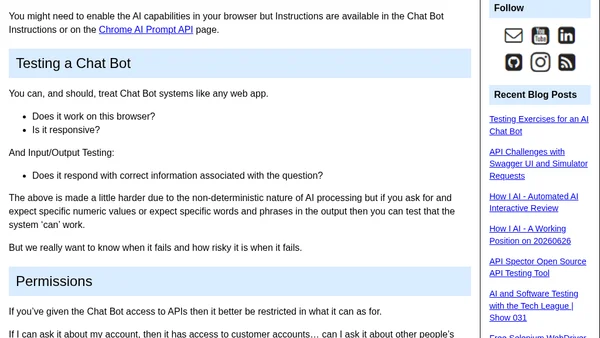
Article on testing AI chatbots, including prompt injection, permissions, and bypassing guardrails using influence techniques.
Building a Slack bot that answers Confluence questions using Amazon Bedrock Knowledge Base and RAG pipeline.
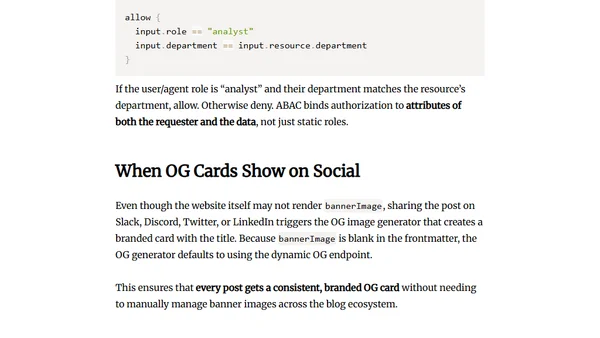
Explains why policy-as-code, not RAG, is the key to secure enterprise AI by embedding authorization into query engines.
Explains how to design governed RAG systems using data products, separating retrieval and governance for accurate, policy-compliant AI responses.
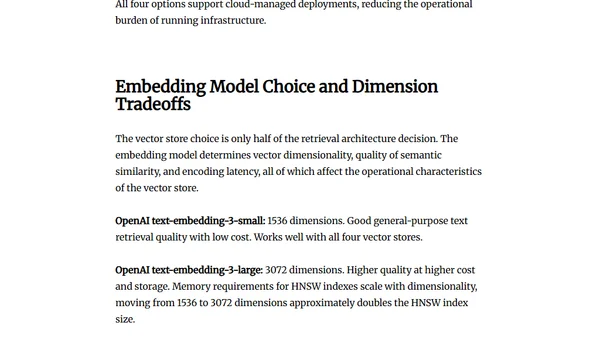
A guide comparing vector stores like pgvector, Milvus, Weaviate, and LanceDB for retrieval workloads, focusing on index types and tradeoffs.
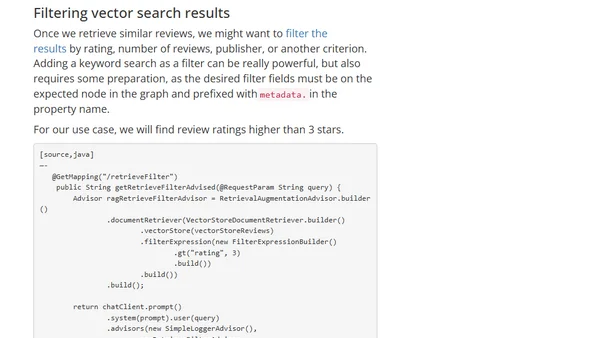
Guide to building a GraphRAG application using Spring AI Advisors, covering the advisor API and integration with Neo4j for book recommendations.
Explores building AI agents using RAG, tool calling, and memory, with practical insights from a key paper and Anthropic's SDK.
Explains grounding in LLMs: connecting them to reliable data for accurate, context-aware responses using techniques like RAG and fine-tuning.
A critique of an AI shopping assistant's failure to answer a product question, highlighting the superiority of simple keyword search over retrieval-based AI.
Announcing a talk at Adriatics Tech Summit 2026 on implementing RAG with Microsoft.Extensions.VectorData in .NET.