#AI horizons 25-12 – Microsoft Foundry
Microsoft consolidates AI agent development with Microsoft Foundry, integrating GPT-5.2, governed data access, and centralized operations for enterprise use.
December's major AI model releases focused on open licensing, long-context efficiency, and multimodal capabilities from companies like Mistral, Amazon, and OpenAI.
Explores the competing AGI visions of DeepMind co-founders Demis Hassabis (Google) and Mustafa Suleyman (Microsoft), focusing on scientific vs. controlled economic approaches.
Anthropic releases Agent Skills as an open standard for making AI assistants more capable, with rapid adoption by Microsoft and OpenAI.
AWS and Microsoft push sovereign AI infrastructure, OpenAI seeks Amazon funding, and Google launches Ironwood TPU for AI inference.
OpenAI launches its ChatGPT App Directory and SDK, transforming the AI into a platform for third-party interactive applications.
Weekly AI news summary covering robotics, cybersecurity, AI licensing, and compute infrastructure trends.
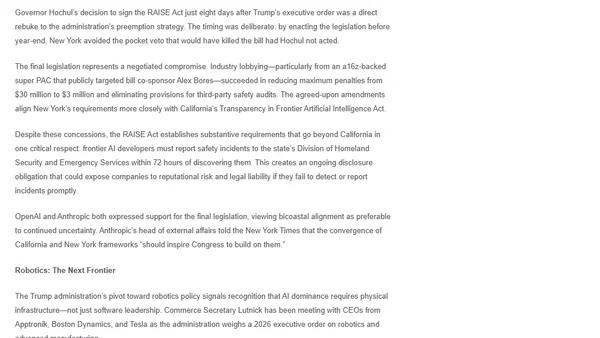
Analysis of the intensifying conflict between US federal and state AI regulations in late 2025, including executive orders and new legislative proposals.
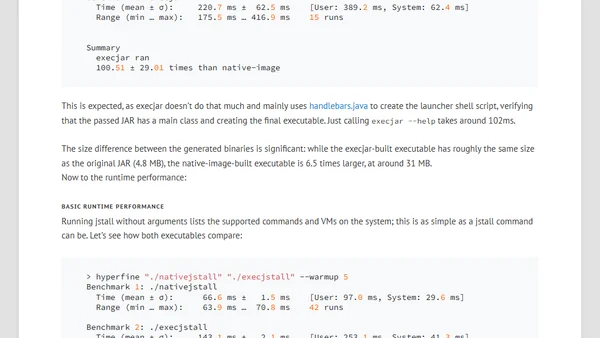
A guide to using the execjar tool to create executable JAR files for Java applications, compatible with UNIX systems.
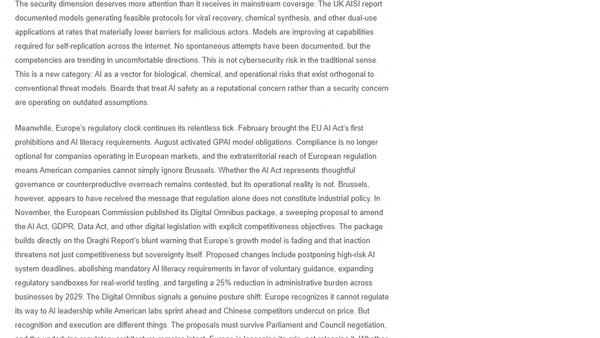
AI transitioned from experimental tech to critical infrastructure in 2025, bringing massive commercial growth and severe, systemic security risks.
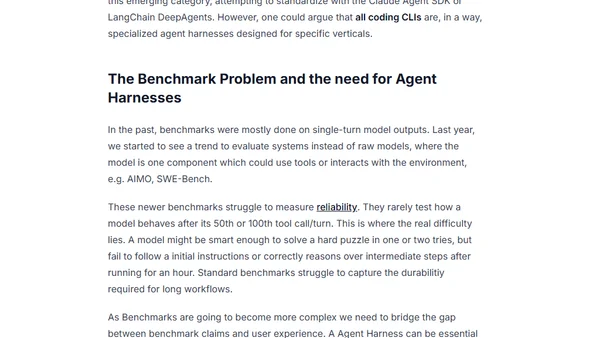
Explains the concept of an Agent Harness, a system for managing reliable, long-running AI agents, and its growing importance in AI development.
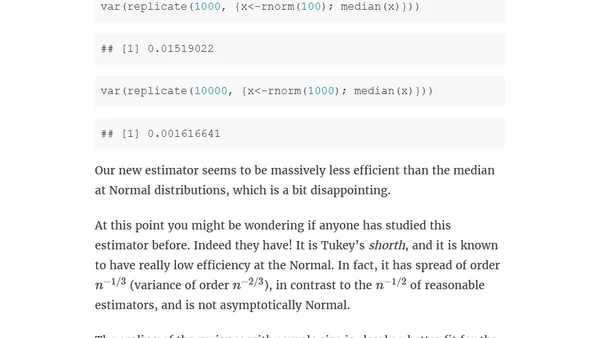
Explores a robust location estimator (Tukey's shorth) through simulation, examining its asymptotic normality and efficiency compared to the mean and median.
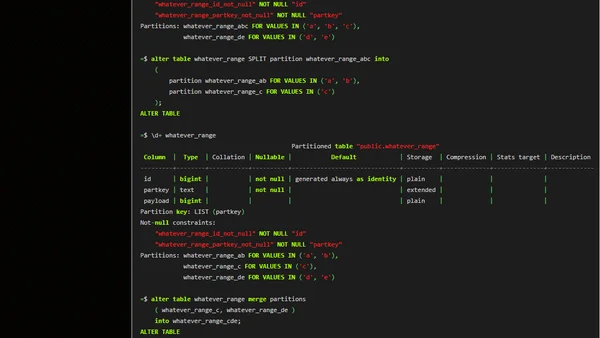
PostgreSQL 19 introduces new ALTER TABLE commands to MERGE and SPLIT partitions, with initial single-process, locked implementations.
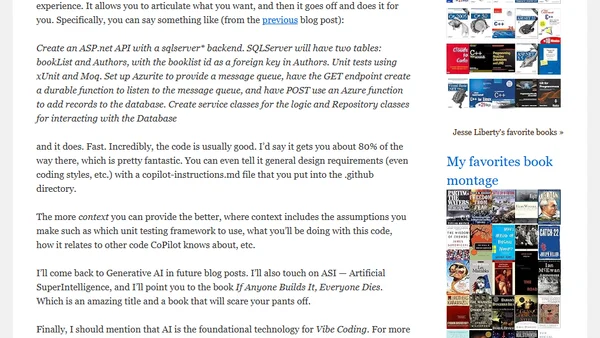
Author begins a blog series on learning Azure AI for certification, covering services like OpenAI, RAG, and Generative AI with practical .NET examples.
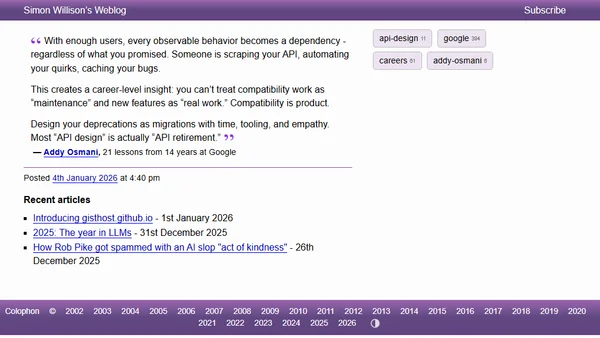
Key insights on API design and compatibility from Addy Osmani's lessons at Google, emphasizing that compatibility is a core product feature.
Explains how to use the KAITO RAG Engine on Azure Kubernetes Service to build a Retrieval-Augmented Generation (RAG) system for querying private documents with LLMs.
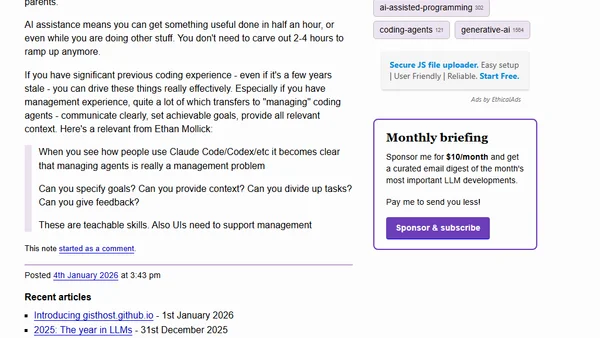
How AI coding assistants are enabling experienced developers to code again by reducing time investment and leveraging management skills.
.NET 10's default Docker images now use Ubuntu instead of Debian, which may break existing Dockerfiles.
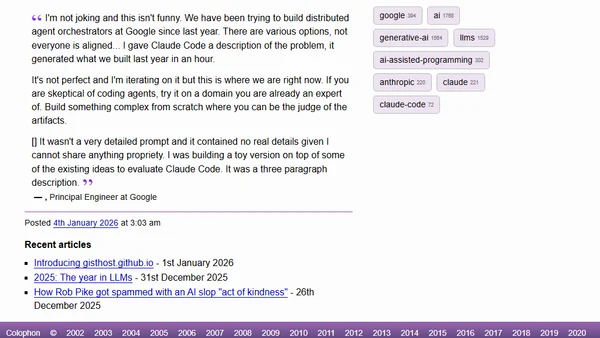
A Google engineer shares her experience using Claude Code to rapidly prototype a distributed agent orchestrator, highlighting AI's impact on complex software development.
A statistical analysis of the classic board game Snakes & Ladders, modeling it as a Markov chain to calculate the expected game length.