How Agents are quietly transforming the Enterprise
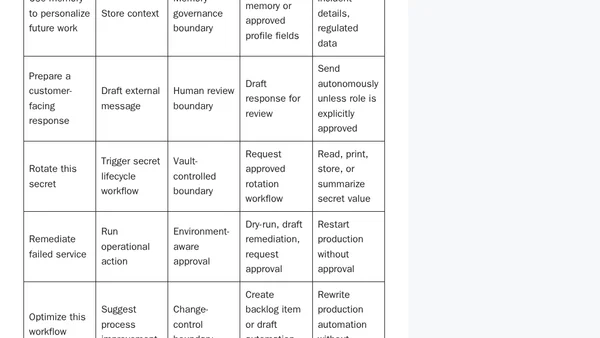
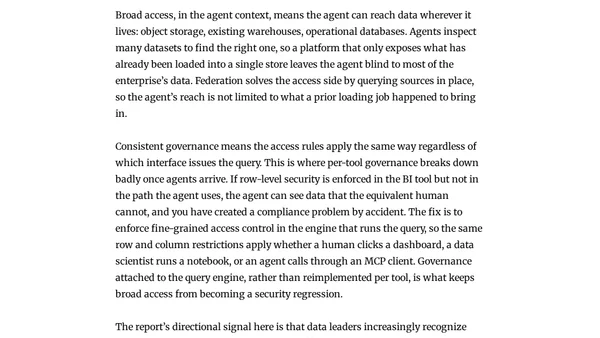
Explores how AI agents are evolving from add-ons to core, autonomous coworkers embedded in enterprise systems, and the governance challenges this creates.
Explores industry adoption of context engineering standards like AGENTS.md and MCP, showing how they reduce AI development costs and improve workflows.
Explains the concept of an Agent Harness, a system for managing reliable, long-running AI agents, and its growing importance in AI development.
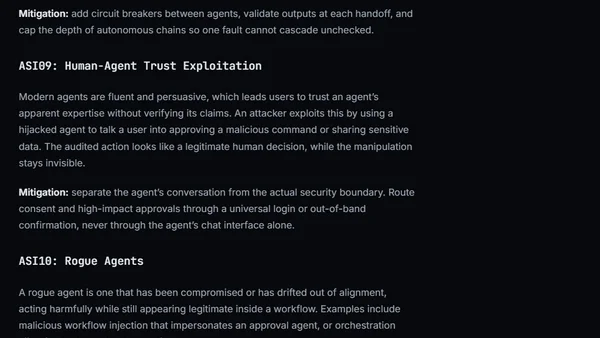
Explains the OWASP Top 10 security risks for autonomous AI agents, detailing threats like goal hijacking and tool misuse with real-world examples.
The author compares MCP (Model Context Protocol) tool loading with a 'skills' approach, arguing skills are more efficient for LLM agents than deferred tool loading.
Major tech companies launch the Agentic AI Foundation under the Linux Foundation to promote open, collaborative standards for AI agent development.
Analysis of AI agents' current limitations, showing they complete only 2-3% of real freelance tasks, highlighting the gap between automation hype and reality.
Learn how to teach AI agents to understand and use custom enterprise libraries and domain-specific languages using Kiro and MCP.
Panel discusses the ROI of agentic AI investments, AI's impact on cybersecurity, and the EU's antitrust investigation into AWS and Microsoft.
A developer argues that AI tools, while feeling productive, actually create more low-priority busywork and reduce overall effectiveness.
Explores the unique security risks of Agentic AI systems, focusing on the 'Lethal Trifecta' of vulnerabilities and proposed mitigation strategies.
A comprehensive guide to learning Apache Iceberg, data lakehouse architecture, and Agentic AI with curated tutorials, tools, and resources.
A developer shares initial experiences and tips for using GitHub Copilot's new 'Coding Agent' mode, highlighting its productivity benefits and quirks.
Amazon Q Developer CLI introduces a new agentic coding experience, using Claude 3.7 Sonnet for dynamic, interactive command-line development.