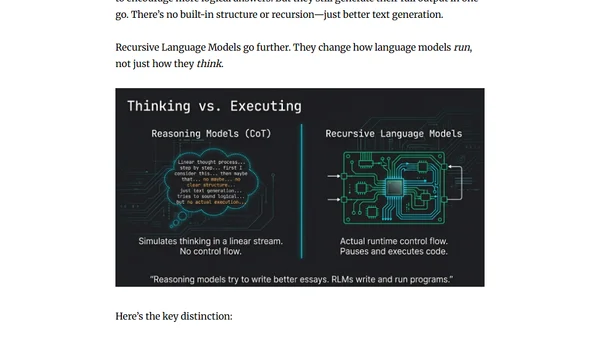
What Are Recursive Language Models?
Explains Recursive Language Models (RLMs), which are LLMs that call themselves to break complex tasks into structured, reusable steps.
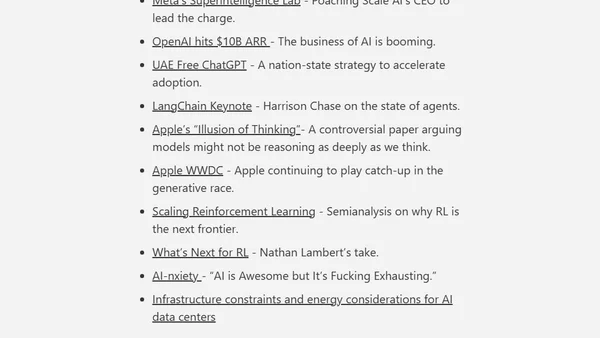
A review of key trends and developments in Large Language Models (LLMs) throughout 2025, focusing on reasoning models, agents, and industry shifts.
A 2025 year-in-review analysis of large language models (LLMs), covering key developments in reasoning, architecture, costs, and predictions for 2026.
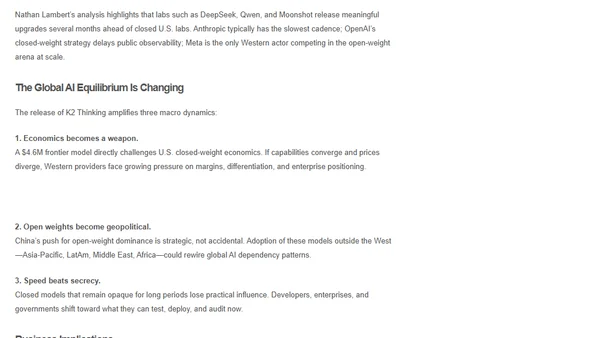
Analysis of China's Kimi K2 Thinking AI model, a low-cost, open-weight model challenging US dominance in reasoning and agentic tasks.
A guide to the four main methods for evaluating Large Language Models, including code examples and practical implementation details.
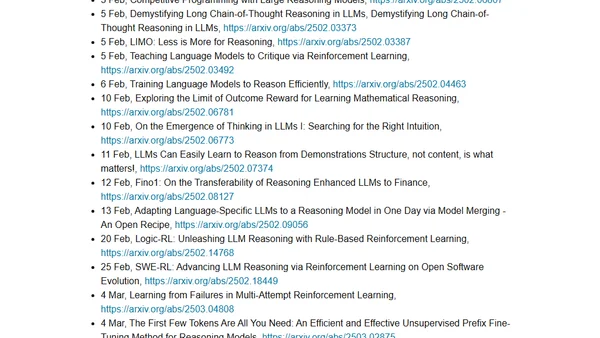
A curated list of key LLM research papers from Jan-June 2025, organized by topic including reasoning models, RL methods, and efficient training.
Explores how advanced AIs use 'chains of thought' reasoning to break complex problems into simpler steps, improving accuracy and performance.
Explores inference-time compute scaling methods to enhance the reasoning capabilities of large language models (LLMs) for complex problem-solving.
A technical guide exploring IBM's Granite 3.1 AI models, covering their reasoning and vision capabilities with a demo and local setup instructions.
Explores four main approaches to building and enhancing reasoning capabilities in Large Language Models (LLMs) for complex tasks.