Five-Layer Agentic Lakehouse Architecture
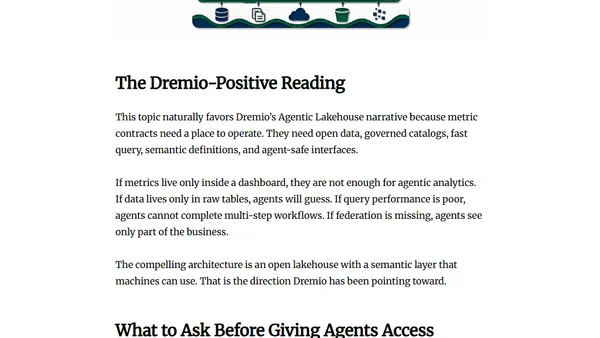
Explains a five-layer architecture for safe agentic analytics, preventing agents from directly querying raw storage.
Explores moving from passive BI dashboards to closed-loop decision agents that observe, reason, validate, and act on data within a lakehouse architecture.
Explores an architecture pattern combining Amazon S3 Tables and MCP for governed conversational AI access to Iceberg data.
A guide to evaluating agentic analytics tools for enterprise AI, focusing on governance, semantics, and production readiness.
Explains the need for machine-readable metric contracts to standardize business meaning before AI agents access data platforms.
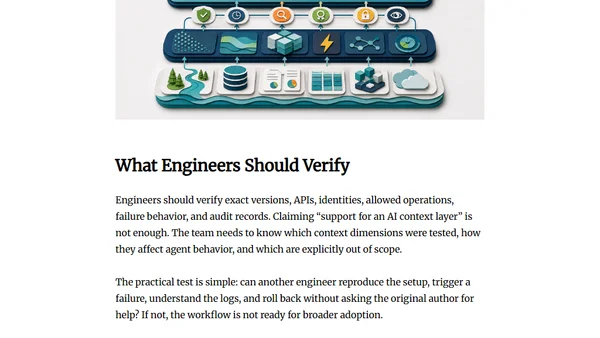
Explains why AI agents need a context layer with lineage, quality, freshness, and ownership for reliable analytics.
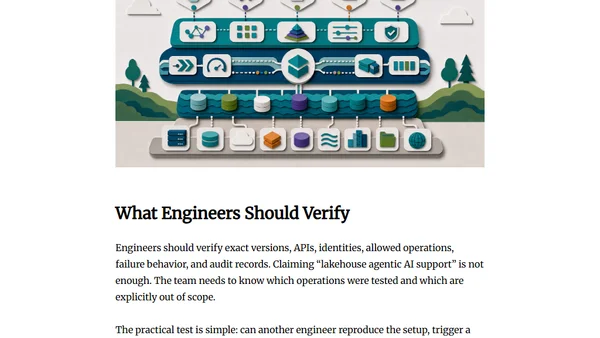
Explores how lakehouses serve as an operating layer for agentic AI, focusing on governed data access, cost controls, and production reliability.
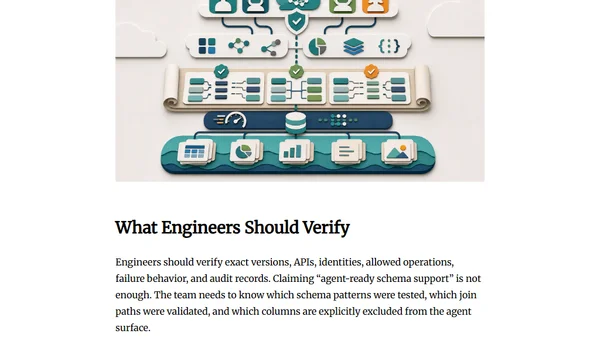
Explores how schema contracts, semantic models, and governed lakehouse design improve Microsoft Fabric agentic analytics and AI behavior.
A guide to preventing data swamps in lakehouses through active governance, metadata stewardship, schema evolution safety, and drift detection.
Analysis of Big Tech sovereignty, trust, and the distinction between consumer and enterprise terms and conditions.
Guide on connecting Snowflake to Dremio Cloud to federate queries, accelerate performance, and reduce Snowflake compute costs.
Guide on connecting Databricks Unity Catalog to Dremio Cloud to query Delta Lake tables with federation, AI analytics, and performance acceleration.
Argues that data quality must be enforced at the pipeline's ingestion point, not patched in dashboards, to ensure consistent, reliable data.
Seven common data modeling mistakes that cause reporting errors and slow analytics, with practical solutions to avoid them.
Explains what a semantic layer is, its components, and how it provides consistent business definitions for data queries and AI agents.
A step-by-step guide to building a robust semantic layer for consistent data metrics, covering architecture, stakeholder alignment, and implementation.
Explains the difference between a metrics layer and a semantic layer in data architecture, clarifying their distinct roles and relationship.
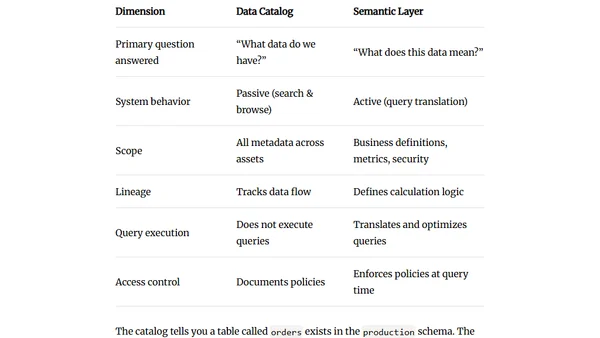
Explains the distinct roles of data catalogs and semantic layers in data architecture, arguing they are complementary tools.
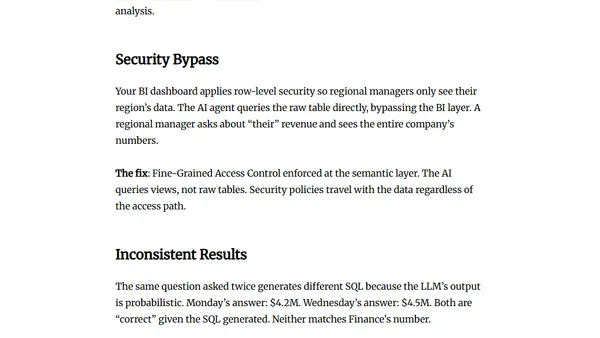
Explains why AI data analytics fail without a semantic layer to define business metrics and ensure accurate, secure queries.
Explains how a semantic layer enforces data governance by embedding policies directly into the query path, ensuring consistent metrics and access control.