AI Confidence Is Not Evidence: Building an Evidence Contract
AI confidence calibration vs. evidence qualification: an evidence contract pattern to ensure agent claims are supported by authentic, relevant data.
AI agent verification: prove runtime outcomes, not just tool call success. Separate acceptance, config, convergence, and service results.
Overview of wrapture, Graham Dumpleton's new Python monkey patching library for testing, tracing, and observability.
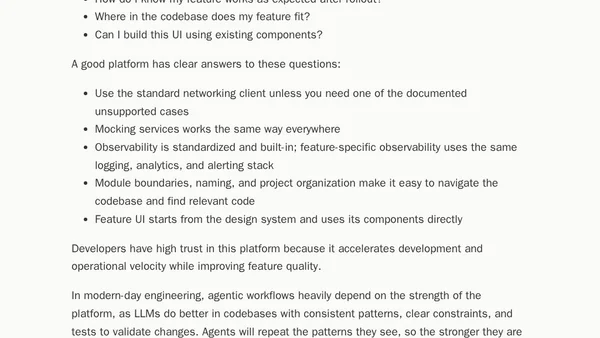
An exploration of mobile platform foundations, covering build, run, observe, and distribute systems, and their impact on engineering velocity and app reliability.
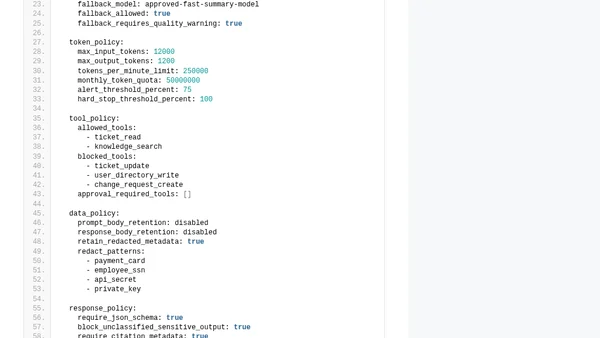
Learn how to build an operating model for AI gateways, covering identity, policy, observability, and cost controls for production readiness.
Learn how to integrate OpenTelemetry with Microsoft Agent Framework apps for enhanced observability, including key trends, challenges, and code examples.
Explores Microsoft Agent Framework's integration with OpenTelemetry for monitoring and debugging AI agents.
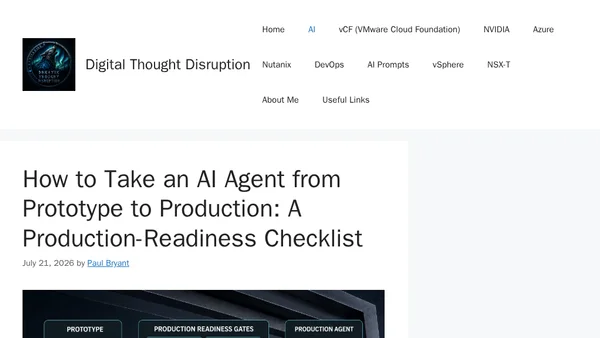
Checklist for moving AI agents from prototype to production, covering identity, state, tools, policy, observability, and governance.
A daily tech reading list covering AI hiring trends, agentic AI, Clickhouse, coding benchmarks, and AI developer tools.
Analysis of why Clickhouse is winning the observability wars with columnar storage, handling massive data scales better than competitors.
Analysis of AWS Summit Japan 2026 focusing on Agentic AI, data platforms, and the operational infrastructure needed for reliable AI in production.
A guide to evaluating agentic analytics tools for enterprise AI, focusing on governance, semantics, and production readiness.
Explores necessary platform controls for scaling AI-assisted engineering, focusing on cost visibility, ownership, and governance.
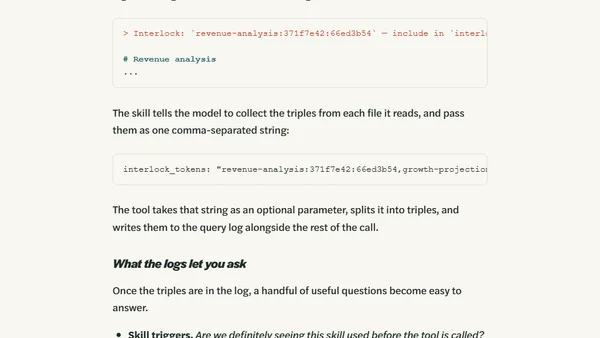
How incident.io uses interlocks to prove Claude read skill files before calling tools, improving AI agent reliability.
Critique of the 'three pillars' observability model, arguing it destroys data context and relationships, making AI and engineering insights harder.
Explains why context and relationships in observability data are crucial, arguing the three pillars model destroys data value.
A reflective analysis on SREs and generative AI, one year after a keynote at SRECon25, arguing the need for SREs to engage with AI.
A tech author realizes she wrote the wrong book for engineers, then rewrites it based on community advice about software buying.
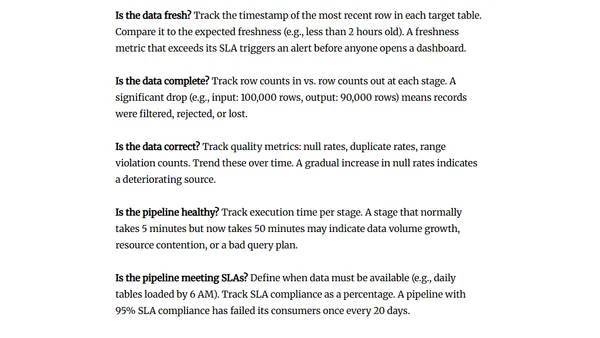
Explains the importance of pipeline observability for data health, covering metrics, logs, and lineage to detect issues beyond simple execution monitoring.
A tech professional outlines his 2026 plans, focusing on creating content around Terraform, Kubernetes, WebAssembly, and OpenTelemetry.