Block vs. Object Storage: A Deep Dive Into the Foundation of Modern Data, and How the Lakehouse Made the Slow Option Fast
A deep dive comparing block vs. object storage, explaining how lakehouses made slower object storage fast for analytics.
Explores an architecture pattern combining Amazon S3 Tables and MCP for governed conversational AI access to Iceberg data.
Explores concurrency challenges in agentic lakehouses with Iceberg, balancing academic proofs and high-frequency production writes.
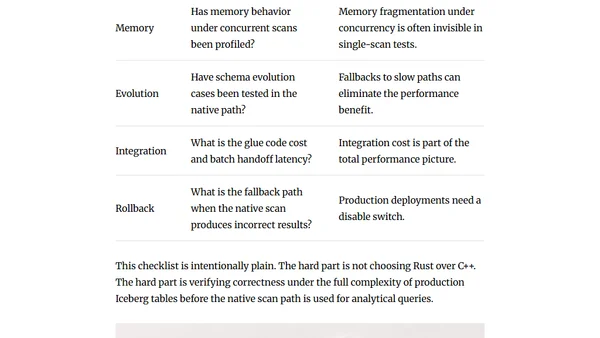
Analysis of Rust vs C++ for building native Iceberg scan operators, focusing on production performance, safety, and interoperability.
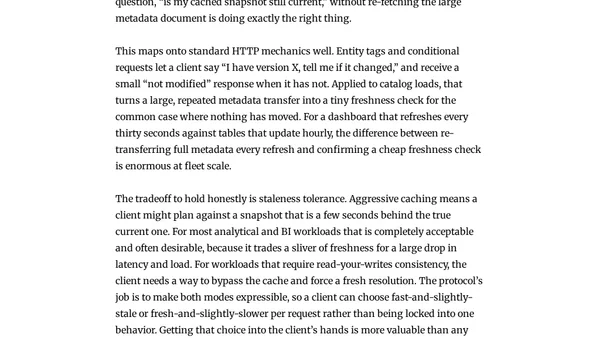
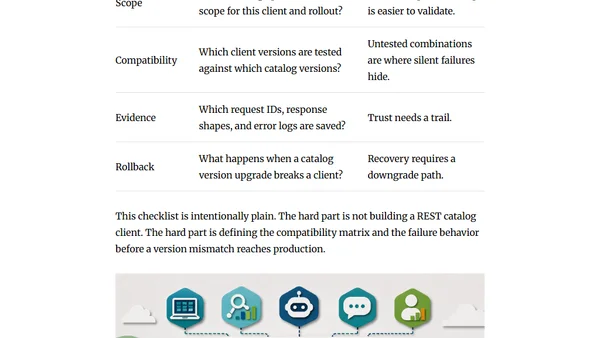
Analysis of REST Catalog V2 LoadTable and client capability negotiation for lakehouse platforms.
Analysis of Apache Iceberg v4 performance focusing on metadata round trips, root manifests, and object storage latency for platform engineers.
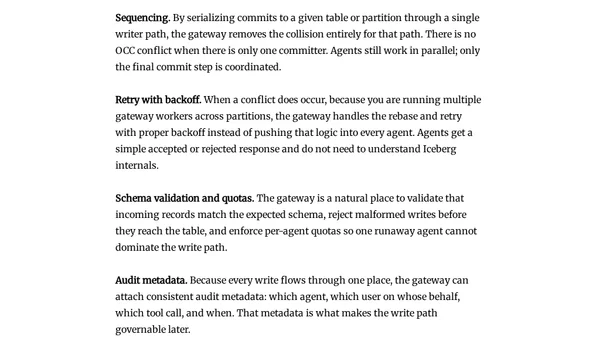
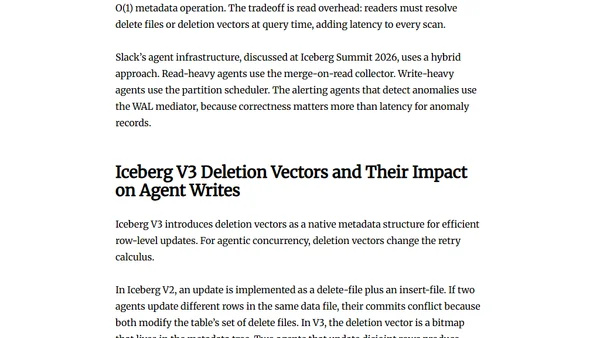
Explores concurrency and isolation challenges when AI agents write to Apache Iceberg lakehouses, covering OCC mechanics, failure modes, and architectural patterns.
Analysis of zero-copy mirroring for safer lakehouse migration, focusing on architecture, governance, and multi-engine data platforms.
Explains Snowflake's bidirectional Iceberg writes via Horizon Catalog, powered by Apache Polaris, enabling external engines to write to Snowflake-managed Iceberg tables.
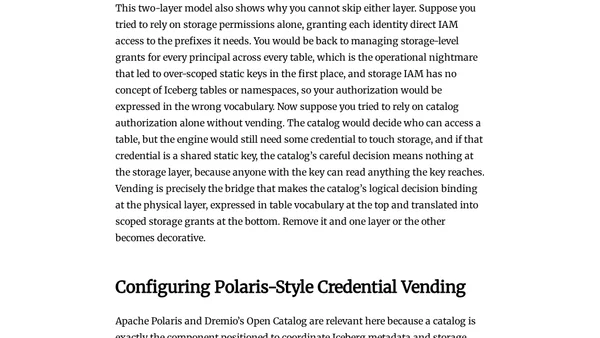
This article discusses authentication and authorization patterns for securing AI agent identities in the Iceberg lakehouse, including OAuth 2.0 token exchange and credential vending.
Explains Iceberg remote signing for regulated datasets, enhancing security by issuing per-file, one-time-use pre-signed URLs instead of storage credentials.
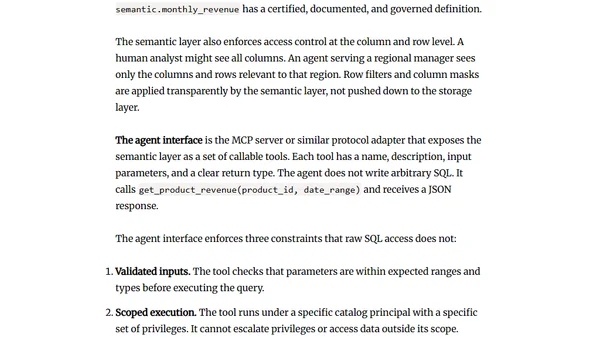
Explains the four-layer architecture of an agentic lakehouse for reliable AI agent data access.
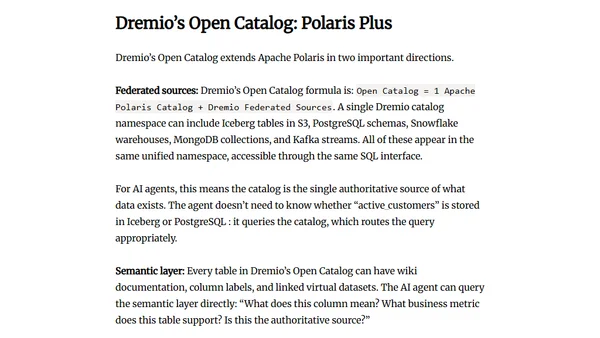
Explains designing an open catalog architecture for AI agents in an agentic lakehouse, covering Apache Polaris and Dremio's Open Catalog.
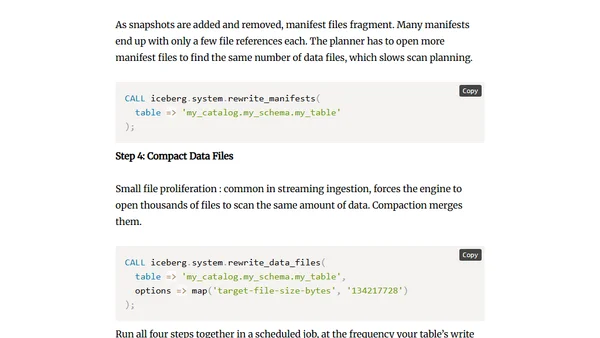
Best practices for managing Apache Iceberg snapshot expiration in data lakehouses to optimize query performance and metadata size.
Compares Apache Paimon and Iceberg for handling mutable streams, focusing on Paimon's LSM-tree architecture for high-frequency updates.
Explores using Lance and Iceberg formats for multimodal AI data, addressing scan-heavy analytics vs. random-access retrieval for ML training.
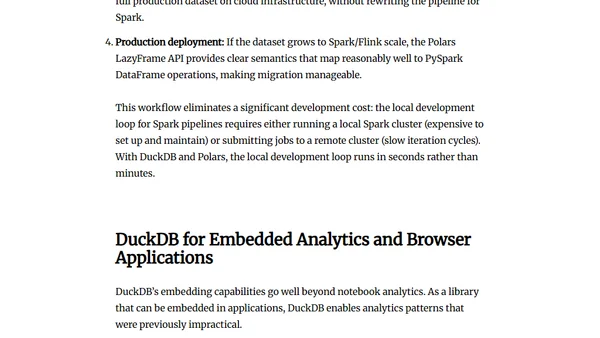
Explores using DuckDB and Polars to query and write to Iceberg tables, covering new features, workflows, and practical patterns.
Explains how Apache Iceberg uses metadata for data skipping, enabling fast query performance by eliminating 90-99% of files before scanning.
Apache Polaris is an open-source catalog service that unifies the Iceberg ecosystem by implementing the Iceberg REST API for vendor-neutral lakehouse metadata management.
Explores two paths for building a universal lakehouse catalog that extends beyond Apache Iceberg tables to manage diverse data formats and sources.