Iceberg Variant Type for AI JSON Data
Explains why a native variant type in Apache Iceberg is needed for semi-structured AI data like LLM outputs and agent logs.
Explores how AI agent write patterns stress Apache Iceberg tables and offers patterns like partition isolation and commit queues to maintain performance.
Explores moving from passive BI dashboards to closed-loop decision agents that observe, reason, validate, and act on data within a lakehouse architecture.
An in-depth analysis of Apache Parquet in 2026, covering new features, versioning debates, and its evolving role in the lakehouse and AI eras.
Analysis of Apache Polaris in July 2026, covering its graduation, release updates, federation, governance, and adoption as an open lakehouse catalog.
Explores fine-grained security for AI agents in analytics, covering dynamic access control, identity propagation, and governance at machine speed.
Explains how Iceberg v3's positional deletes and merge-on-read improve event lake performance for fast-inbound data corrections.
Explores Iceberg v3's variant type for standardizing semi-structured AI JSON payloads in lakehouse architectures.
A 2026 playbook for migrating proprietary data warehouses to open lakehouses using zero-copy metadata translation and staged modernization.
A deep dive comparing block vs. object storage, explaining how lakehouses made slower object storage fast for analytics.
Explores federation vs. lakehouse architectures for unified data access, offering a decision framework and best practices.
An in-depth guide to file compression codecs, covering how data shrinks, codec differences, and practical recommendations for lakehouse architectures.
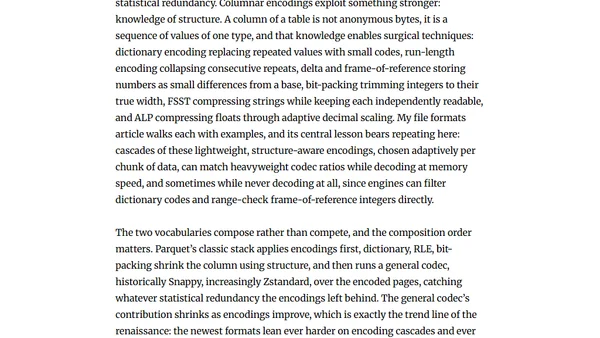
Explores autonomous materialization for agentic analytics, focusing on performance, governance, and lifecycle management in data platforms.
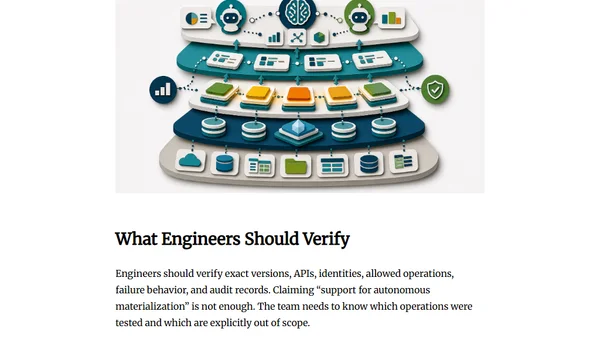
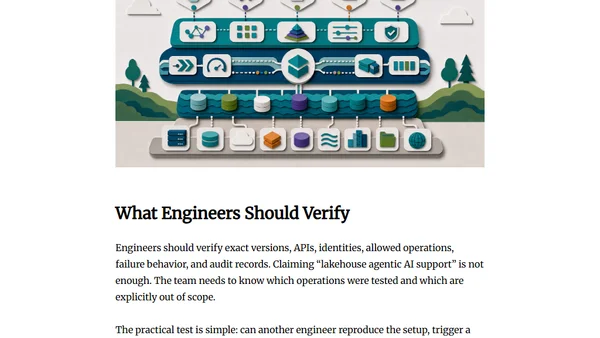
Explores how lakehouses serve as an operating layer for agentic AI, focusing on governed data access, cost controls, and production reliability.
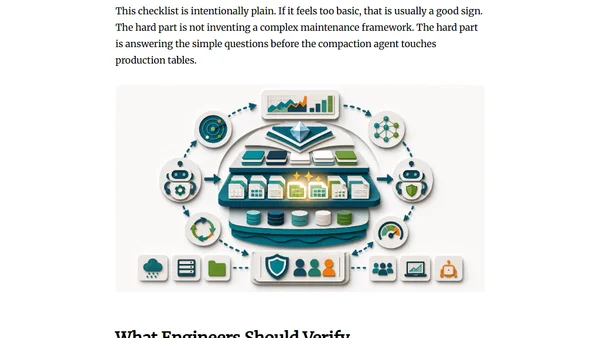
Explores event-driven table compaction using agents in lakehouse architectures, focusing on small file problems and production patterns.
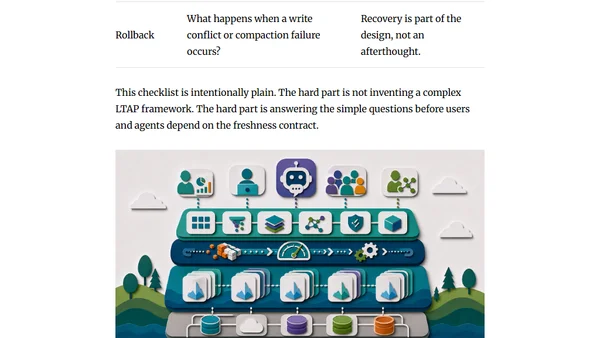
Analysis of LTAP (Lakehouse Transactional Analytical Processing) focusing on freshness, isolation, and workload boundaries for data architects.
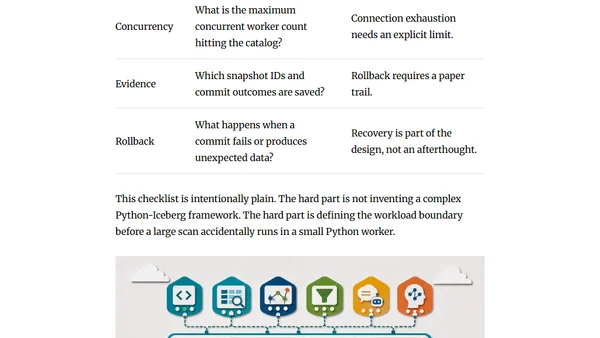
Explores using PyIceberg without Apache Spark for Python-based Iceberg table operations, focusing on architecture, boundaries, and production patterns.
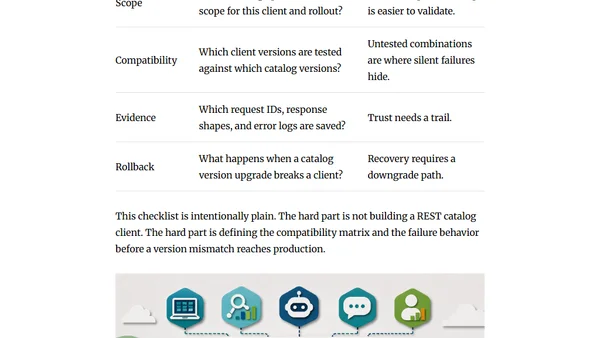
Analysis of REST Catalog V2 LoadTable and client capability negotiation for lakehouse platforms.
Analysis of Snowflake interoperable lakehouse lessons focusing on production contracts, multi-engine access, and agentic analytics challenges.
Explores concurrency and isolation challenges when AI agents write to Apache Iceberg lakehouses, covering OCC mechanics, failure modes, and architectural patterns.