NVIDIA GTC 2025 - Building LLM-Powered Applications
Summary of a panel discussion at NVIDIA GTC 2025 on insights and lessons learned from building real-world LLM-powered applications.
Explores how large language models (LLMs) are transforming industrial recommendation systems and search, covering hybrid architectures, data generation, and unified frameworks.
A tutorial on implementing function calling with Google's Gemma 3 27B LLM, showing how to connect it to external tools and APIs.
A clear explanation of the attention mechanism in Large Language Models, focusing on how words derive meaning from context using vector embeddings.
Argues that AI can improve beyond current transformer models by examining biological examples of superior sample efficiency and planning.
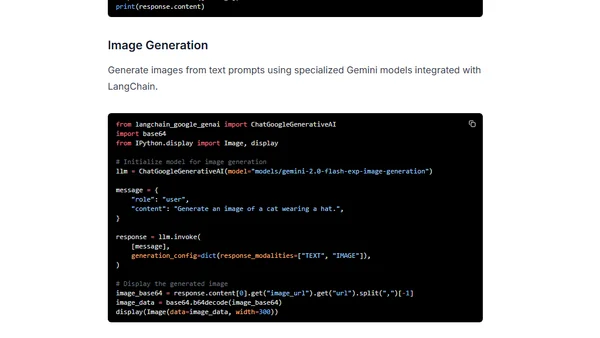
A practical guide to implementing function calling with Google's Gemini 2.0 Flash model, enabling LLMs to interact with external tools and APIs.
Explores the concept of 'generality' in AI models, using examples of ML failures and LLM inconsistencies to question how we assess their capabilities.
Explains how to extract logprobs from OpenAI's structured JSON outputs using the structured-logprobs Python library for better LLM confidence insights.
Introducing Physica, a Physics World Model AI that enforces physical laws to prevent errors in AI-generated simulations, moving beyond token fluency.
Explains the LLMs.txt file, a new standard for providing context and metadata to Large Language Models to improve accuracy and reduce hallucinations.
Introducing Tinbox, an LLM-based tool designed to translate sensitive historical documents that standard models often refuse to process.
An analysis of the ethical debate around LLMs, contrasting their use in creative fields with their potential for scientific advancement.
Reflections on the first unit of the Hugging Face Agents course, focusing on the potential and risks of code agents and their evaluation.
Learn to automate pull request descriptions in Azure DevOps using Azure OpenAI's GPT-4o to generate summaries of code changes.
A developer shares insights from Jfokus 2025, highlighting talks on Java performance optimization and AI agents in software development.
Summary of key concepts for optimizing AI inference performance, covering bottlenecks, metrics, and deployment patterns from Chip Huyen's book.
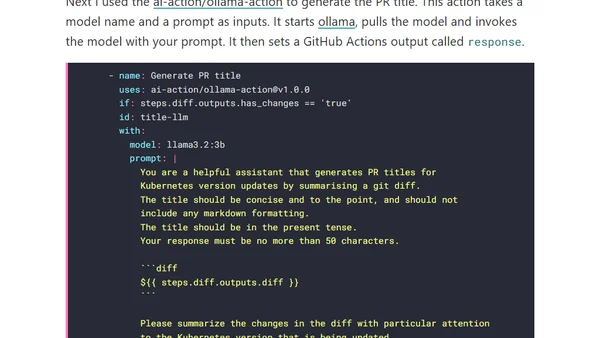
A tutorial on installing and running the Mistral AI large language model locally on a Linux system using the Ollama platform.
Explores four main approaches to building and enhancing reasoning capabilities in Large Language Models (LLMs) for complex tasks.
Argues that learning to code remains essential in 2025 despite advanced AI, emphasizing critical thinking, debugging, and career value.
A developer's experience with the Cline AI coding assistant, exploring its capabilities for bug fixing and the implications for programmers.