Five principles to guide any government IT effort
A former Presidential Innovation Fellow shares five core principles for successful government IT projects, focusing on culture, user needs, and modern development.
An interview discussing the importance and ongoing debate around commenting code, challenging the 'comments are a failure' clean code perspective.
Critique of blind review processes for tech conference talks, arguing they lead to conservative selections and overlook speaker skill.
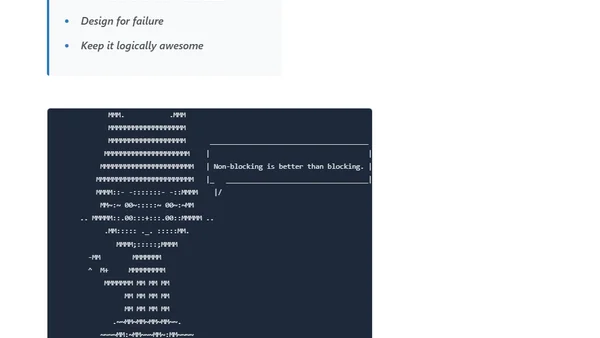
Explores the 'Zen of GitHub,' a set of guiding principles that shape GitHub's engineering culture and decision-making processes.
Applies the 'keep your bench clean' principle from cooking to software development, emphasizing clean code, atomic commits, and removing unused code.
A passionate rant arguing for the importance of writing clear comments in code, even when the code itself is well-structured and 'self-documenting'.
Explores how government IT procurement is evolving from waterfall to agile methods and aligning with open source development practices.
Explains why applying closed-source, meeting-heavy workflows to open source projects leads to failure and advocates for asynchronous, transparent collaboration.
Explains best practices for copyright notices in open source projects, covering dates, copyright holders, and legal necessity.
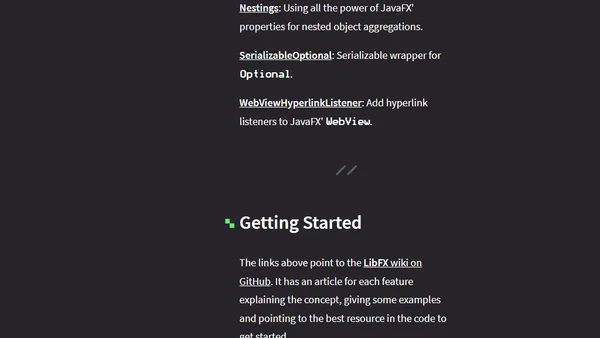
Announcement of LibFX 0.3.0 release, a JavaFX utility library with features like transforming collections and tree node streaming.
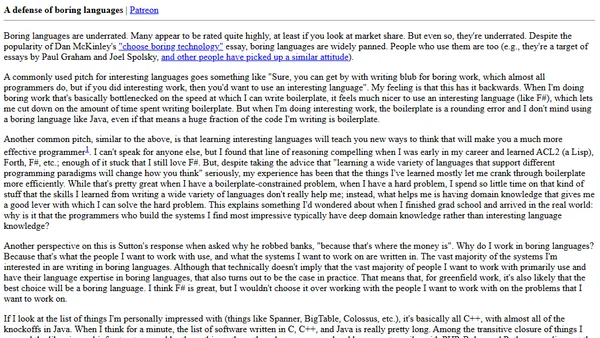
An essay arguing that 'boring' programming languages are superior for complex, interesting work, contrary to popular tech industry advice.
Explains the distinct missions and approaches of two U.S. government tech modernization groups: 18F and the U.S. Digital Service (USDS).
A critique of government agency workplace culture, listing 19 reasons why technologists avoid public sector jobs and offering solutions.
SUSE's Hack Week allows engineers to work on self-chosen projects, fostering innovation, learning, and collaboration.
A developer reflects on the emotional and professional revitalization they experience at PyCon, the annual Python conference.
A developer shares how starting with a minimal, functional version of a side-project (a Python TODO manager) leads to completion and avoids abandonment.
Five best practices for fostering internal collaboration and culture to succeed in open source projects, especially within large organizations.
A blueprint for product management focusing on building trust, establishing velocity, and strategically killing scope to align product and engineering teams.
A developer reflects on the value of functional, working code over perfect architecture, using a collaborative iOS project as an example.
Advocates for establishing a 'Git-iquette'—a set of etiquette rules for using Git in team projects to improve code history clarity and collaboration.