Architecture is a game of constraint satisfaction.
Explores how past technological constraints shape software architecture and business behavior, and why removing them doesn't automatically change established practices.
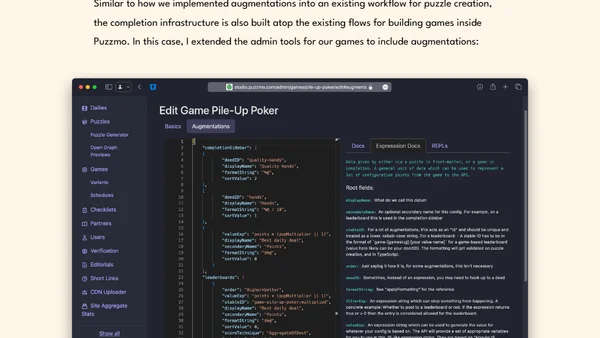
The technical changes behind Puzzmo's 'Weird Puzzmo' update, enabling playful puzzle variants and a new extension system.
A summary of John Ousterhout's book on managing software complexity through decomposition, encapsulation, and incremental design.
A programmer shares his method for providing realistic project estimates by multiplying optimistic timelines and using ranges to account for unforeseen changes.
Explores using three complementary metrics—delivery date accuracy, feature completeness, and defect rates—to measure software team health and prevent gaming single metrics.
A critique of modern software development's 'move fast and break things' ethos, arguing it leads to fragile, unreliable technology.
A software tester discusses the importance of build versions, release candidates, and best practices for managing and testing builds in an agile development environment.
Explores how government IT procurement is evolving from waterfall to agile methods and aligning with open source development practices.
Explores how to effectively handle software architecture within agile projects, based on a talk by Molly Dishman and Martin Fowler.
A critique of modern software versioning practices, proposing clearer definitions for semantic versioning (x.y.z) and addressing confusion caused by terms like alpha, beta, and release candidates.
Argues for adopting Agile development in federal IT to replace outdated waterfall methods, improve efficiency, and adapt to changing tech needs.