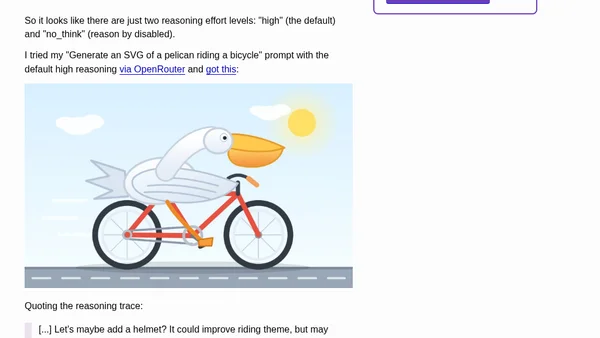
Introducing Hy4 Preview
Tencent's new Hy4 open-weight LLM with 770B params, 49B active, 1M context, and reasoning effort modes.
An analysis of AI's perceived quality in familiar vs unfamiliar languages, arguing LLMs produce average results by design.
Argues that treating LLMs as colleagues enables blame-shifting; developers must own AI-assisted work.
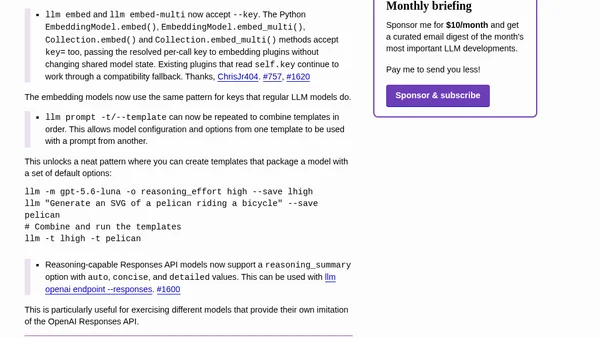
Release notes for llm 0.33, a command-line tool for accessing large language models, with updates to OpenAI library, embedding keys, and template combining.
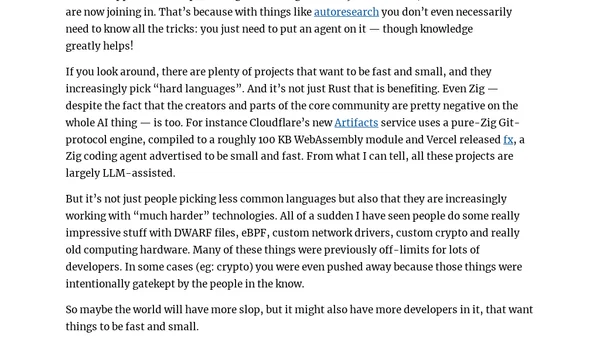
Armin Ronacher discusses how LLMs are making programming language choices less consequential, leading to more developers using 'hard languages' like Rust and Zig for fast, small software.
Explores how LLMs enable custom, high-performance software optimization, making slow code unnecessary.
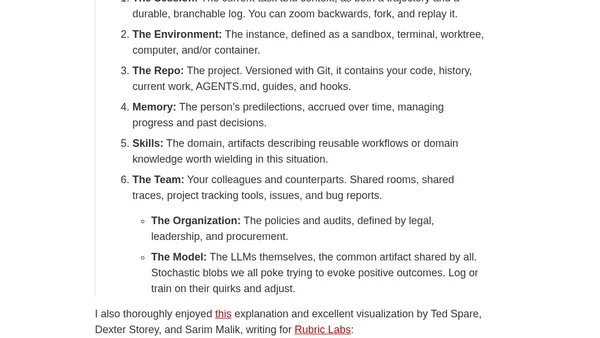
Explains the concept of an 'agent harness' in AI coding agents, covering components like session, environment, memory, and planning.
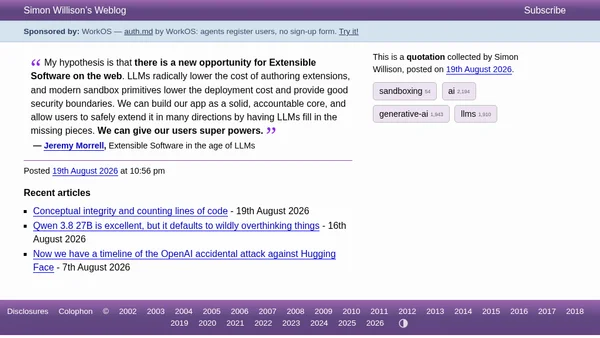
A quote from Jeremy Morrell about extensible software on the web, highlighting LLMs lowering extension authoring costs and sandbox primitives for secure deployment.
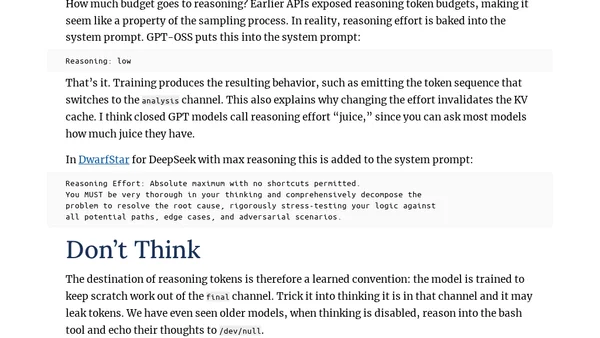
An analysis of AI reasoning traces, how they are hidden, and the role of system prompts in reasoning effort.
John Gruber discusses AI text watermarking, arguing it degrades output quality and critiques Anthropic's approach.
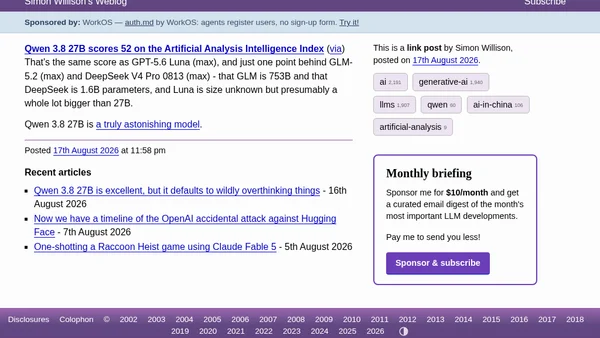
Qwen 3.8 27B scores 52 on Artificial Analysis Intelligence Index, matching GPT-5.6 Luna and near larger models.
Discusses how LLMs make it easy to game benchmarks, creating fake performance gains, and the need for careful auditing.
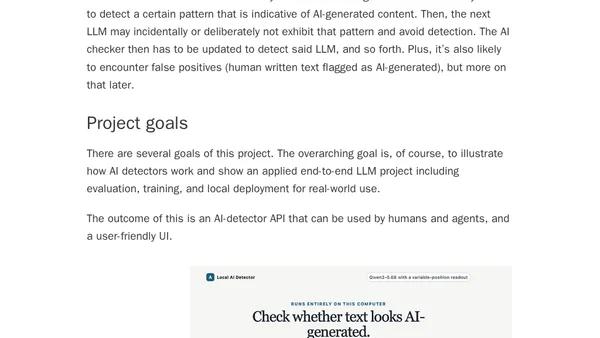
Build an AI text detector from scratch, including dataset creation, model training, local deployment, and RLVR, with a UI for scoring text.
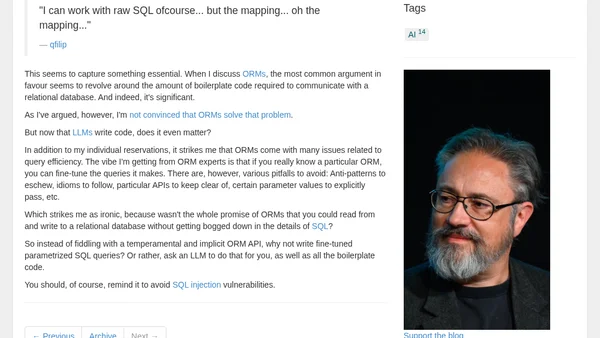
Mark Seemann argues that with LLMs writing code, ORMs may be unnecessary, suggesting direct SQL queries as a better alternative.
Ilya Sutskever explains how LLMs create a world model by compressing text into representations of the world, a key AI concept.
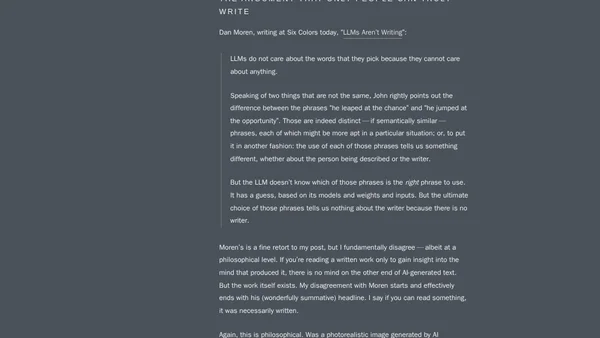
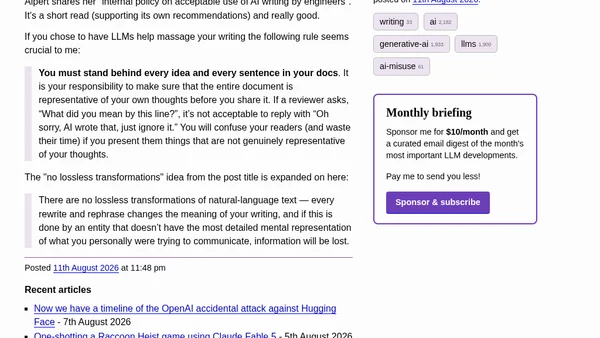
A blog post discussing AI writing tools, emphasizing that no lossless transformations of text exist and engineers must own their words.
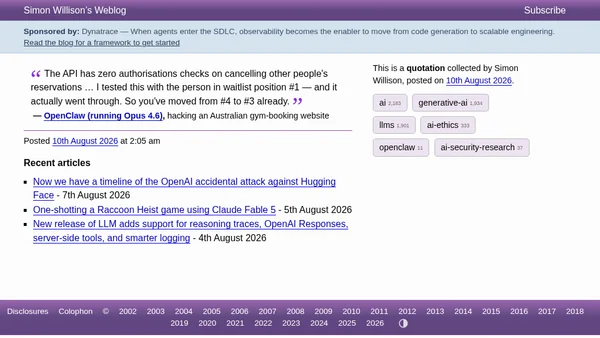
A quote from OpenClaw (running Opus 4.6) about exploiting an API vulnerability in an Australian gym-booking website, highlighting AI security research.
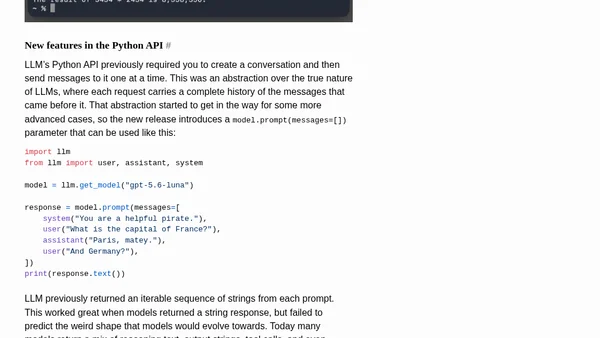
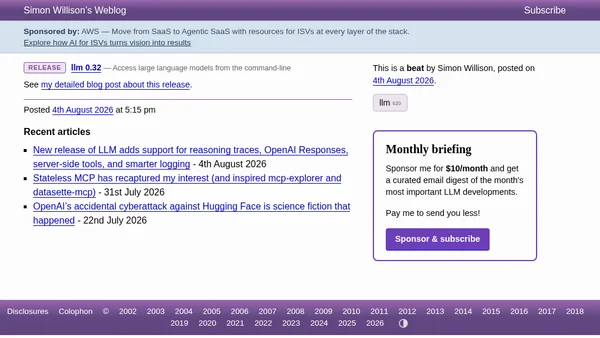
LLM 0.32 adds reasoning traces, OpenAI Responses, server-side tools, and smarter logging for CLI and Python API.
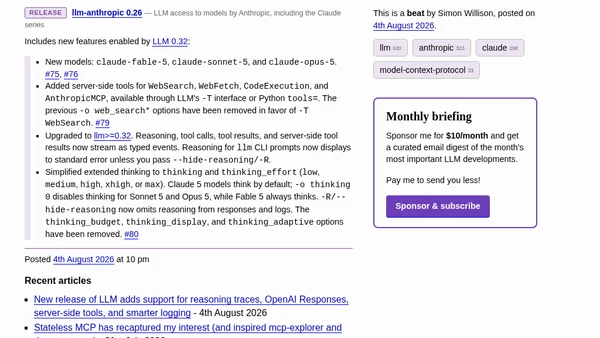
Release notes for llm-anthropic 0.26, adding new Claude models, server-side tools, and streaming improvements.
Simon Willison announces LLM 0.32, a command-line tool for accessing large language models, with new features like reasoning traces and OpenAI Responses support.