From coder to curator
A developer reflects on AI coding tools shifting their role from coder to curator, exploring the future of software engineering.
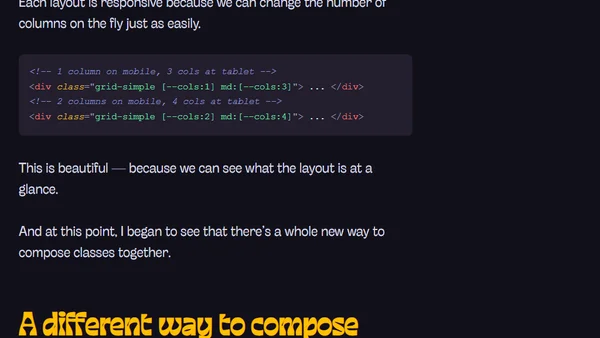
Using Tailwind CSS to build responsive layouts without writing custom CSS, leveraging breakpoint variants and CSS variables.
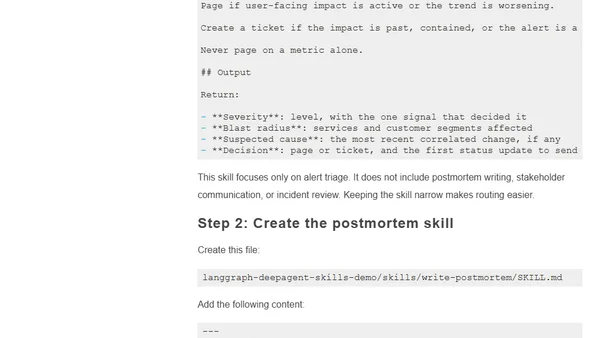
Tutorial on using Skills with LangGraph Deep Agents for modular, on-demand agent workflows.
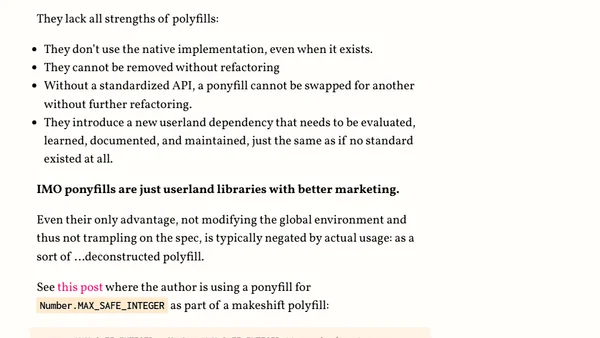
A defense of polyfills in web development, arguing they are a net positive despite concerns from standards editors about design flexibility.
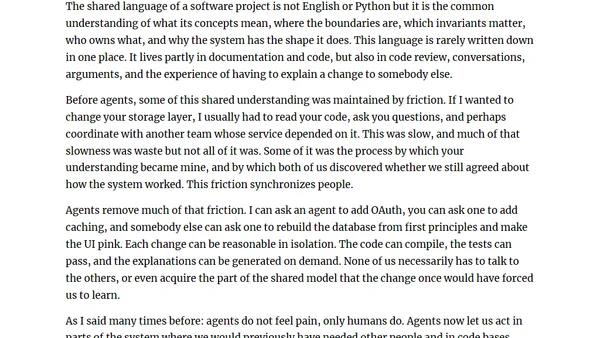
Explores how AI-assisted programming affects coordination in large software projects, using the Tower of Babel as a metaphor.
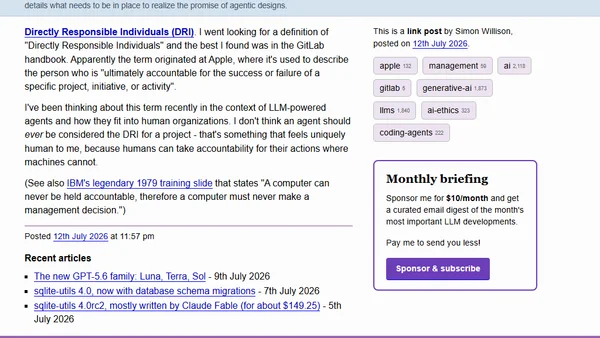
Explores the concept of Directly Responsible Individuals (DRI) and argues that AI agents should not be DRIs due to lack of accountability.
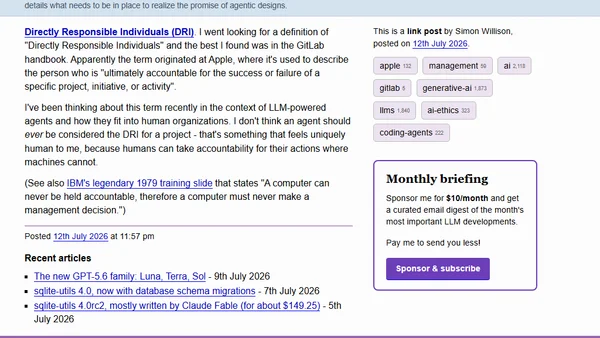
Explores the concept of Directly Responsible Individuals (DRI) and argues that LLM-powered agents should not serve as DRIs due to lack of accountability.
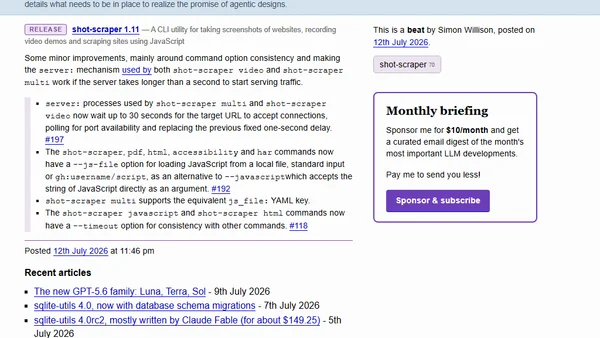
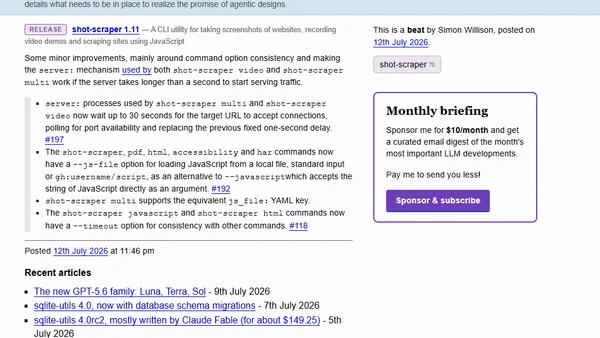
Release notes for shot-scraper 1.11, a CLI tool for website screenshots, video demos, and JavaScript scraping with minor improvements.
Release notes for shot-scraper 1.11, a CLI tool for website screenshots, video demos, and scraping with JavaScript improvements.
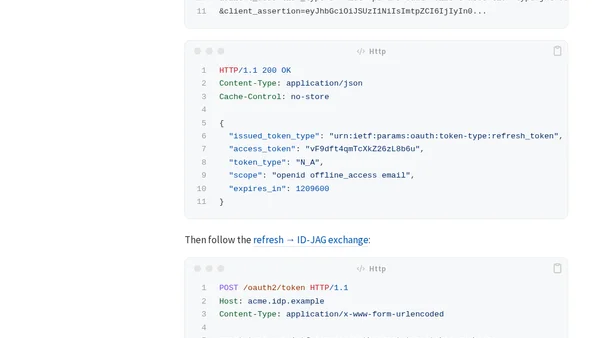
Explains how to use Okta SAML and Keycloak for ID-JAG Cross App Access, bridging enterprise identity with scoped OAuth tokens.
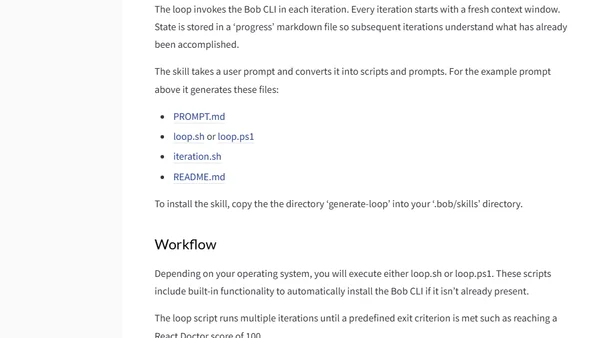
Guide to using IBM Bob's CLI for automated multi-iteration code improvement loops, with a React Doctor example.
Explores active analytics loops for AI agents that proactively monitor, investigate, and act on data anomalies beyond passive chat.
Explores Apache Polaris, an open source Iceberg REST catalog enabling multi-engine interoperability for open lakehouse architectures.
Explores the gap between AI agent demos and production-ready enterprise systems, focusing on data and knowledge challenges.
Explores Dremio's automated materialized views and reflections for optimizing AI-era lakehouse workloads beyond static cron-based maintenance.
Analysis of Dremio's Lakehouse AI report on shifting enterprise priorities from cost migration to agent-ready data platforms.
Explores how open standards like Iceberg and REST catalogs prevent data silos for AI agents in lakehouse architectures.
Explains a five-layer architecture for safe agentic analytics, preventing agents from directly querying raw storage.
Explores how GSA MCP servers make federal open data AI-ready, bridging the gap between public datasets and agent-friendly interfaces.
Designing a hybrid lakehouse for regulated markets where data cannot move due to residency or sovereignty laws.