Join us to discuss transparency and governance at FOSDEM '25
A call to discuss transparency and governance issues at FOSDEM '25 following the cancellation of a controversial sponsored keynote talk.
A developer reflects on career transition struggles, exploring tech stacks like Rust and Elixir, and the challenge of focusing on a single path to build products.
A reflection on the concept of 'theoretical software engineers' and the tension between ideal best practices and pragmatic, real-world development.
A guide to common mistakes developers make when building applications with generative AI, including overuse and poor UX integration.
Argues that politeness markers like 'please' weaken technical documentation and should be replaced with direct, actionable instructions.
An analysis of three common reasons why funding models for open source software projects often fail, based on the author's long-term experience.
Explains why developers should split unrelated changes into separate pull requests for faster reviews, cleaner Git history, and better automation.
A senior developer shares eight key lessons on writing clean code, conducting effective reviews, and professional best practices from decades of experience.
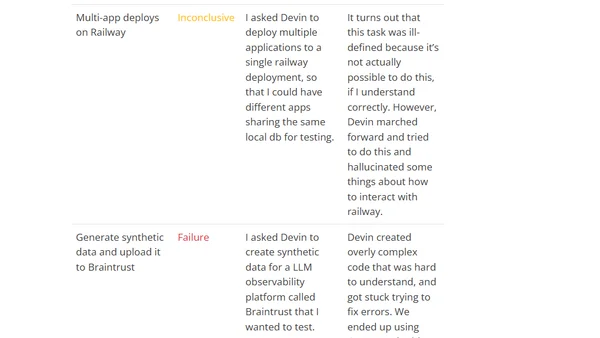
A real-world evaluation of Devin, an AI software engineer, testing its capabilities on practical development tasks after its high-profile launch.
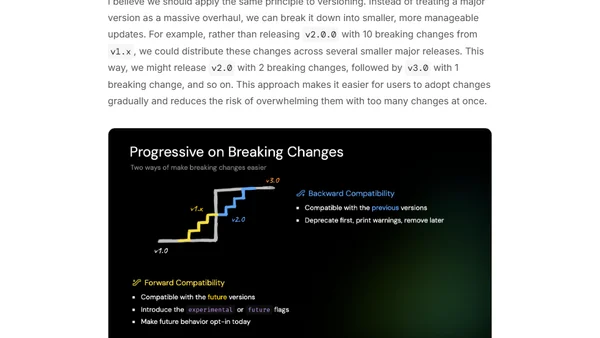
Explores the meaning of zero-major versioning in software, challenges assumptions about production readiness, and discusses Semantic Versioning (SemVer) as a communication contract.
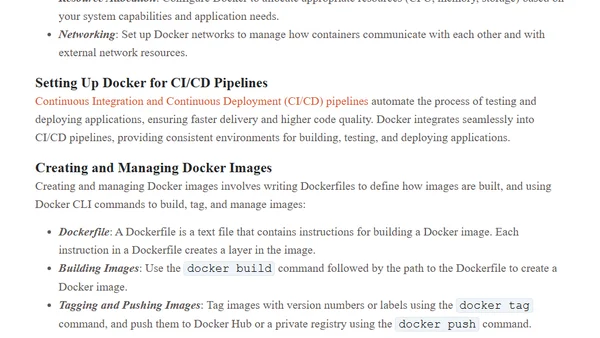
An introduction to containerization technology, covering Docker basics, benefits, and Kubernetes orchestration for modern software development.
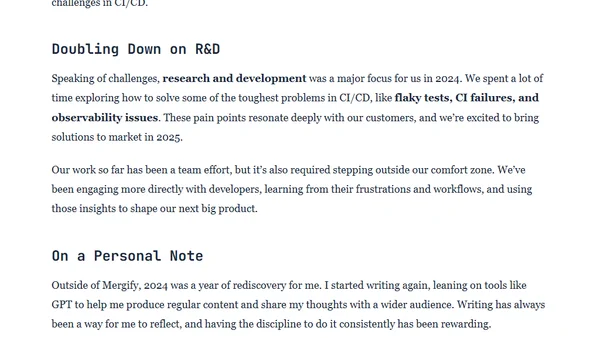
The founder of Mergify reflects on 2024, discussing the company's shift from tech-driven to product-focused, market challenges, and new product development.
An open source maintainer discusses the importance of open source software, its widespread use, and challenges like the Log4Shell vulnerability and the left-pad incident.
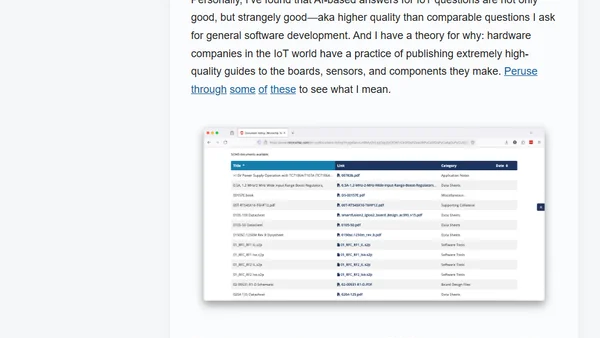
AI is making IoT development more accessible by helping developers navigate fragmented hardware and software ecosystems with high-quality, context-aware assistance.
Mitchell Hashimoto reflects on the personal journey and philosophy behind releasing Ghostty, a new terminal emulator, after reaching version 1.0.
A review of Brian's book 'Approachable Open Source', highlighting its advice on contributing to open source beyond just writing code.
A critique of semantic versioning in observability marketing, arguing that terms like 'Observability 2.0' describe a real technical shift despite overuse.
A critique of Paul Graham's 'founder mode' concept, analyzing leadership advice and the mythmaking around tech founders.
A guide on transitioning into AI careers, distinguishing between working 'on' AI models and 'in' AI infrastructure, products, and engineering processes.
Explains the new Experimental attribute in C# 12, which allows developers to mark library features as experimental and generate compile-time warnings.