Scientific Computing in Python: Introduction to NumPy and Matplotlib
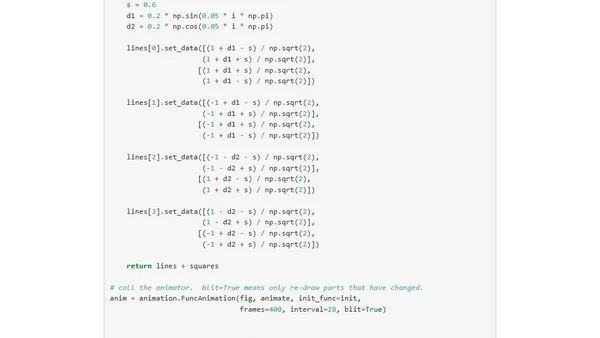
An introduction to scientific computing in Python using NumPy for numerical arrays and Matplotlib for data visualization.
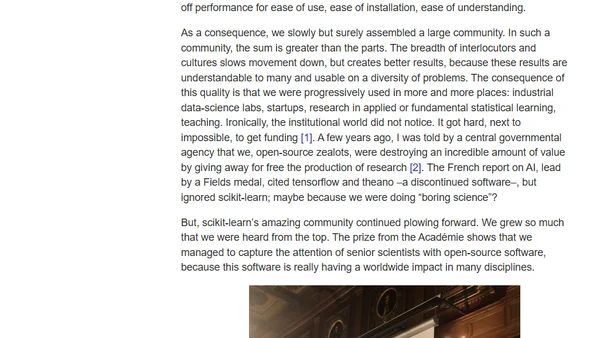
Authors of scikit-learn receive a major scientific prize, highlighting a cultural shift towards recognizing open-source software as valuable academic contribution.
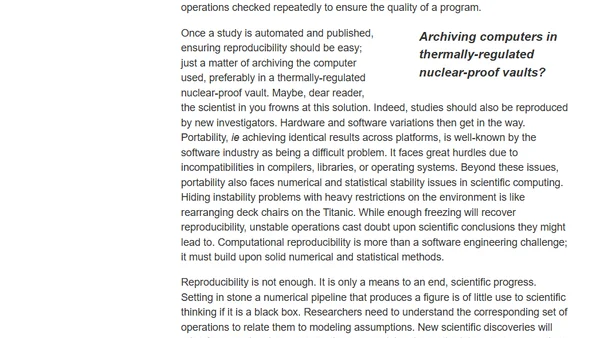
Argues that scientific progress requires reusable software libraries, not just reproducible results, and discusses challenges in computational research.
Argues that Python is the best programming language for scientists to learn, highlighting its community, learning resources, and scientific packages.
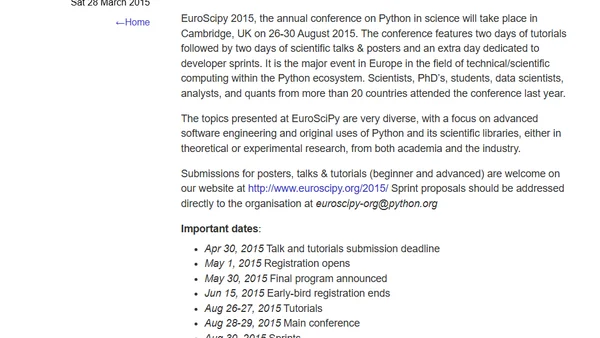
Announcing EuroSciPy 2015, the European conference on Python for scientific computing, with calls for papers, talks, and tutorials.
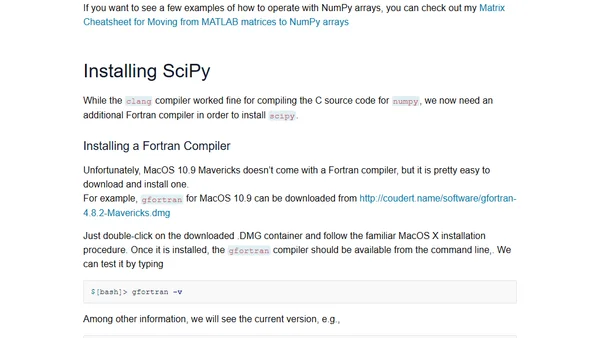
A guide to installing Python scientific libraries (NumPy, SciPy, matplotlib) on macOS 10.9, covering both Anaconda/Miniconda and manual pip installation methods.
A tribute to John Hunter, creator of the matplotlib Python library, reflecting on his impact on scientific computing and open source.
A developer discusses the challenges of open-source maintenance and urges users to contribute code instead of demanding features.
The article discusses the growing inclusion of Python tracks at scientific conferences, focusing on computational science and high-performance computing.
A personal recap of the Scipy 2011 conference, highlighting keynotes on scientific software, data mining with Python, and trends in statistics and parallel computing.
Announcing early bird registration deadline for EuroSciPy 2011, a conference on scientific computing with Python, featuring tutorials and talks.
EuroScipy conference in Paris announces program details, keynote speakers, and a new poster session. Submission deadline is May 8th.
A guide to Christoph Gohlke's repository of pre-compiled Windows binaries for scientific Python packages like NumPy, SciPy, and scikit-learn.
A recap of EuroSciPy 2010, highlighting the growth of the Python in science conference, key topics, and the community atmosphere.
Argues for better scientific computing tools, emphasizing readability, reproducibility, and open-source libraries as crucial for research.
EuroScipy 2010 extends abstract submission deadline for its Python scientific computing conference in Paris.
Registration is now open for EuroScipy, a conference on scientific computing with Python, featuring tutorials, talks, and a potential journal publication.
Explains two methods in Mayavi to visualize a surface colored by a separate scalar value, not just elevation.
A review of the book 'Matplotlib for Python Developers', covering its content, target audience, and usefulness for scientific plotting.
Announcement of new Mayavi releases (3.3.0 & 3.3.1) detailing new features, bug fixes, and contributor acknowledgments.