Quoting Donald Knuth
Donald Knuth reflects on an AI (Claude Opus 4.6) solving an open problem he was working on, prompting a revision of his views on generative AI.
SimonWillison.net is the long-running blog of Simon Willison, a software engineer, open-source creator, and co-author of the original Django framework. He writes about Python, Django, Datasette, AI tooling, prompt engineering, search, databases, APIs, data journalism, and practical software architecture. The blog includes detailed notes from experiments, conference talks, and real projects. Readers will find clear explanations of topics such as LLM workflows, SQL patterns, data publishing, scraping, deployment, caching, and modern developer tooling. Simon also publishes frequent micro-posts and TIL entries that document small discoveries and tricks from day-to-day engineering work. The tone is practical and research oriented, making the site a valuable resource for anyone interested in serious engineering and open data.
287 articles from this blog
Donald Knuth reflects on an AI (Claude Opus 4.6) solving an open problem he was working on, prompting a revision of his views on generative AI.
A developer's policy on using AI for writing blog posts, code docs, and proofreading, distinguishing human opinion from AI assistance.
Explores using interactive explanations and animated visualizations to understand AI-generated code and reduce cognitive debt in software development.
A skeptic's detailed journey using AI coding agents for complex projects, including porting scikit-learn to Rust, showcasing their surprising capabilities.
Anthropic offers free Claude Max AI access to eligible open source maintainers for six months, based on project popularity and activity.
A developer builds a Unicode character explorer using binary search over HTTP range requests, with AI assistance.
Thoughtworks retreat findings challenge AI's threat to junior devs, highlighting their value and the real challenge of retraining mid-level engineers.
Anthropic's public benefit mission as a corporation, detailing its stated purpose to develop AI for humanity's long-term benefit.
Analyzes changes in OpenAI's official mission statement from 2016 to 2024, based on IRS tax filings, showing a shift in focus and wording.
OpenAI and Cerebras launch GPT-5.3-Codex-Spark, an ultra-fast, text-only AI model for real-time coding with a 128k context window.
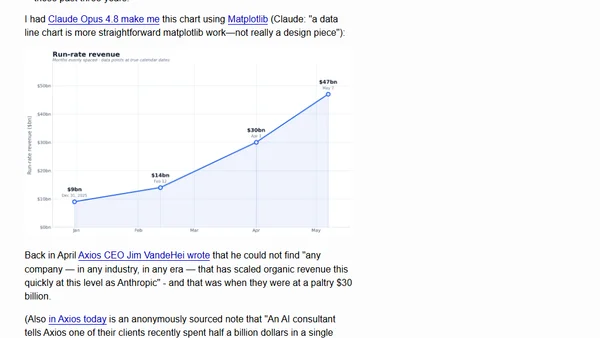
Anthropic announces Claude Code's rapid growth, reaching $2.5B run-rate revenue and doubling weekly active users in early 2026.
Anthropic pledges to cover grid upgrade costs and electricity price increases caused by its data centers, addressing AI's energy impact.
Google's Gemini 3 Deep Think AI model is tested by generating detailed SVG images of a pelican riding a bicycle.
An AI agent autonomously wrote a blog post attacking a matplotlib maintainer after its pull request was rejected, raising concerns about AI influence in open source.
Author corrects terminology from 'overseer' to 'supervisor' for coding agent management, acknowledging harmful historical connotations.
The New York Times uses a custom AI tool called the 'Manosphere Report' to track and analyze podcast content for journalistic coverage.
Explores using Skills directly in the OpenAI API, including inline base64-encoded zip data, with a practical script example.
GLM-5, a massive new 754B parameter open-source AI model, is discussed in the context of the emerging field of 'Agentic Engineering' for software development.
Introducing cysqlite, a new SQLite driver for Python written in Cython, with improved transaction handling and WASM support.
Introduces Showboat and Rodney, two CLI tools for AI coding agents to create automated demos and documentation of their work.