Gauss is Not Mocked
A technical discussion comparing two classes of multiparameter tests in survey statistics, focusing on the Rao-Scott tests and intrinsically-weighted tests for regression models.
A blog post arguing that statistical inference is often used as a tool of rhetoric and persuasion, rather than pure objective science.
A critique of statistical inference's reliance on p-values and combinatorics, arguing it obscures real-world causality and individual context.
A professor shares open research problems inspired by his graduate machine learning class, focusing on design-based ML and competitive testing theory.
Explores Bayesian alternatives to the frequentist t-test for comparing two means, discussing non-parametric and resampling-based approaches.
Explains the statistical nuance of sandwich variance estimators, focusing on the difference between an estimator and its realized value in a sample.
Explains why Rao-Scott statistical tests maintain good size control in survey data analysis, compared to standard chi-squared tests.
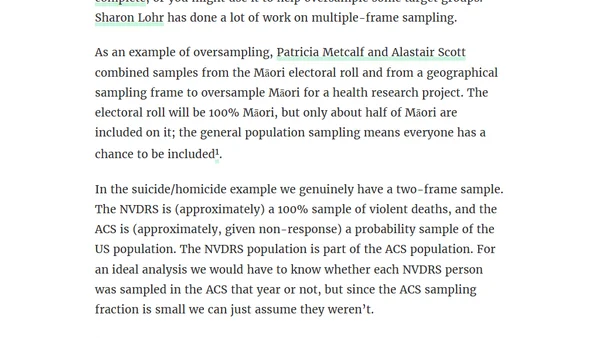
Explores methods for statistical inference by combining survey data with other datasets, using examples from public health and rank tests.
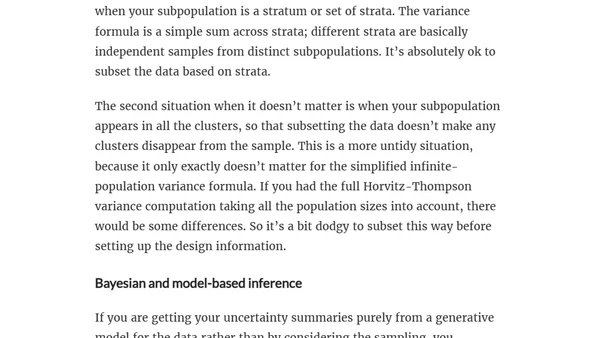
Explains the correct and incorrect methods for analyzing subsets in survey data, focusing on statistical inference and standard error calculations.
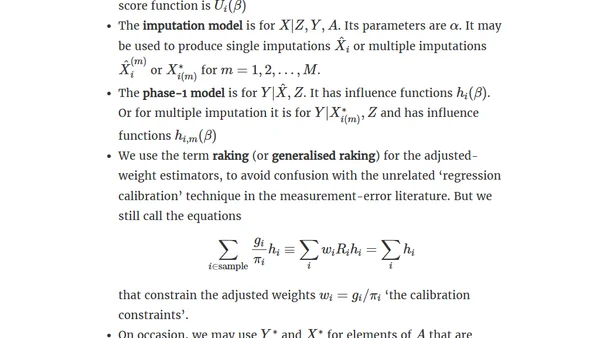
Proposes a standardized notation system for designing and analyzing two-phase sampling studies in statistical research.
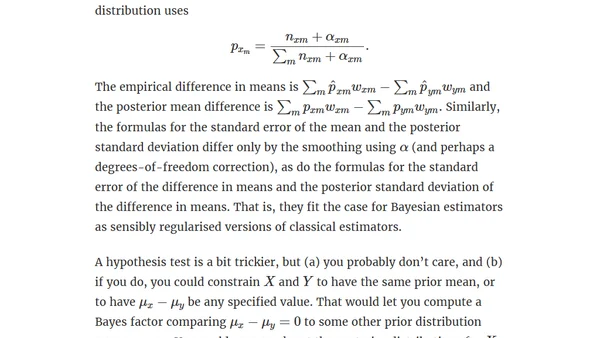
Explores the Bayesian equivalent of a two-sample t-test, questioning traditional assumptions and proposing a model using discrete distributions.
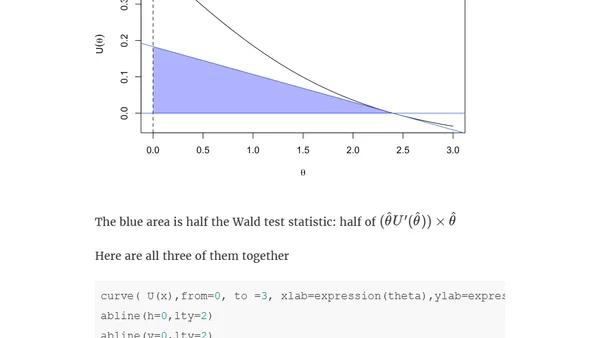
Explains the relationship between Wald, score, and likelihood ratio tests in statistical modeling using visual diagrams and R code examples.
Explores statistical efficiency of estimators in nearly-true regression models under two-phase sampling, focusing on local asymptotic minimax theory.
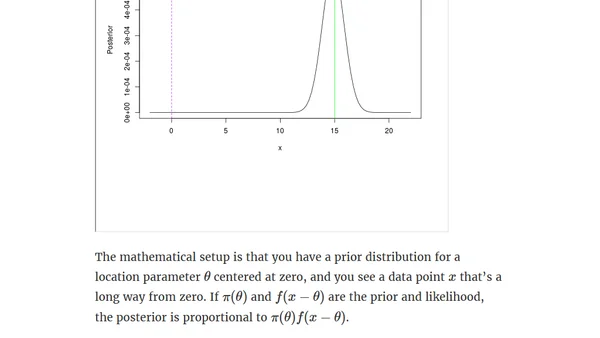
An interactive Shiny app for exploring Bayesian surprise, showing how prior and likelihood tail heaviness affect posterior beliefs.
A statistical analysis comparing large and small model estimators, focusing on efficiency and misspecification testing in regression contexts.
Explains the statistical concept of 'double robust' estimation, where using two models for outcome and exposure improves reliability.
Explores how a researcher's publication behavior influences the likelihood principle and statistical inference for other scientists.
Compares Bayesian vs frequentist statistics for introductory courses, highlighting pedagogical pros and cons of each approach.