Open Source .NET – 3 years later
A retrospective analysis of the .NET framework's open-source journey after 3 years, examining community contributions, key milestones, and project activity.
A blog post celebrating C# history, popularity, and Microsoft's modern learning resources like in-browser tutorials and documentation.
An introduction to ReactiveUI, a .NET library for building WPF apps using reactive and functional programming principles.
A conference talk summary exploring Microsoft's open-source journey, community contributions to .NET Core, and how developers can get involved.
Introducing JustEat.HttpClientInterception, a .NET library for reliable testing of HTTP API integrations by intercepting calls.
The developer of the M2Mqtt library announces a community-driven future for the GnatMQ MQTT broker, moving it to an open-source organization.
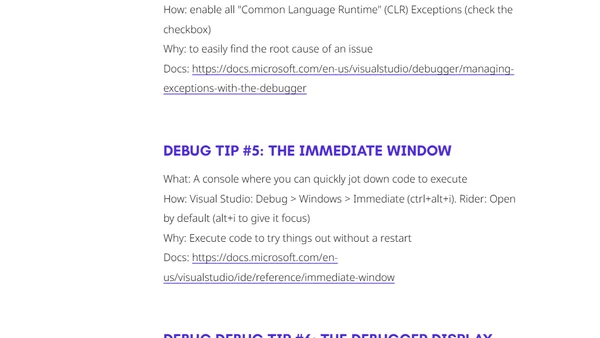
How to use Visual Studio's debugger to step into and debug .NET library code while running it from a LINQPad script.
Introducing the Disassembly Diagnoser for BenchmarkDotNet, a tool to disassemble .NET code to ASM, IL, and C# for performance analysis.
A developer discusses the challenge of keeping up with rapid tech changes and shares a curated list of RSS feeds for staying current.
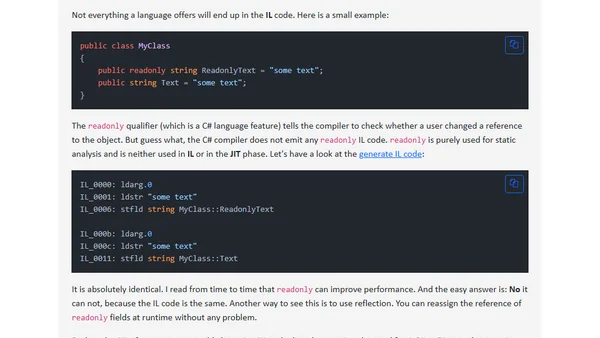
Explains how boxing works internally in the .NET CLR, covering type creation, IL code, and JIT compilation.
Explains how to properly retrieve the current culture in UWP apps using a non-hacky method based on .NET Core Runtime internals.
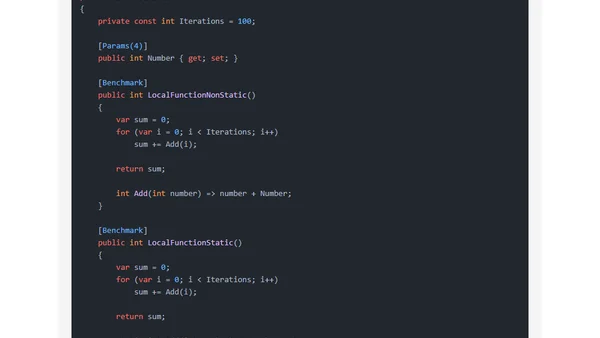
A technical overview of new features in C# 7, including pattern matching, tuples, out variables, and local functions.
Announcing FakeItEasy 3.0.0, a .NET mocking framework update with .NET Core support, new syntax, and improved features.
Explains how .NET delegates work internally, including their CLR implementation, IL representation, and runtime behavior.
A technical analysis comparing pause times in .NET's Workstation and Server Garbage Collection modes using a standardized benchmark.
A technical guide on using Microsoft's ClrMD library to inspect and analyze the .NET managed heap, including memory structures and debugging techniques.
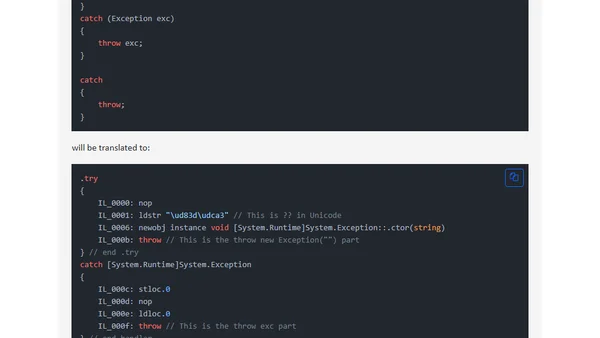
Explains why exceptions in .NET should be rare, comparing them to asteroid strikes, and analyzes their performance costs versus error codes.
Explores why reflection in .NET is slow, examining CLR design goals, internal data structures, and the multi-step invocation process.
Explores academic research papers referenced in the .NET runtime and compiler source code, focusing on data structures and optimization algorithms.
Analyzes community and Microsoft contributions to open source .NET repositories over two years, showing trends in issues and pull requests.