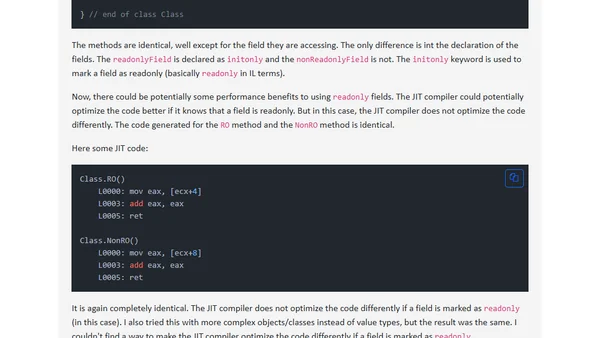
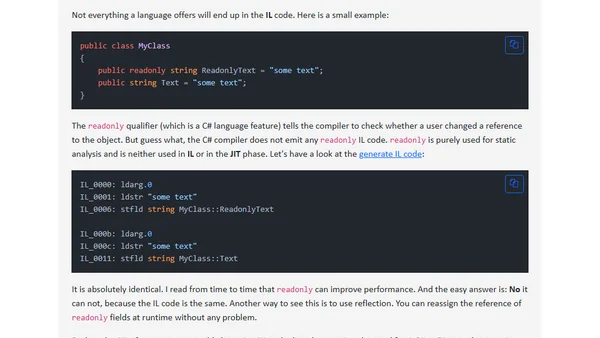
Does readonly make your code faster?
Analyzes whether using the 'readonly' modifier in C# leads to performance improvements by examining generated IL and JIT code.
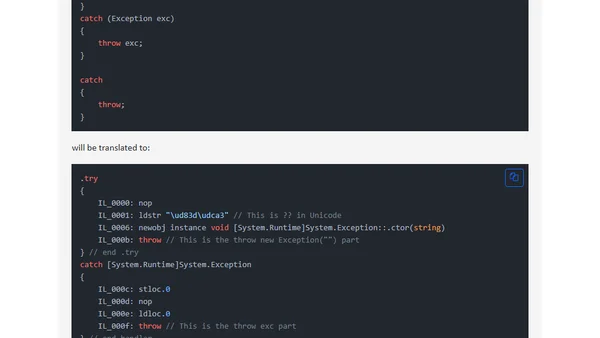
Explains the difference between 'throw;' and 'throw exc;' in C#, focusing on how the latter truncates the stack trace.
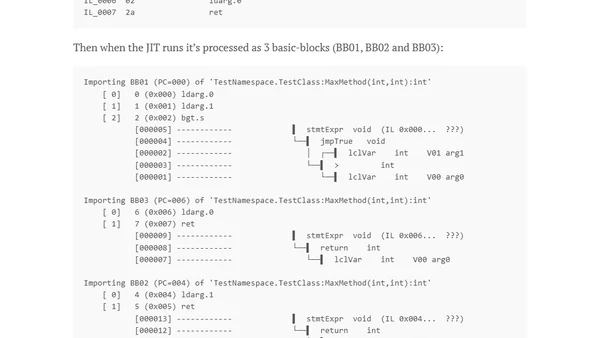
Explains the differences between C#, .NET, IL, and the JIT compiler, detailing their roles in the .NET development stack.
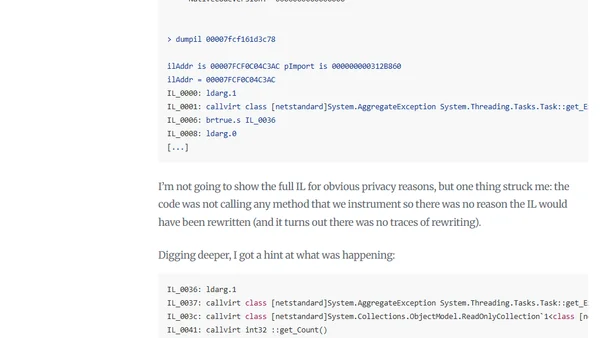
Debugging an InvalidProgramException in a profiler by finding generated IL code in a memory dump (part 2 of a series).
A deep dive into debugging a rare .NET InvalidProgramException caused by faulty IL generation in Datadog's automated instrumentation.
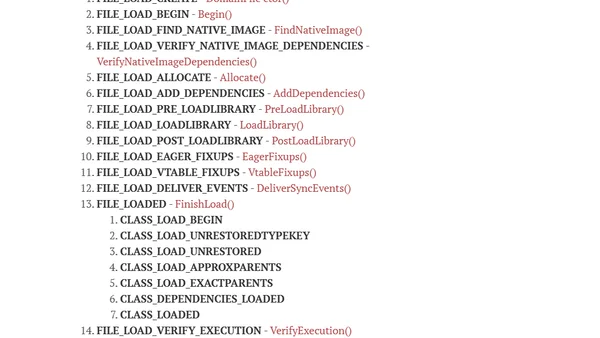
Explains the detailed, step-by-step process the .NET Runtime (CLR) uses to safely load and validate types, ensuring type safety.
A technical guide on adding a custom bytecode instruction (IL opcode) to the .NET CoreCLR runtime, including steps for the runtime, JIT, and Reflection.Emit.
Explains how .NET delegates work internally, including their CLR implementation, IL representation, and runtime behavior.