AI Feedback Governance: Control What Becomes Learning
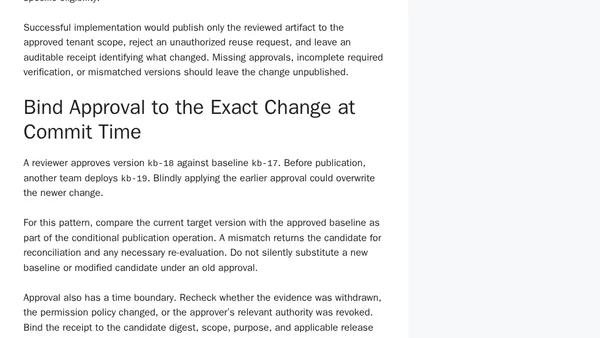
AI feedback governance: control which observations become persistent changes, where they apply, and who can authorize them.

Build an offline Python grader for AI agents that separates control, behavior, and outcomes—not just explanations.
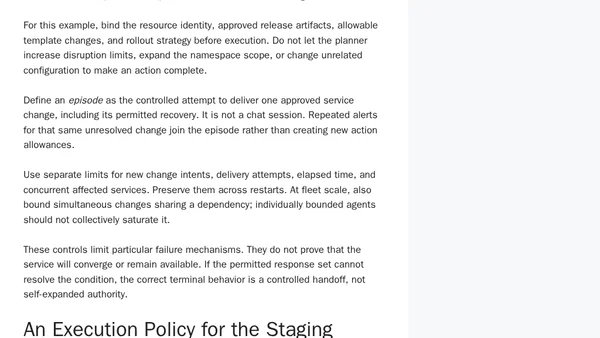
Designing stable AI agents: separate retries, reconciliation, and recovery to control interventions, not just model retries.
AI agent verification: prove runtime outcomes, not just tool call success. Separate acceptance, config, convergence, and service results.
Armin Ronacher's critical take on AI 'doom' narratives and the push to pace frontier AI development.
Podcast deep dive into Microsoft Agent Framework with Daniel Costea, hosted by Jesse Liberty.
Explains Azure/Microsoft Entra ID tenants: identity boundaries, uses, differences from subscriptions, and best practices.
Dew Drop roundup: TechBash registration, Visual Studio tips, WinUI 3, AI agents, .NET, Windows dev news, and more.
A technical overview of new migration features in EF Core 11.0, but the page content is blocked by a CAPTCHA.
How to test AI generalization in incident triage: controlled variations, scoring rubrics, and avoiding shortcut learning and data leakage.
Explore VMware Cloud Foundation 9.1 as a governed platform engine for building and managing private cloud environments.
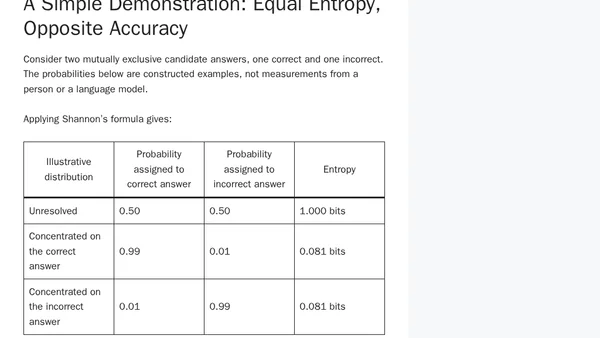
Explores entropy in AI and human thinking, clarifying why certainty and predictability don't guarantee accuracy.
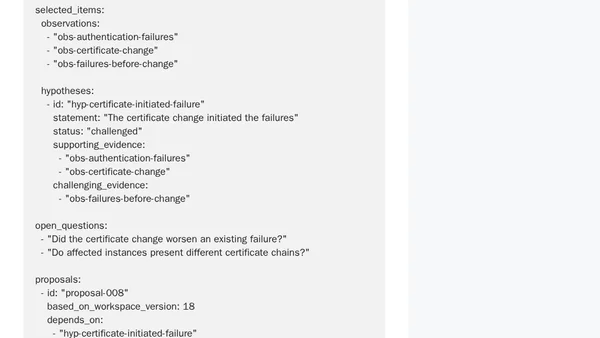
Designing a shared workspace for AI agents: bounded, versioned task state, controlled interfaces, and atomic updates to coordinate evidence and proposals.
AI reward design: define business outcomes, not easy metrics. Separate permissions, verification, escalation, and efficiency to avoid gaming.
Enterprise RAG citation controls: separate citation existence from evidence quality, applicability, and disclosure permission.
How to enforce RAG retrieval permissions based on the user, not service accounts, to prevent unauthorized access.
Enterprise RAG security as a data boundary: source admission, processing controls, derived data governance, and lifecycle management for AI pipelines.
How to assess management-plane failures in hybrid infrastructure: what keeps running, what stops, and how to recover without vCenter, Azure, identity, or WAN.
Identity disaster recovery: restoring Active Directory, Entra, certificates, and privileged access before workloads return.
Treating Kubernetes as a platform product: SLOs, upgrade gates, capacity planning, and recovery for dependable services.