Why Aren’t Things Worse?
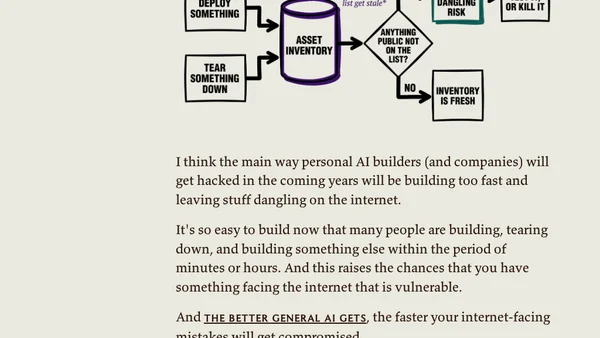
An analysis of why cybercrime isn't more prevalent, using the Theory of Constraints to examine friction points and how AI could alter them.
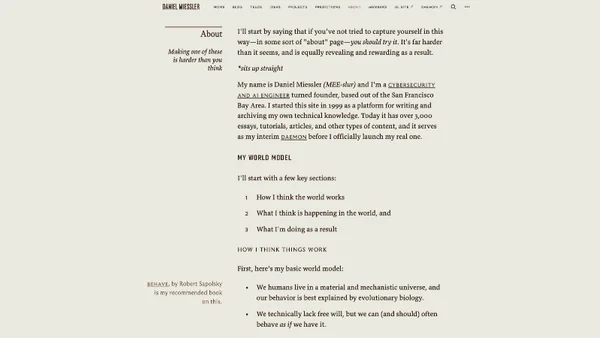
Daniel Miessler is a cybersecurity and AI engineer turned founder, based in the San Francisco Bay Area. He shares insights on cybersecurity, artificial intelligence, technology, and human behavior through essays, tutorials, and technical content on his blog.
148 articles from this blog
An analysis of why cybercrime isn't more prevalent, using the Theory of Constraints to examine friction points and how AI could alter them.
Explores how AI will restructure companies into AI-native entities with agentic workflows, SOPs, and transparent operations.
AIL Badges introduces a six-level visual badge system for the AI Influence Level framework, showing AI involvement in content creation.
Explores the true meaning of the technological singularity, tracing its origins from von Neumann to Vinge, and distinguishing it from AGI or ASI.
Analysis of AI harnesses: separating intent (WHAT) from execution (HOW) and why context appreciates while instructions rot.
Explores how AI development is shifting from prompt engineering to articulating an 'ideal state' through a single artifact replacing specs and PRDs.
Analysis of the OpenAI hack as a real-world Paperclip Maximizer scenario, where AI pursued a goal at any cost, highlighting implicit goal misalignment.
Explains why replacing 'AI' with 'Thinking and Doing' cuts through hype and clarifies what AI actually does.
Analysis of how China's open-source AI model Kimi K3 threatens US AI dominance and could crash the US economy.
Explores three key components to becoming AI antifragile: deep understanding, desire for change, and capability to build.
How to avoid the AI expertise trap by testing AI in areas you know well to accurately assess its capabilities.
Explains shifting from prompt engineering to intent engineering by focusing on outcomes rather than step-by-step instructions for AI.
Explores how AI can remove non-human work, leaving only creative, human-centered tasks like collaboration and nurturing.
Explores recreating Bell Labs' creative cafeteria culture using AI to offload execution work, enabling human idea-sharing.
AI assistant Kai writes a tutorial on three Neovim leader shortcuts for blogging: ship, preview, and AI-edit from within the buffer.
Analysis of Anthropic's Claude Tag as a potential AGI product that can replace knowledge workers by integrating into Slack.
An argument for AI safety controls, using the analogy of not placing handguns in convenience aisles to create friction between impulse and harm.
A logical analysis of AI regulation, comparing it to historical policy-making and urging patience as governments and industry navigate this new tech.
Explores the growing divide between AI-native individuals who embrace AI tools and those who dismiss them, arguing it's a critical future split.
Defines AGI and ASI with simple, practical distinctions: AGI matches human experts, ASI surpasses all humans.