Re: Version 1 is for you
A response to Jason Fried's article advocating for 'Maximally Proud Version 1s' (MPV1s) over traditional MVPs in software product development.
October 2024 updates for Azure OpenAI, including Data Zone Standard deployment, Global Batch API, and a real-time audio API.
A quick tip on using the `.git-blame-ignore-revs` file to exclude specific commits (like formatting changes) from Git blame output.
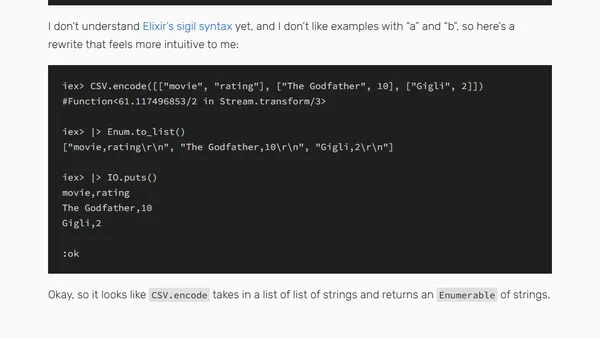
Explores using Python's pattern matching and comprehensions for efficient data cleaning, transformation, and analysis.
A critique of modern bug trackers, proposing a 'separation of concerns' principle to better distinguish factual bug records from planning data.
An experiment by MongoDB to predict customer demand and auto-scale database resources in MongoDB Atlas, aiming to reduce costs and carbon emissions.
A technical tip showing how to use AWK to convert CSV/TSV data into a human-readable markdown or HTML table for documentation.
A guide to building a declarative Copilot agent with actions using Visual Studio Code and the Teams Toolkit extension.
An exploration of ASCII control characters in the terminal, explaining their functions, categories, and limitations.
A technical analysis of the Outbox Pattern for microservices, its implementation, criticisms, and modern alternatives in 2024.
A guide to building a personal 'AppRunner' on a single EC2 instance using Cloudflare Zero Trust for secure, internal app hosting.
A hands-on tutorial for setting up a local data lakehouse with Apache Iceberg, Dremio, and Nessie using Docker in under 10 minutes.
Explains the Tip & Tail release model used by OpenJDK to manage Java library dependencies and releases, helping developers innovate faster.
A technical analysis of the Outbox Pattern for microservices, examining its implementation, criticisms, and modern alternatives in 2024.
A guide to using the Porcupine library to check for linearizability in distributed systems like registers and key-value stores, implemented in Go.
A whimsical exploration of the HTML <body> element, its structure, and its relationship to the <head> element, using analogies to human anatomy.
Explores the proposed CSS syntax for creating masonry layouts, a grid-like design popularized by Pinterest, and the debate around its implementation.
A developer explains why they limit AI use in programming, citing the difficulty of verifying AI-generated code without a proper mental model.
Advocates using explicit mapping objects over complex ternaries for state transitions in TypeScript/React, using a theme toggle as an example.
Robin, a German software engineer, introduces his background, mission to make coding education accessible, and his freelance work.