Best TidyTuesday 2019
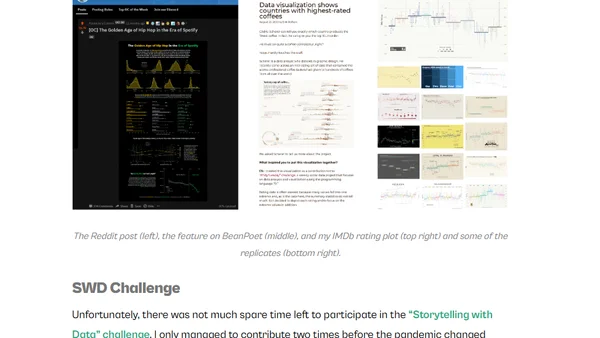
A review of the best #TidyTuesday data visualization submissions from 2019, highlighting creative and insightful uses of R and ggplot2.
A developer's experience and technical learnings from participating in the 30DayMapChallenge, creating maps using R and geospatial tools.
A guide with practical heuristics for converting ggplot2 (R) visualization code to plotnine (Python) code, including syntax and style differences.
A tutorial on using Plotnine, a Python data visualization library based on the grammar of graphics, translated from the ggplot2 R tutorial.
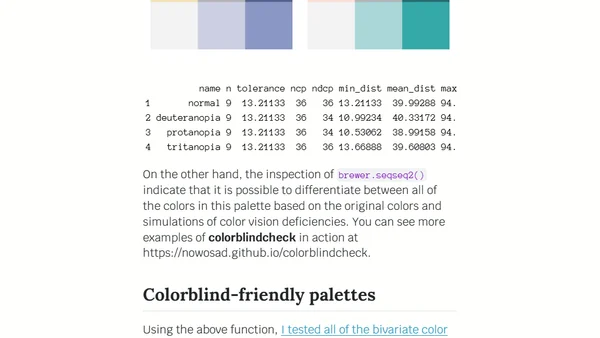
Analysis of R 4.0's new default color palette, testing its accessibility for color vision deficiencies using the colorblindcheck package.
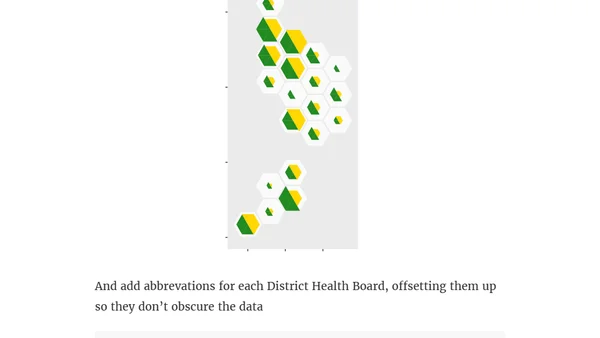
A technical tutorial on creating hexagon maps (hexmaps) for visualizing New Zealand District Health Board data using the R programming language and the DHBins package.
A case study on implementing accessible data visualizations using SVG for the Khan Academy 2018 Annual Report website.
A tutorial on creating animated bar chart races in R using gganimate, applied to visualize historical temperature trends in Berlin.
A comprehensive tutorial on creating beautiful and customizable data visualizations using the ggplot2 package in R, covering syntax, themes, and advanced techniques.
Explains how information theory and R code can quantify and classify spatial patterns, with examples from landscape ecology.
A personal request for help finding a short-term sublet in NYC after a last-minute cancellation.
A guide on how to extract your personal run data from the Nike Run Club app using a bash script and visualize it with Python.
An analysis of user-created Sankey diagrams from Reddit, visualizing personal Tinder match data and dating outcomes.
Analysis of PHP's limitations for machine learning, focusing on visualization, Jupyter support, and GPU capabilities compared to Python.
A technical tutorial on creating animated cartograms in R to visualize global population growth and distribution from 1800 to 2100.
A workshop tutorial on using Pangeo tools and Met Office weather data for business decision-making, like a ferry schedule.
An introduction to graph theory using examples from Facebook, Game of Thrones, and social relationships to explain network concepts.
A tutorial on creating an animated world population cartogram from 1800 to 2100 using R, open data, and open-source geospatial libraries.
Introduces the 'sabre' R package for quantitatively comparing two categorical maps or regionalizations to measure spatial similarity.
A data science tutorial using Leaflet to map Wellington bus locations and lateness, analyzing real-time transit data with R.