HIPAA compliant AI
Explains why running AI locally on your own hardware is the best way to maintain HIPAA compliance, avoiding costly and restrictive cloud options.
John D. Cook provides expert consulting in applied mathematics and data privacy, helping clients from tech, biotech, and legal industries—including Amazon, Google, Microsoft, and Amgen—solve complex problems efficiently.
141 articles from this blog
Explains why running AI locally on your own hardware is the best way to maintain HIPAA compliance, avoiding costly and restrictive cloud options.
Explains how updating an average grade relates to Bayesian statistics and Kalman filtering, using weighted averages and gain.
Explores the hyperbolic analog of Napier's mnemonic for spherical trigonometry, comparing circular and hyperbolic functions.
Comparison of Artemis II mission trajectory with Apollo 8 and Apollo 13, highlighting lunar free-return and orbit details.
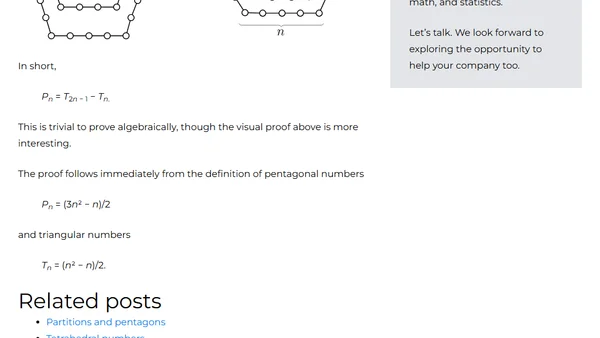
Explores the relationship between pentagonal and triangular numbers through visual and algebraic proofs.
Explores the parallels between Y2K preparation and the need for post-quantum cryptography, warning of financial collapse if unprepared.
Analysis of a Morse code decision tree design that fits compactly into a circle using horizontal and vertical paths.
A critique of an AI shopping assistant's failure to answer a product question, highlighting the superiority of simple keyword search over retrieval-based AI.
Explains embedded regex flags like (?i) and Python version compatibility issues with global modifiers in regular expressions.
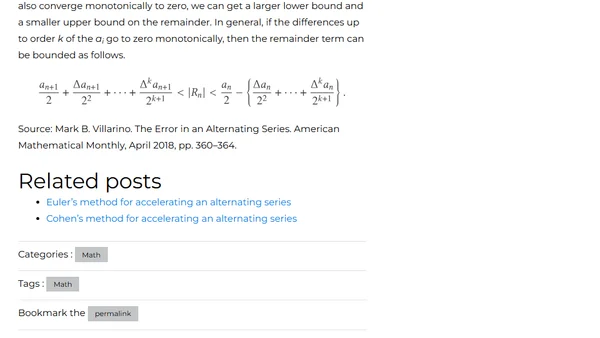
Explores refined mathematical bounds for the remainder term in alternating series, relevant for numerical computing.
Explores Langford's problem: arranging two copies of numbers 1-n so that k numbers separate the two k's, with solutions for n ≡ 0 or 3 mod 4.
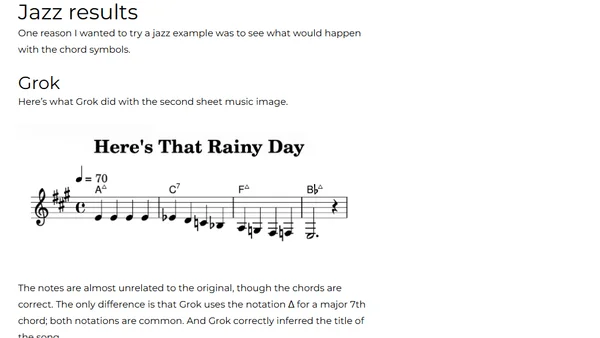
Testing AI's ability to generate Lilypond code from sheet music images, with mixed and often inaccurate results from Grok and ChatGPT.
Explores the simplification of sin(arccos(x)) and its extension to complex numbers, discussing branch cuts and analytic continuation.
Using SymPy to simplify hyperbolic expressions and exploring domain-specific simplification nuances.
Explores why Mathematica doesn't simplify sinh(arccosh(x)) as expected, delving into branch cuts and complex function definitions.
Explains a trigonometric composition table and provides Python code to verify the identities.
Discusses verifying mathematical identities using point-checking, Python, and formal methods, relating to programming and proofs.
Explores the evolution from simple logistic regression to modern AI, comparing model complexity, data requirements, and the surprising effectiveness of large neural networks.
Explores the challenges of getting consistent, reliable answers from AI models like ChatGPT due to prompt sensitivity and hidden variables.
Discusses the reliability challenges and lack of provable correctness guarantees in current AI systems, despite their productivity benefits.