Big News from Project Valhalla - Inside Java Newscast #77
A breakdown of the latest draft proposal for value types (Project Valhalla) in Java, explaining the potential new programming model.
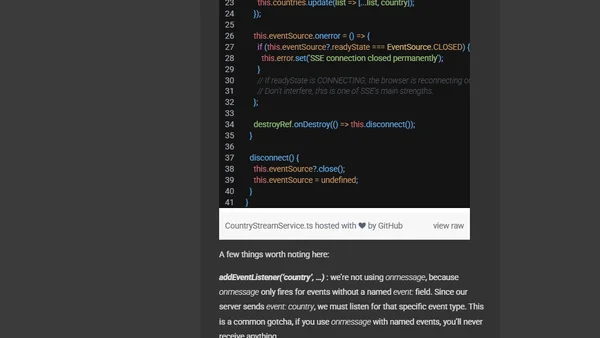
Node.js v22 introduces an experimental flag to run TypeScript files directly without external tools or a build step.
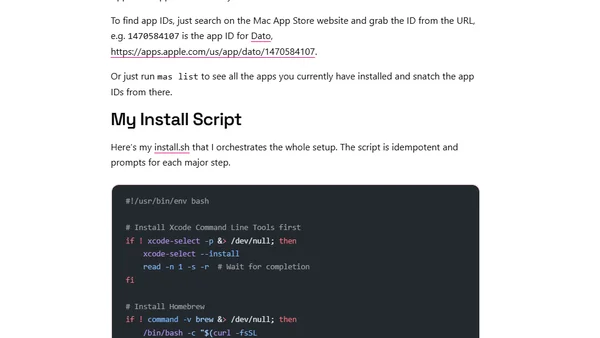
How using XcodeGen to generate Xcode projects eliminated over 58,000 lines of code and simplified managing a multi-project Swift codebase.
A conversation exploring AI understanding through David Deutsch's constructor theory, questioning if AI can truly 'understand' based on task execution.
Explores .NET 9's AlternateLookup and IAlternateEqualityComparer for efficient, low-allocation IP address tracking in dictionaries.
A satirical and dramatic blog post explaining the HTML <bdo> element, which overrides text directionality.
Explains Function as a Service (FaaS), a core serverless technology, covering its characteristics, use with AWS Lambda, and best practices for development.
Explains AWS Lambda and serverless computing, using analogies to describe its event-driven, on-demand nature and benefits.
Compares Rust and Python using a 'build vs. wash' analogy, arguing Rust's upfront effort yields long-term maintenance and performance benefits.
A developer shares their personal story of gaining visibility by consistently sharing knowledge, teaching complex topics, and engaging with the community.
A developer discovers and explores Djot, a stricter, feature-rich alternative to Markdown created by John MacFarlane.
Explores common terminal color contrast issues, explains ANSI color inconsistencies, and discusses two methods to reconfigure terminal colors.
Introducing Dashi, a lightweight Ruby framework inspired by Streamlit for building data and AI applications with minimal code.
A developer shares a detailed guide on how to effectively prepare for, attend, and follow up after a tech conference, based on personal experience.
Explains the concept of a product engineer, contrasting them with traditional software engineers by emphasizing user-centric design and business value.
Mitchell Hashimoto announces a $300,000 personal pledge to support the Zig programming language and its software foundation.
Analysis of Mozilla's public AI paper, highlighting the benefits of small, open-source language models for efficiency, privacy, and global access.
A defense of Web Components, explaining their differences from JavaScript frameworks and why their long-term, standards-based approach is valuable.
Explores the philosophical argument that AI, particularly LLMs, possess a form of understanding and model reality, challenging the notion they are mere token predictors.
A developer's weeknotes covering JavaScript work, attending a Frontend Masters web performance workshop, reading tech news, and personal updates.