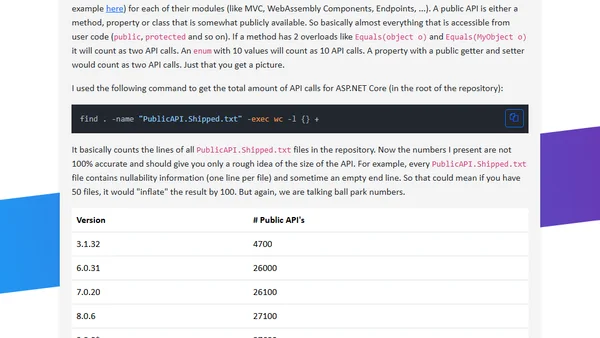
Looking back on 15 years of EqualsVerifier
A retrospective on the 15-year journey of EqualsVerifier, a Java library for testing equals and hashCode methods, covering its evolution and community.
Analyzes how LLMs and AI are making technical interviews harder, leading to more complex coding questions and increased cheating, and proposes work sample tests as a better alternative.
A senior engineer reflects on the complex reasons behind messy codebases, arguing against blaming developers and for focusing on systemic solutions.
A programmer shares personal strategies for effective learning, including spaced repetition and maintaining a 'Today I Learned' repository.
A software engineering manager shares a strategic framework to diagnose and fix common team problems like low morale, buggy code, and poor communication.
An introduction to property-based testing in TypeScript using fast-check, explaining how to test program properties instead of specific examples.
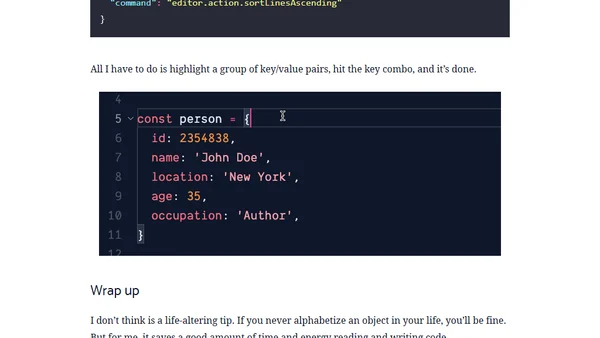
A guide to writing effective Git commit messages, focusing on essential information and reasoning over minor stylistic details.
Argues for naming code components with noun-adjective order (e.g., StreamCreated) instead of adjective-noun for better alphabetical grouping and searchability.
A software engineer's perspective on the challenges of giving and receiving feedback in a technical workplace, focusing on delivery vs. content.
An article exploring how perfectionism hinders web development progress and advocating for incremental, sustainable improvements.
A backend developer shares a hackathon experience using ChatGPT for frontend coding, highlighting its limitations and the need for domain expertise.
A developer shares updates on starting a new C# .NET contract role, pursuing indie game development by acquiring an existing game, and streaming programming/gaming content.
Argues against blindly following software development best practices, advocating for user-centric and context-specific approaches instead.
Analyzes the claim that AI will replace human programmers in five years, examining current AI coding benchmarks and limitations.
A software consultant outlines four essential elements for an effective development process: visible, small, prioritized, and completed work.
A podcast episode discussing the pros and cons of solo versus team-based game development, focusing on decision-making, timelines, and motivation.
An analysis of key qualities that define excellent non-corporate technical blogs, including tackling complex topics and showing working code.
Interview with Sema CEO Matt Van Itallie on using generative AI for code analysis, developer productivity, and explaining software to non-technical executives.
A tech manager outlines their ideal job criteria, focusing on management roles, fast-paced environments, remote work, and pragmatic technology use.
The author announces a change in the blog's content license from CC BY-SA 4.0 to the more permissive CC BY 4.0, citing a shift in perspective on licensing reciprocity.