What Building AI Agents in .NET Taught Me in 2025
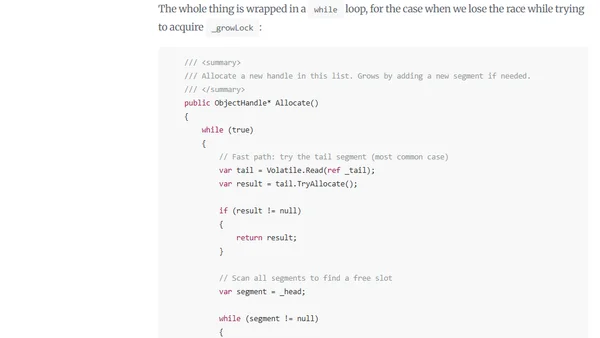
A developer shares key engineering lessons learned from building AI agents in .NET, focusing on state management, orchestration, and observability.
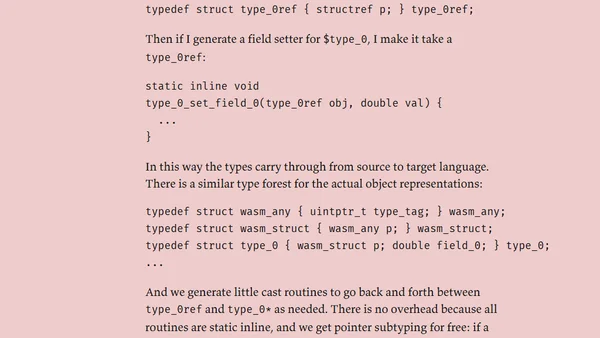
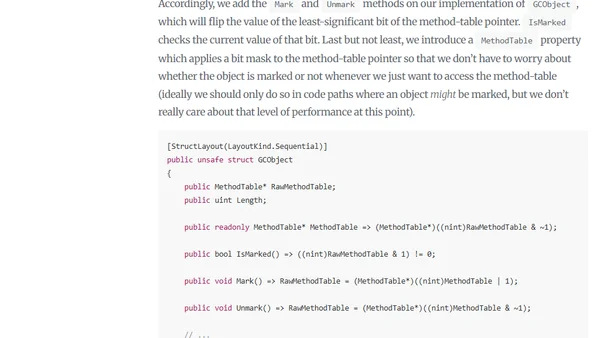
A technical article exploring how to create closures in C to add a context pointer to Win32 window procedures, bypassing the standard four-parameter limit.
Explores entity validation in .NET 10, covering the Data Annotations API, common attributes like Required and MinLength, and recent changes.
A developer-friendly introduction to the Microsoft Agent Framework, an open-source SDK for building and orchestrating AI agents in C# and Python.
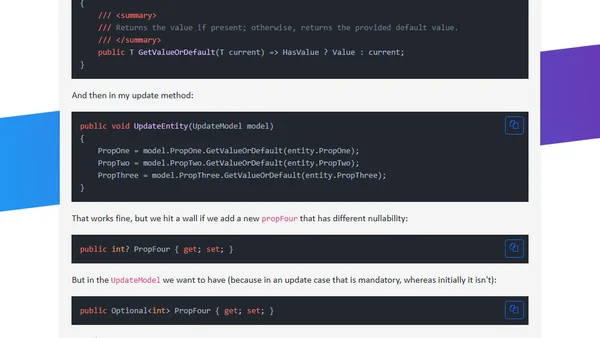
Explains the differences and usage of nullable and required types in C#, covering value types, reference types, and the nullable operator.
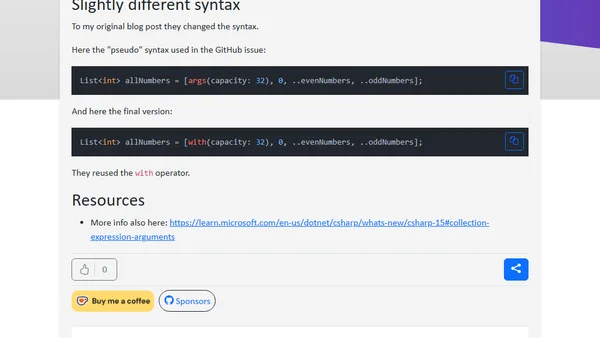
C# 14 introduces user-defined compound assignment operators (like +=), allowing custom types to define in-place operation logic for better performance and domain-specific behavior.
C# 14 introduces partial constructors and events, enabling cleaner code organization and better integration with source generators.
C# 14 introduces the 'field' keyword, allowing developers to add logic to auto-properties without manually declaring a backing field.
C# 14 allows using modifiers like 'ref' and 'out' on lambda parameters without explicitly stating the type, reducing code noise.
C# 14 introduces new implicit conversions for Span<T> and ReadOnlySpan<T>, reducing boilerplate and improving code readability.
Announcing elbruno.Extensions.AI.Claude v0.1.0-preview.2, a .NET library for integrating Claude AI models with Azure AI Foundry and Microsoft.Extensions.AI.
C# 14 introduces the null-conditional assignment operator, allowing safe property and indexer assignments that skip execution if the receiver is null.
C# 14 introduces breaking changes to LINQ queries. This article explains the issues with Reverse and Contains and provides workarounds.
C# 14 introduces extension members, allowing developers to add properties and static members to existing types, not just methods.
Explains C# 14's new Interceptors feature, allowing compile-time method call replacement without runtime overhead.
A technical guide on retrieving geographic location and weather data from an IP address using C# and a free API service.
Explains a cross-platform quirk in .NET's Uri.TryCreate method where a relative path string is treated as a valid absolute URI on Linux but not on Windows.
Explains how to capture console output in xUnit.v3 tests using the new CaptureConsoleAttribute assembly-level attribute.
Explains the new null-conditional assignment operator in C# 14, a feature for safer null handling in .NET development.
Learn how to use the Microsoft Agent Framework for .NET to create AI agents with persistent memory across sessions using persisted threads.