Passing by value or by reference - What is faster?
Explores the performance differences between passing by value and by reference in C#, focusing on structs, copying costs, and dereferencing overhead.
A guide to advanced .NET Collections, covering generic, concurrent, and immutable namespaces for efficient C# development.
Final part of a series on migrating C# codebases to nullable reference types, covering practical techniques and tools for incremental adoption.
Explains the difference between ReadOnlyCollection and truly immutable collections in C#, showing how underlying data can still change.
Part 3 of a series on migrating C# code to nullable reference types, focusing on advanced annotations and attributes for better compiler flow analysis.
Explores the pitfalls of using public const in C#, explaining compile-time replacement and versioning issues, and suggests using static readonly instead.
Explores how C# nullable reference types work under the hood, comparing their IL compilation to nullable value types.
Explores four methods for creating arrays in C#, comparing performance and use cases for new, ArrayPool, GC.AllocateArray, and GC.AllocateUninitializedArray.
Explains the difference between default(MyStruct) and new MyStruct() in C# 10, highlighting that default bypasses parameterless constructors.
A technical guide on building a fully automated CI/CD pipeline using GitHub Actions, DocFx, and .NET to test, build, release, and document with one click.
A guide to migrating existing C# codebases to use nullable reference types, covering concepts, techniques, and tools to reduce NullReferenceExceptions.
Explains the differences between struct, readonly struct, ref struct, and record struct in C#, focusing on usage, limitations, and memory management.
Explains core C# concepts essential for LINQ and IEnumerable, including boxing, extension methods, lambdas, and closures.
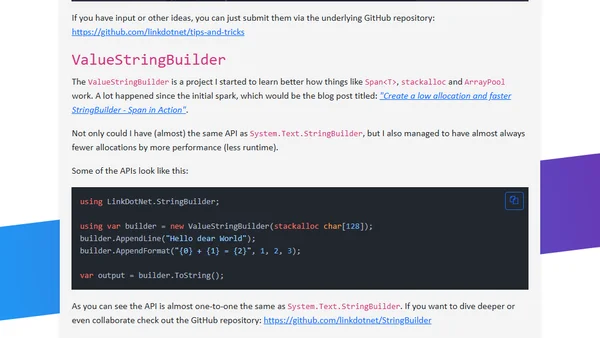
A guide to creating a low-allocation, faster StringBuilder alternative in C# using Span<T> for improved performance in string concatenation.
Final part of a UNO Platform tutorial series, implementing drag-and-drop functionality and state persistence for a Todo app.
Part 4 of a tutorial series on building a Todo app with the UNO Platform, focusing on adding created items to a view model collection.
A technical guide explaining the Trie data structure, its implementation in C#, and its advantages for autocomplete and search operations.
Part 3 of a tutorial series on building a Todo app with the UNO Platform, focusing on creating a dialog component for user interaction.
Part 2 of a tutorial series on building a Kanban-style Todo app using the UNO Platform for cross-platform development.
A tutorial on building a cross-platform Kanban-style Todo application using the UNO Platform with C# and XAML.