Alex Russell
Alex Russell is a Microsoft Partner Product Architect on the Edge team and Blink API owner, formerly a Chrome engineer and web standards leader, dedicated to building an accessible and performant web.
Gunnar Morling is a Java Champion and open-source software engineer specializing in Java and data streaming. He works at Confluent, contributes to projects like Hibernate and Debezium, and shares his expertise through blogs, talks, and conferences.
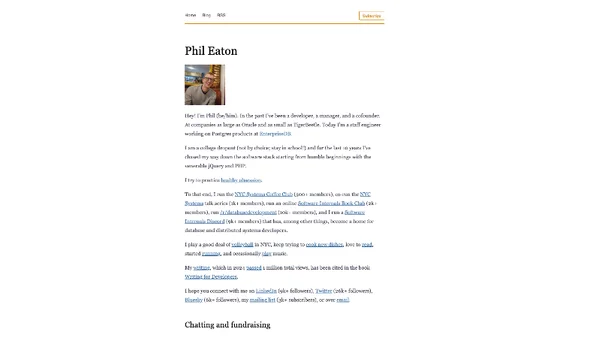
Phil Eaton is a staff engineer working on Postgres and software internals, sharing insights on databases, systems engineering, and life deep in the software stack.
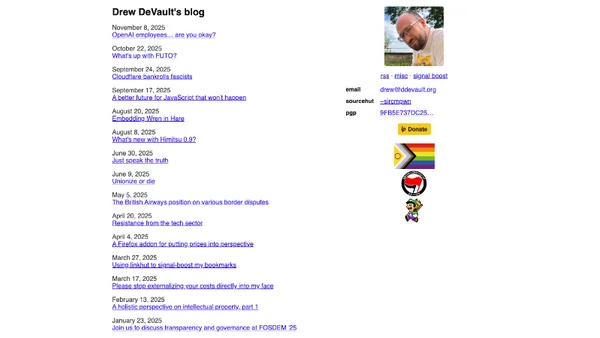
Drew DeVault’s blog features sharp commentary on open source, software engineering, programming languages, ethics in tech, and the social impact of technology.
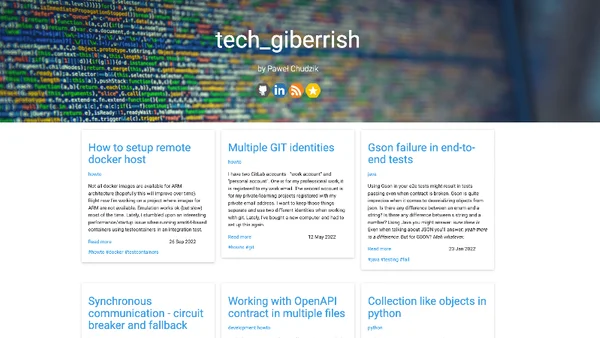
Paweł Chudzik is a programming blog covering practical how-tos and deep dives into Docker, Java, Python, Git, testing, and software architecture.
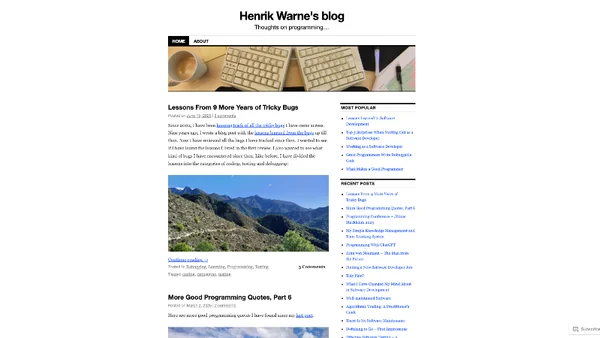
Henrik Warne’s blog shares thoughtful insights on programming, debugging, testing, and software craftsmanship, drawing on decades of experience and real-world lessons from tricky bugs and conferences.
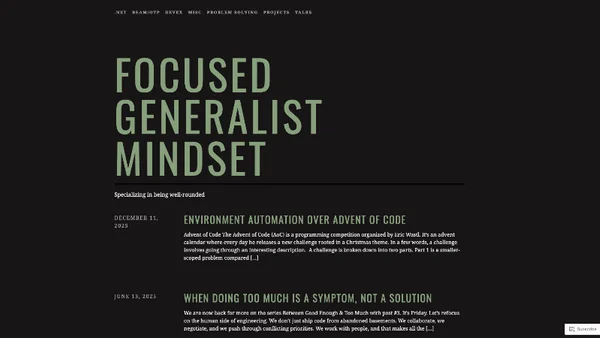
Kevin Avignon is a software engineer and writer embracing the focused generalist mindset, sharing thoughtful insights on engineering, developer productivity, performance, system design, and the human side of building software through in-depth articles and essays.
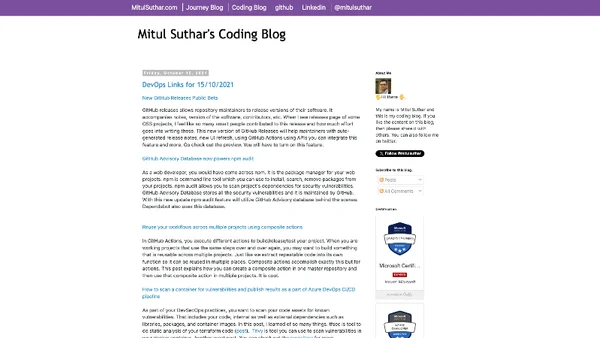
Mitul Suthar’s Coding Blog focuses on DevOps, cloud engineering, and modern developer tooling, covering topics like GitHub Actions, CI/CD pipelines, security scanning, Azure DevOps, containers, and automation to help developers build, secure, and ship software efficiently.
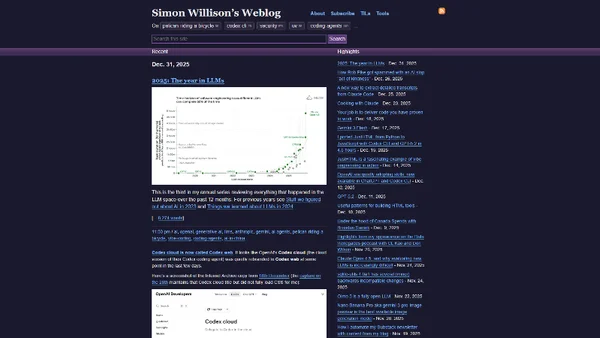
Simon Willison — Independent developer and writer documenting practical experiments, tools, and deep analysis around large language models, generative AI, web development, security, and emerging programming workflows through detailed posts and daily TILs.
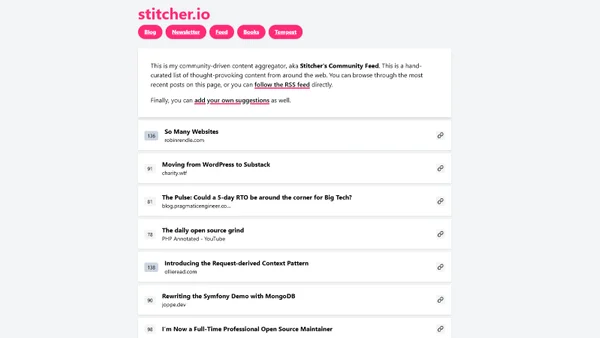
Brent — Curator of Stitcher’s Community Feed, a community-driven, hand-curated content aggregator highlighting thoughtful, high-quality writing from across the web. The feed focuses on software engineering, open source, web development, infrastructure, and the human side of building technology. Readers can browse recent picks, follow via RSS, or contribute their own suggestions.
Alex Merced — Developer and technical writer sharing in-depth insights on data engineering, Apache Iceberg, data lakehouse architectures, Python tooling, and modern analytics platforms, with a strong focus on practical, hands-on learning.
Aurora Scharff — Software Engineer from Norway and Microsoft MVP in Web Technologies, specializing in React, Next.js, .NET, and Azure, and sharing modern React best practices through consulting, writing, and international speaking.
Tibor Bödecs — Swift developer and technical writer sharing in-depth articles on Swift, Swift 6, server-side Swift, and frameworks like Hummingbird and Vapor, with a focus on clean architecture, type safety, and modern language features.
Milan Jovanović — Software Architect and Microsoft MVP for Developer Technologies, helping engineers master .NET and software architecture through practical guidance, newsletters, and videos based on real-world enterprise experience.
Damien Guard est un développeur logiciel et passionné de typographie partageant son expertise sur le développement web, la programmation C#, MongoDB et le lettrage pixel art. Découvrez des tutoriels complets sur l'optimisation vidéo HTML5, les solutions de contournement LINQ C# 14, le MongoDB EF Core Provider avec chiffrement interrogeable et transactions, et le lazy loading avec les proxies EF Core. Explorez des articles sur l'amélioration de contenu Nuxt3, les extraits générés, les formulaires email AWS Lambda avec Brevo et reCAPTCHA, et l'art du lettrage Amiga issu du rétrogaming. Suivez le projet annuel Advent of Fonts présentant de la typographie 8x8 pixels. Apprenez le développement .NET 10, les meilleures pratiques Entity Framework Core, l'optimisation de performance Nuxt3 et la combinaison du développement web moderne avec l'esthétique rétro du pixel art.
SebastianRaschka.com is the personal blog of Sebastian Raschka, PhD, an LLM research engineer whose work bridges academia and industry in AI and machine learning. On his blog and notes section he publishes deep, well-documented articles on topics such as LLMs (large language models), reasoning models, machine learning in Python, neural networks, data science workflows, and deep learning architecture. Recent posts explore advanced themes like “reasoning LLMs”, comparisons of modern open-weight transformer architectures, and guides for building, training, or analyzing neural networks and model internals.
Blog.iSquaredSoftware.com is the personal blog of Mark „acemarke” Erikson, a software engineer and core maintainer of Redux, React-Redux, and Redux Toolkit. He writes deeply informative articles about React, Redux, JavaScript, TypeScript, performance, library maintenance, and frontend architecture. Mark’s posts often take the form of long form essays where he answers questions from the React community, shows internal implementation details of Redux or React-Redux, and explains rendering, context behavior, selector optimization, package migration, and build tooling. His writing is practical, precise, and aimed at developers who want to understand how big frontend libraries and frameworks actually work beneath the surface.
Blog.mgechev.com is the personal blog of Minko Gechev, Lead for Web Frameworks at Google and a widely recognized engineer in the JavaScript and Angular ecosystem. Minko writes about Angular, JavaScript, TypeScript, frontend architecture, web performance, and AI assisted development, mixing clear code examples with insights gained from building frameworks at scale. He is the creator of influential open source projects and has been awarded by Google and the President of Bulgaria for the impact of his contributions. His articles often explore advanced topics such as LLM powered development, predictive prefetching, reactive rendering, framework design, and large scale JavaScript tooling. Beyond engineering, he shares lessons from giving over a hundred conference talks and from leading major web initiatives at Google. Minko is also the co founder of Rhyme.com, an EdTech platform offering hands on technical training. He built the platform and engineering team starting in 2015. In 2018 Rhyme became Coursera’s first acquisition, marking a significant milestone in his career.
PythonSpeed.com is a blog created by Itamar Turner Trauring, a software engineer known for his work on Python performance, memory optimization, and practical tooling for data science and scientific computing. The site focuses on real production challenges: reducing memory usage, making Python code faster, profiling scientific workloads, improving Docker packaging, and understanding how to ship efficient applications. The writing is clear, measurable, and based on hands-on experience rather than theory. Itamar is the creator of Sciagraph, a performance and memory profiler for Python data science, and the author of open source tools such as Fil and Eliot, both designed to help developers understand how their code behaves. His broader mission is to support useful software development, cut CO2 emissions through faster computing, and encourage engineering that matters. Beyond technical work he is active in local bicycle safety advocacy in Cambridge, MA, helping cities adopt sustainable transportation policies. Thanks to this mix of engineering depth and real-world impact, PythonSpeed.com is one of the most practical and thoughtful resources for developers who want to make Python software faster and more efficient.
SimonWillison.net is the long-running blog of Simon Willison, a software engineer, open-source creator, and co-author of the original Django framework. He writes about Python, Django, Datasette, AI tooling, prompt engineering, search, databases, APIs, data journalism, and practical software architecture. The blog includes detailed notes from experiments, conference talks, and real projects. Readers will find clear explanations of topics such as LLM workflows, SQL patterns, data publishing, scraping, deployment, caching, and modern developer tooling. Simon also publishes frequent micro-posts and TIL entries that document small discoveries and tricks from day-to-day engineering work. The tone is practical and research oriented, making the site a valuable resource for anyone interested in serious engineering and open data.