Naked Power
Critique of Apple and Google's failure to enforce their own policies against abusive content on Twitter/X, questioning the legitimacy of their app store monopolies.
Alex Russell is a Microsoft Partner Product Architect on the Edge team and Blink API owner, formerly a Chrome engineer and web standards leader, dedicated to building an accessible and performant web.
30 articles from this blog
Critique of Apple and Google's failure to enforce their own policies against abusive content on Twitter/X, questioning the legitimacy of their app store monopolies.
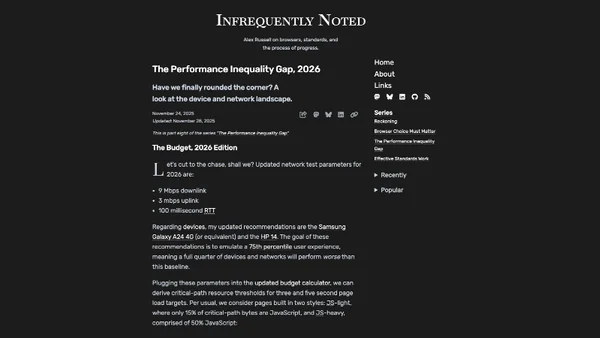
Analysis of 2026 web performance budgets, highlighting the growing inequality gap caused by JavaScript bloat and its impact on Core Web Vitals.
Analysis of Apple's App Store policies, censorship, and resistance to EU's DMA regulations that threaten its control and revenue model.
A technical guide on using 11ty shortcodes and the Bundle plugin to conditionally load page-specific JavaScript and CSS, improving site performance.
Analysis of Apple's alleged anti-competitive tactics and non-compliance with the EU's Digital Markets Act (DMA), focusing on browser restrictions and misleading claims.
Analyzes Apple's influence on web standards and browser competition, questioning its commitment to collaborative API development on iOS.
Analyzes the true role of web standards bodies, arguing they ratify existing designs rather than invent the future, and critiques misconceptions about browser feature development.
Analyzes Apple's control over hardware and software as a threat to internet standards, interoperability, and user choice.
Analyzes the complex, symbiotic relationship between Apple and Facebook regarding user tracking, arguing Apple's privacy measures are superficial.
Advocates for including author names and dates on technical documents to ensure proper attribution, support career advancement, and foster a healthy engineering culture.
Explores how dysfunctional communication and veto power in tech standards committees can lead to stagnation and failure to innovate, a twist on Conway's Law.
A developer shares a curated list of over 250 resources for performance and platform-oriented web development, including blogs, tools, and inspiration.
A critique comparing two JavaScript conferences, JSNation and React Summit, analyzing their technical depth and alignment with user needs.
Analysis of Safari's new features at WWDC '25, highlighting its ongoing catch-up with other browsers and the impact of Apple's iOS browser policies.
A critique of React as legacy technology, arguing against its use in new projects due to performance and accessibility issues, and advocating for simpler client-side stacks.
A critique of JavaScript-first web development and its negative impact on mobile performance, arguing for a strategic platform approach favoring the web's core strengths.
The article critiques excessive JavaScript use harming web performance and user experience, urging teams to prioritize users and adopt better practices.
Analyzes how JavaScript-heavy web architectures harm public service sites, causing slow performance and access barriers for users on low-end devices.
Analysis of California's slow BenefitsCal SNAP portal vs. Code for America's faster, simpler getcalfresh.org, focusing on web performance and architecture.
An investigation into how JavaScript-first frontend culture and bloated frameworks contributed to performance issues, especially on low-end mobile devices.