Moving the goalposts?
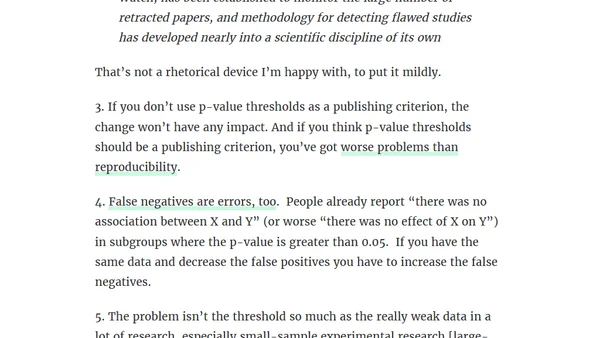
A critique of a proposal to lower the p-value threshold for statistical significance from 0.05 to 0.005, arguing it addresses symptoms, not root causes.
Thomas Lumley writes thoughtful, in-depth articles on statistics, data analysis, and statistical modeling. His blog explores topics like survey methods, regression, simulations, and inference with a rigorous yet reflective approach.
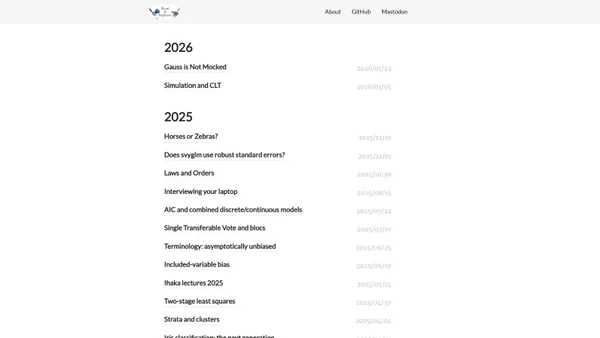
215 articles from this blog
A critique of a proposal to lower the p-value threshold for statistical significance from 0.05 to 0.005, arguing it addresses symptoms, not root causes.
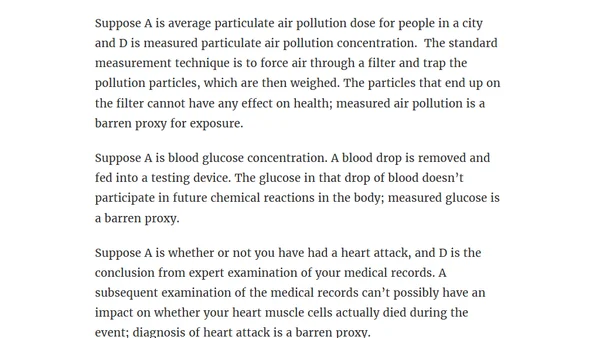
Explores the concept of 'barren proxies' in causal inference, arguing that measurement reliability is more critical than the proxy's barrenness.
Explores non-transitivity in games like rock-paper-scissors, its history, and connections to statistics, evolution, and voting systems.
A simple two-stage list method to increase diversity among invited speakers at tech and academic conferences.
Argues for the importance of statistical theory in data science, using examples from medical research to show where abstract theory solved practical problems.
A critique of common pitfalls and unproductive patterns in statistics research presentations, aimed at improving academic discourse.
Explores the equivalence between causal graphs and counterfactual reasoning in statistics, simplifying the connection between two major causal inference frameworks.
Explains how to parallelize QR decomposition for linear models on big data using R's biglm package and incremental merging.
Explores using sparse matrix techniques in R to efficiently calibrate survey weights for large-scale population data.
Explores limitations of causal graph assumptions in statistical modeling, discussing when variables like poverty or diet may violate the faithfulness condition.
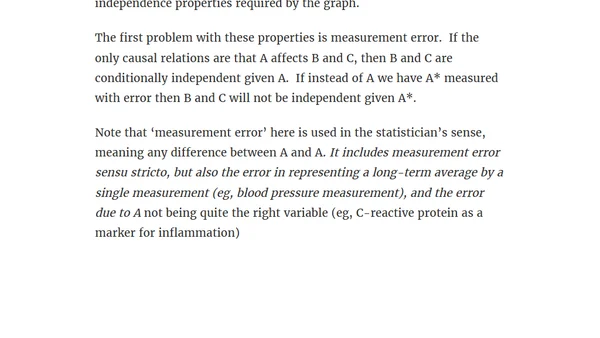
Examines statistical challenges with the causal Markov and faithfulness properties, focusing on measurement error's impact on causal inference.
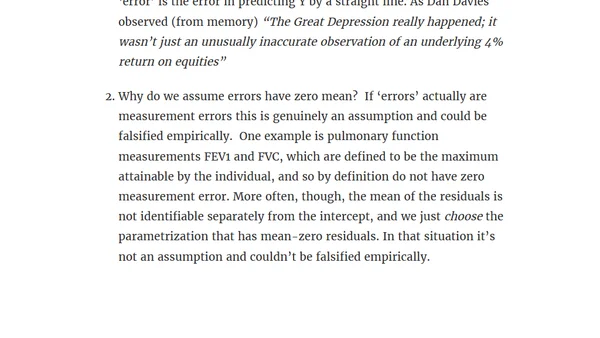
Explores the concept of 'error' in regression models, clarifying when it represents measurement error versus model prediction error.
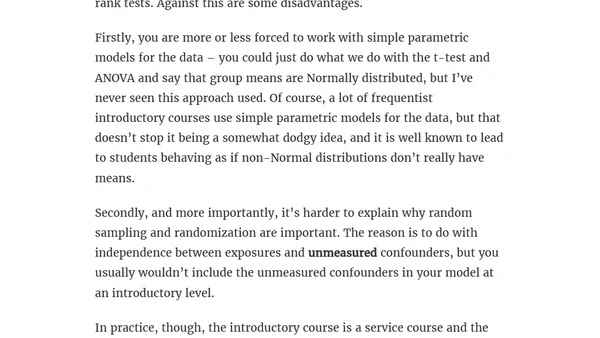
Compares Bayesian vs frequentist statistics for introductory courses, highlighting pedagogical pros and cons of each approach.
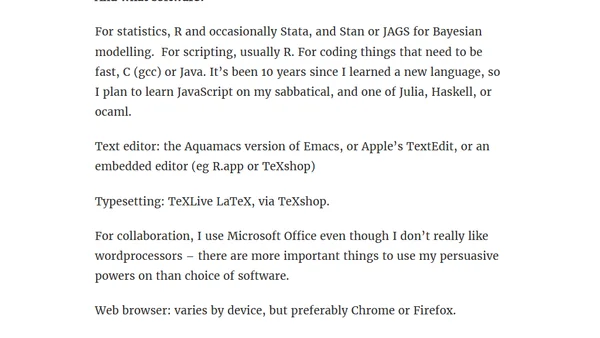
A statistics professor details his hardware and software setup, including Mac laptops, R, LaTeX, and plans to learn JavaScript.
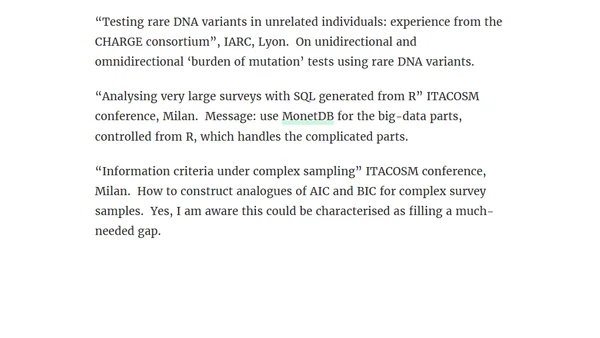
A summary of upcoming technical talks on statistical computing, rare DNA variant analysis, and handling large datasets with R and SQL.