Machine Learning with PyTorch and Scikit-Learn
Author announces a new machine learning book covering scikit-learn, deep learning with PyTorch, neural networks, and reinforcement learning.
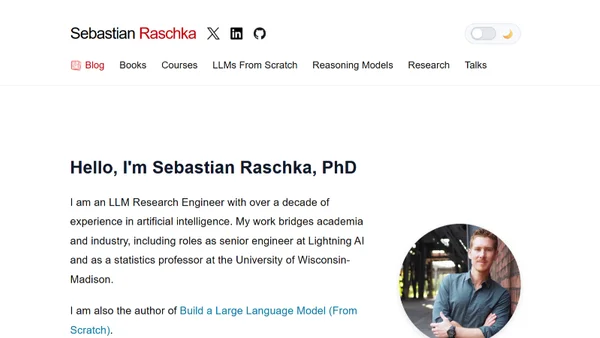
SebastianRaschka.com is the personal blog of Sebastian Raschka, PhD, an LLM research engineer whose work bridges academia and industry in AI and machine learning. On his blog and notes section he publishes deep, well-documented articles on topics such as LLMs (large language models), reasoning models, machine learning in Python, neural networks, data science workflows, and deep learning architecture. Recent posts explore advanced themes like “reasoning LLMs”, comparisons of modern open-weight transformer architectures, and guides for building, training, or analyzing neural networks and model internals.
101 articles from this blog
Author announces a new machine learning book covering scikit-learn, deep learning with PyTorch, neural networks, and reinforcement learning.
A comprehensive collection of 90 machine learning lecture videos covering Python, scikit-learn, algorithms, and model evaluation techniques.
A comprehensive deep learning course covering fundamentals, neural networks, computer vision, and generative models using PyTorch.
A curated list of public dataset repositories for machine learning and deep learning projects, including computer vision and NLP datasets.
A review of the book 'Deep Learning with PyTorch', covering its structure, content, and suitability for students and beginners in deep learning.
A developer shares his personal digital workflow for organizing projects, notes, and tasks using a folder-based system and syncing tools.
An introduction to scientific computing in Python using NumPy for numerical arrays and Matplotlib for data visualization.
A review and tutorial on interpretable machine learning, covering Christoph Molnar's book and providing Python code examples for linear/logistic regression.
An introductory chapter on machine learning and deep learning, covering core concepts, categories, and the shift from traditional programming.
A review of 'Architects of Intelligence,' a book featuring interviews with 23 leading AI researchers and industry experts.
Author announces the 3rd edition of Python Machine Learning, featuring TensorFlow 2.0 updates and a new chapter on Generative Adversarial Networks.
A professor reflects on teaching new Machine Learning and Deep Learning courses at UW-Madison and showcases impressive student projects.
Research on using semi-adversarial neural networks to generate gender-neutral face images, enhancing privacy while preserving biometric utility.
A guide to model evaluation, selection, and algorithm comparison in machine learning to ensure models generalize well to new data.
Author shares the journey and process of writing 'Python Machine Learning,' a technical book for aspiring machine learning practitioners.
A scientist explains why Python is their preferred language for machine learning and data analysis, arguing for productivity over language wars.
An introduction to single-layer neural networks, covering the Perceptron and Adaline models, with Python implementations and gradient descent.
A tutorial explaining Principal Component Analysis (PCA), a dimensionality reduction technique used in machine learning and data analysis.
A guide to implementing a weighted majority rule ensemble classifier in scikit-learn to combine different ML models and improve prediction accuracy.
A developer shares their experience building a machine learning model to classify song moods (happy/sad) based on lyrics using Python and NLP.