AsciiDoc book toolchain released
Author releases an open-source AsciiDoc toolchain for self-publishing technical books in multiple formats like PDF and ePub.
Julien Danjou est un vétéran de l'open source avec 25 ans d'expérience, CEO et co-fondateur de Mergify, et créateur du gestionnaire de fenêtres awesome. Découvrez les insights du plus jeune développeur Debian en 2002, leader du projet de télémétrie OpenStack et créateur de la base de données de séries temporelles Gnocchi. Explorez l'expertise issue des innovations cloud computing chez Red Hat, du développement du profileur Python chez Datadog et de la maîtrise des mécanismes internes de CPython. Apprenez de l'auteur des livres "Serious Python" et "Scaling Python", animateur du podcast français CI/CD "Nom d'un Pipeline!" et fondateur du Toulouse SaaS Club. Suivez pour des insights sur les plateformes SaaS, l'expertise en développement Python, les meilleures pratiques CI/CD, l'optimisation de l'expérience développeur, les contributions GNU Emacs et la programmation Lisp. Accédez aux connaissances sur l'automatisation de fusion de code, la collaboration d'équipes d'ingénierie logicielle et l'architecture cloud computing.
246 articles from this blog
Author releases an open-source AsciiDoc toolchain for self-publishing technical books in multiple formats like PDF and ePub.
Explains how to store high-precision timestamps in MySQL using the DECIMAL type, including storage optimization and historical context.
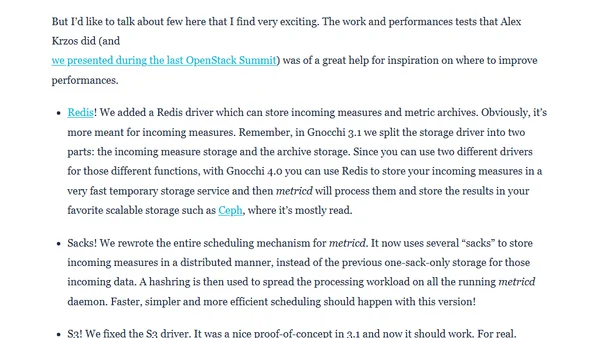
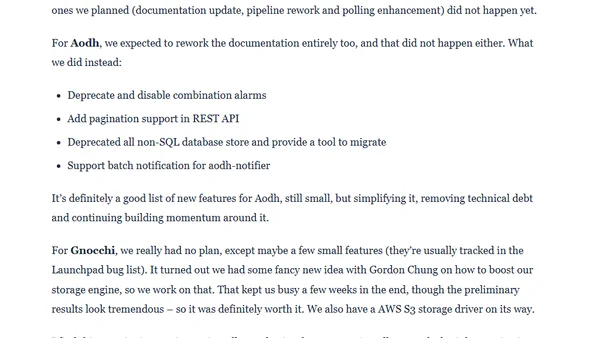
A developer's retrospective on the OpenStack Telemetry project's Newton development cycle, covering what was planned versus what was actually delivered.
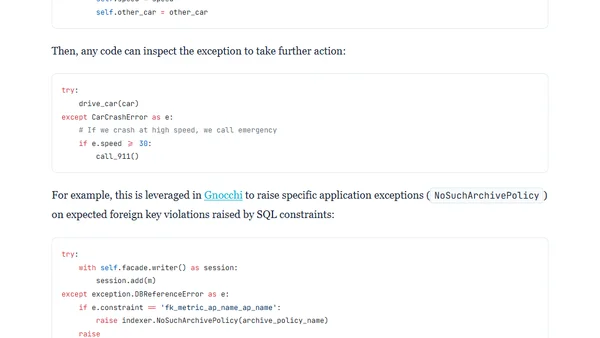
A deep dive into Python exception handling, covering the BaseException hierarchy, internal implementation, and best practices for defining custom exceptions.
An experienced open source contributor outlines common social mistakes in FOSS project management, such as discouraging contributors and assigning only grunt work.
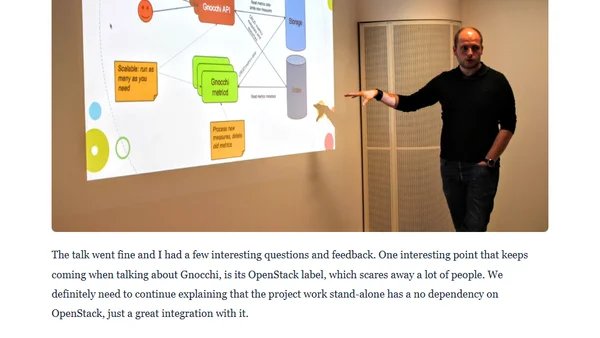
A speaker's experience presenting the Gnocchi monitoring tool at a Paris meetup, addressing its independence from OpenStack.
A summary of the OpenStack Newton Summit from the Telemetry project lead, covering discussions on Ceilometer, Gnocchi, Aodh, and future plans.
Gnocchi 2.1 release introduces dynamic resource types, performance improvements, and Ceph backend optimizations.
Introducing Pifpaf, a tool for temporarily running daemons like PostgreSQL or Redis during testing, making integration tests easier.
Analyzes OpenStack's rapid growth from a few IaaS projects to a vast ecosystem of 54 teams, highlighting the tensions between its old integrated model and new 'big tent' approach.
Announcing Gnocchi 2.0, a major release of the OpenStack time-series database with new features like data compression, batching, and Ceph optimizations.
Explores improvements in Gnocchi's timeseries database storage, focusing on data splitting and compression techniques for better performance.
A developer's recap of FOSDEM 2016, focusing on a talk and panel about the Lua and GNU Guile programming languages.
A guide to profiling Python code using cProfile to identify performance bottlenecks and optimize execution time.
Gnocchi 1.3.0, the final Liberty cycle release, introduces performance improvements, async metric deletion, and a new dedicated website.
A developer's summary of key discussions and decisions from the OpenStack Summit Mitaka, focusing on the Telemetry projects (Ceilometer, Gnocchi, Aodh).
A technical article about benchmarking the performance of Gnocchi, a time-series database, including tool development and hardware setup results.
A developer presents Gnocchi, an OpenStack metrics project, at a Paris meetup, explaining its purpose, functionality, and advantages over Ceilometer.
Interview with a software engineer about his work on OpenStack, his role at Red Hat, and his book on Python.
Announcing a Grafana plugin for Gnocchi, enabling visualization of metrics from the OpenStack-compatible time-series database.